

How to Manage a Distributor Network That Keeps Selling

Distributor management is the ongoing work of ranking, developing, and documenting the relationships a manufacturer holds with the distributors who sell its products. Most programs fail for one reason: the relationship lives in a single salesperson’s head, so the revenue walks out the door the quarter after that person does.
TL;DR
- Rank distributors on two axes, revenue and relationship quality, so you can see which revenue is protected and which is exposed.
- Write down what a strong distributor relationship looks like, so the standard stops depending on individual habit.
- Build a contact schedule that includes non-selling touches. Order-chasing calls teach a distributor you only appear when you want something.
- Move the relationship record into a system the company owns: named contacts, history, commitments, next steps.
- Watch five leading indicators every month and act on the distributors trending down before they go quiet.
Why do most distributor management programs fail?
They fail because the relationship was never installed anywhere. A manufacturer with 40 distributors usually has three or four that produce most of the revenue, and one salesperson who knows all of them personally. Ask who the second contact is at the largest distributor. Ask what was promised at the last joint planning meeting. Ask which product line that distributor quietly stopped quoting eighteen months ago. The answers live in one person’s memory and one person’s phone.
That is the exposure, and the cause is structural. Nobody set out to build a channel that depends on one relationship-holder. It happened because the early distributors were signed by the founder or the first outside salesperson, those relationships worked, and no one had a reason to write anything down while the orders kept coming. The bill arrives later, in the quarter after that person retires, changes jobs, or gets pulled onto a large account and stops calling. Orders slow before anyone notices, because nothing in the business was watching the relationship itself.
The rest of this guide is the fix, in five steps. Each one produces something concrete: a ranked list, a written standard, a contact schedule, a relationship record, and a set of monthly triggers. You can build all five in about six weeks with a sales leader, a spreadsheet, and whatever CRM you already own. It sits underneath the wider dealer network strategy question of which distributors you should have in the first place.
Defined Term: Distributor management.
The repeatable set of practices a manufacturer uses to rank, develop, document, and measure its distributor relationships, so that the value of those relationships belongs to the company and survives a change in personnel.
Step 1: How do you rank your distributors by relationship quality and revenue?
Score every distributor on two axes, revenue contribution and relationship quality, then plot them so you can see which revenue is protected and which is sitting on a single friendship. Ranking on revenue alone hides the problem you are trying to solve, because your largest distributor and your most fragile distributor are frequently the same company.
Score every distributor on two axes
Build a simple sheet with one row per distributor and two scores, each on a 1 to 5 scale.
Revenue contribution is the easy axis. Use trailing twelve-month revenue, then note the three-year trend beside it so a declining account does not score the same as a growing one at the same dollar level.
Relationship quality is the axis most manufacturers have never scored. Use these five inputs, one point each:
- Named relationships beyond one person. You have at least two working relationships inside the distributor, and they have at least two inside you.
- Joint planning in the last twelve months. A real conversation about their goals for the year, documented somewhere other than an inbox.
- Two-way information flow. They tell you about lost quotes, competitor activity, and end-customer problems without being asked.
- Product breadth. They actively quote more than one of your lines.
- Documented history. Someone other than the account owner could open a file and understand the last two years of this relationship.
A distributor scoring 4 or 5 on relationship quality is one you own as a company. A distributor scoring 1 or 2 is revenue you are renting from an individual.
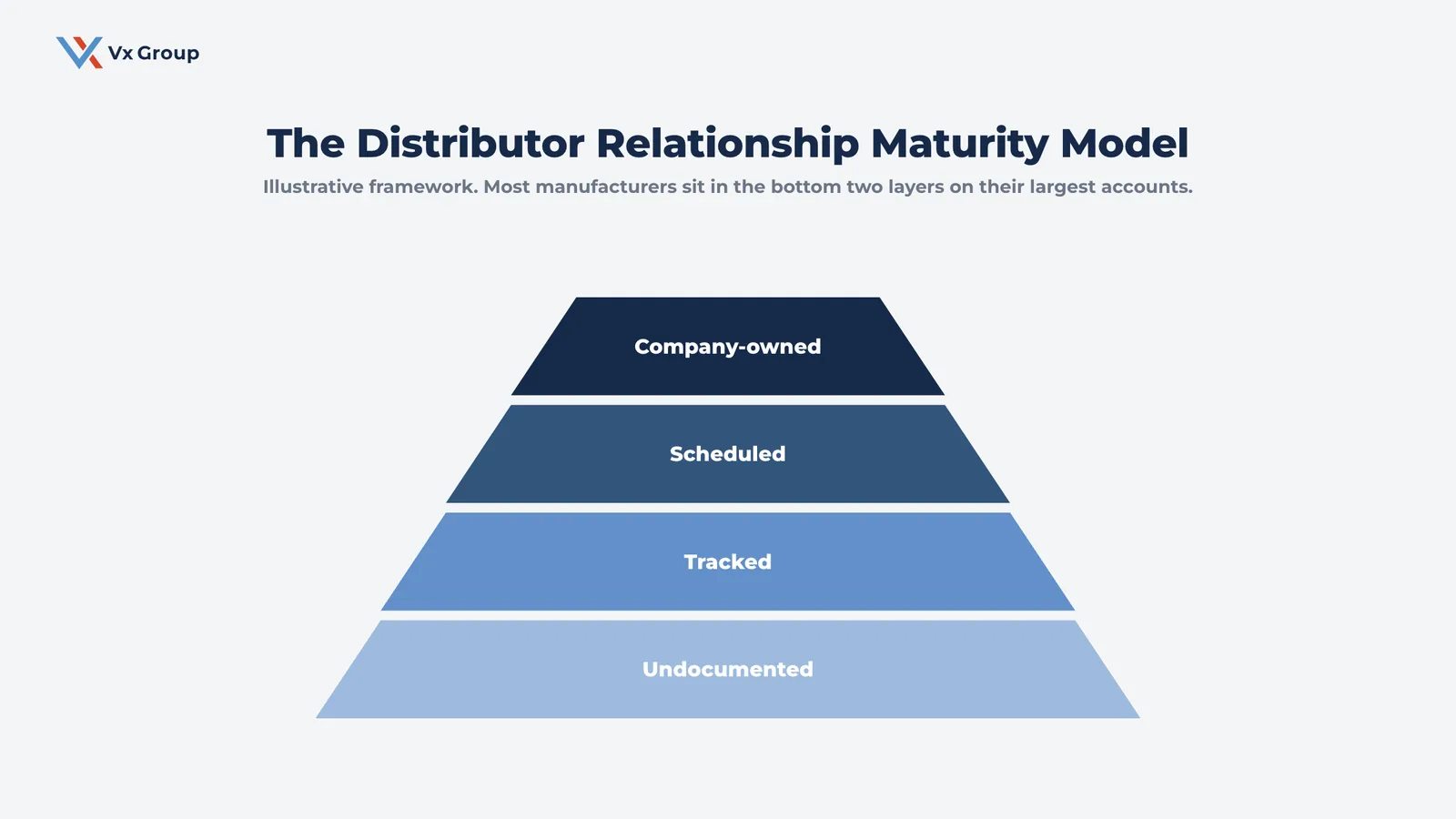
Sort the network into four groups
Once every distributor has two scores, the network sorts itself into four groups, and each group gets a different plan.
| Group | Revenue | Relationship quality | What it needs |
|---|---|---|---|
| Protect | High | High | Keep the rhythm, expand product breadth, name a successor for every contact |
| Fix first | High | Low | Urgent: add a second relationship, document the history, book joint planning inside 60 days |
| Develop | Low | High | Growth candidates. They trust you already. Give them a reason and a plan to sell more |
| Decide | Low | Low | Choose deliberately: invest, coach, or stop spending time here |
The “Fix first” group is the point of the whole exercise. That is where a resignation letter turns into a revenue problem. In most networks it holds two to five distributors and somewhere between a quarter and a half of channel revenue, which makes it a close cousin of customer concentration risk with an extra layer of fragility on top.
Write down where you are exposed
Finish the step with a one-page exposure summary for the leadership team. Three lines is enough:
- Percentage of channel revenue sitting in the “Fix first” group.
- The number of distributors where exactly one employee holds the only working relationship.
- The dollar value of the three largest single-threaded relationships.
Those three numbers turn an abstract worry into something a president or an owner can act on. They also make the case for the next four steps without any further argument.
Step 2: What written criteria define a strong distributor relationship?
Write a one-page standard that says what a strong distributor relationship looks like in your business, covering communication rhythm, joint planning, and mutual commitments. Without a written standard, every salesperson applies a private definition, and the quality of your channel becomes a function of who happens to own the account.
Write the one-page distributor standard
The standard is short by design. One page, six headings, plain language. Here is the structure to fill in:
- Contacts. How many named relationships we hold inside each distributor, by tier, and who owns each one.
- Communication rhythm. How often we talk, in what form, and who initiates.
- Joint planning. What we plan together, how often, and what comes out of it in writing.
- Mutual commitments. What we commit to them. What they commit to us.
- Information we expect to flow both ways. Named specifics: lost quotes, competitor pricing pressure, end-customer complaints, our lead times, our product changes.
- What we do when the standard slips. The conversation, who has it, and how quickly.
Write it once, review it with the sales team, and put it where new hires find it in their first week.
Name the mutual commitments
The section people skip is the one that matters most. A distributor relationship that only lists what you expect from them reads as a demand. Write both columns.
| We commit to | We expect in return |
|---|---|
| Quote turnaround inside two business days | Advance notice on large project quotes |
| Named technical contact who answers the phone | Access to the end customer on complex jobs |
| Product and application training twice a year | Two people trained and current on our lines |
| Lead time honesty, including bad news early | Honest loss reporting, including price losses |
| Leads passed in their territory without exception | Territory coverage they can describe and defend |
Specifics matter more than tone here. “Responsive support” commits you to nothing. “Quote turnaround inside two business days” is a promise a distributor can hold you to, which is exactly why it earns trust.
Publish the criteria to the distributor
Send the standard to your top-tier distributors and walk them through it. This feels exposed the first time, and it is the fastest trust-builder in the whole program. You are telling a partner what good looks like from your side and inviting them to hold you to it. Most manufacturers never do this, so the act itself separates you from the other six lines that distributor carries.
Expect two reactions. The strong distributors will tell you what is missing and ask for a planning meeting. The weak ones will not respond. Both answers are useful, and both belong in the scoring from Step 1. The same standard-setting logic applies to the support you build around the channel, which channel marketing for manufacturers and distributors covers in more detail.
Ready to grow?
Bring your distributor list and we will score it with you in one working session.
Step 3: How do you build a distributor contact rhythm that includes non-selling touches?
Set a written contact schedule by tier that mixes commercial conversations with non-selling touches, and put it on a calendar the company controls. A distributor who only hears from you at quarter end learns that you appear when you need something, which is the fastest way to slide from the line they lead with to one of the six they happen to carry.
Set the annual rhythm by tier
Different tiers earn different amounts of attention. Write the schedule down so it becomes a company commitment that a sales leader can check.
| Touch | Protect tier | Fix first tier | Develop tier | Decide tier |
|---|---|---|---|---|
| Joint planning session | 2 per year | 2 per year, first one inside 60 days | 1 per year | None until they earn it |
| Business review with numbers | Quarterly | Quarterly | 2 per year | Annual |
| Non-selling check-in call | Monthly | Monthly | Quarterly | Quarterly |
| On-site visit | 2 per year | 2 per year | 1 per year | As needed |
| Training or product update | Quarterly | Quarterly | 2 per year | Open invitation only |
That is roughly 20 touches a year with a top distributor and about eight with a development account. For a network of 40 distributors, one full-time channel manager can carry all of it, provided the rhythm is scheduled in advance.
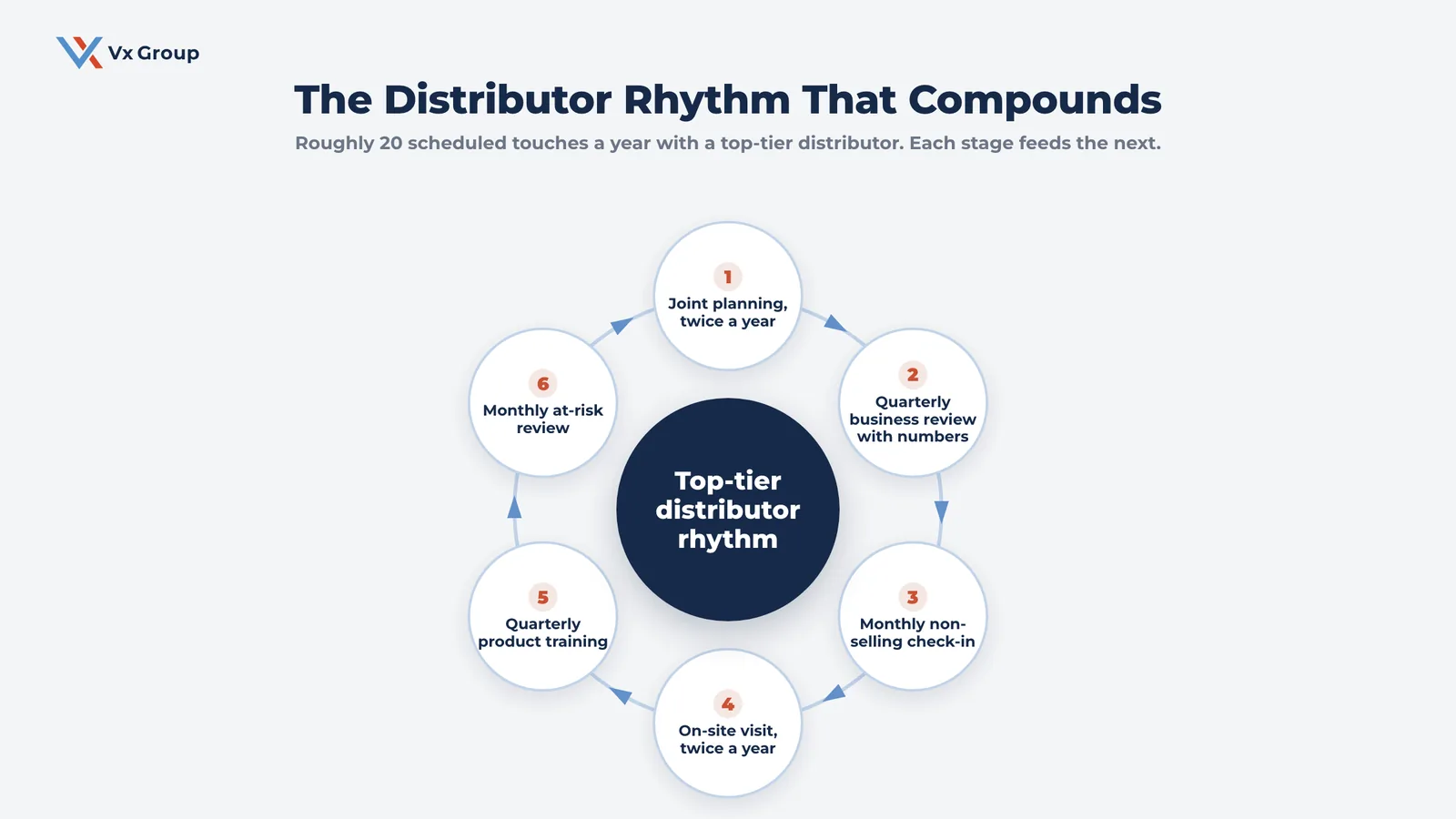
Script the non-selling touch
The monthly check-in is where relationships get built, and it is the touch most salespeople skip because it has no obvious purpose. Give it a purpose by scripting it. Three questions, ten minutes, no order talk:
- “What is busy for you right now, and what is slow?”
- “What did you lose in the last month that you thought you would win?”
- “Is there anything on our side making your job harder?”
Log the answers in the relationship record from Step 4. Do this for six months and you will know more about your territories than any market report will tell you. You will also hear about a competitor’s pricing move or a quality complaint weeks before it shows up in your order book.
Put the rhythm on one calendar the company owns
A schedule that lives in one salesperson’s calendar is the same exposure in a new outfit. Build a single channel calendar, visible to the sales leader, with every scheduled touch for every distributor and the owner’s name against each one. Review it monthly. Missed touches are the earliest signal you have that a relationship is drifting, and they are visible to leadership only when the schedule is shared.
This is the same discipline that makes a forecast trustworthy. If you want the fuller version of that argument, the piece on sales pipeline management covers what changes when the rhythm belongs to the company.
Step 4: How do you install a distributor relationship in a system the company owns?
Capture the contacts, the history, the commitments, and the next steps in a system the company controls, so a new person can pick up a relationship in an afternoon. A relationship the company owns survives turnover, because everything the next person needs is already written down somewhere they can reach.
Defined Term: Relationship record.
A single company-owned file for one distributor holding named contacts and their roles, the commitments made in both directions, a dated history of substantive conversations, open items, and the next scheduled touch.
Capture the relationship record
Use whatever CRM you already own. The tool matters far less than the discipline. Each distributor gets one record with six fields:
- Contacts. Names, roles, phone numbers, who owns each relationship on your side, and who backs them up.
- Commitments. What was promised in each direction, by whom, and by when.
- History. Dated notes from every substantive conversation. Two paragraphs beats two pages.
- Commercial picture. Lines they carry, lines they do not, trailing revenue, three-year trend.
- Open items. What is unresolved right now, with an owner and a date.
- Next touch. Date, type, and owner.
The test for whether the record is good enough is simple: hand it to a salesperson who has never met this distributor and ask them to prepare for a joint planning meeting. If they can do it without calling the previous account owner, you are done.
Move the history out of the inbox
Most of what a company knows about its distributors sits in email threads that belong to individuals. Pick a Saturday morning, take your top ten distributors, and have each account owner write two paragraphs of history per account into the record: how the relationship started, what has gone wrong, what has gone well, what they care about, and what they have been promised. Ten accounts takes about three hours. It is the highest-return three hours in this entire guide.
Write the handoff document before you need it
For every distributor in the Protect and Fix first tiers, write a one-page handoff document that answers four questions: who are the people, what is the state of the relationship, what has been promised, and what would go wrong first if we stopped paying attention. Keep it current at each quarterly review.
Companies that do this stop treating a resignation as an emergency. The idea generalizes past the channel, and the piece on how to build an infinite team works through what it looks like across a whole business.
Field Notes:
A Midwest equipment manufacturer we worked with had 31 distributors and a top three that produced 58 percent of channel revenue. All three were held by one regional manager with 22 years of tenure. When we scored the network, those three accounts came back at revenue 5 and relationship quality 2, because no second contact existed anywhere and nothing was documented. The company spent one quarter adding a second named relationship inside each of the three distributors and writing two paragraphs of history per account. The regional manager announced his retirement eleven months later. Revenue in those three accounts held flat through the transition year, and the newest of the three grew, because the incoming manager walked in knowing what had been promised and what mattered to each owner.
Ready to grow?
We will walk your distributor list with you and show you where the revenue is single-threaded.
Step 5: Which leading indicators tell you a distributor is going dormant?
Track engagement signals that move before revenue does: quote frequency, product breadth, response time, information flow, and missed touches. Revenue is the last thing to fall, which is why a channel managed on revenue reports always finds out too late.
Track five leading indicators
For every distributor, log these five monthly. All of them are available from data you already have.
| Indicator | What it measures | Warning sign |
|---|---|---|
| Quote requests per month | Whether they are still putting you in front of customers | Down 30 percent or more against their own trailing twelve-month average |
| Lines quoted | Whether you are their default or a one-product habit | Any line they used to quote and have not quoted in 90 days |
| Response time to your outreach | Whether the relationship still has priority | Replies taking more than three business days when they used to take one |
| Inbound information | Whether they still treat you as a partner | No unprompted competitive or end-customer information in 60 days |
| Missed scheduled touches | Whether the rhythm is holding | Two consecutive missed touches on the channel calendar |
Two or more warning signs on the same distributor means somebody makes a call this week. A distributor going dormant almost never announces it. They just stop including you, and the order book takes two or three quarters to catch up to the decision.
Set the trigger thresholds
Write the thresholds down and attach an action to each one, so the response does not depend on who happens to notice.
- One warning sign. The account owner raises it at the monthly channel review with an explanation.
- Two warning signs. A non-selling call inside seven days, and a note in the relationship record.
- Three or more warning signs. The sales leader joins an on-site visit inside 30 days.
- Missed joint planning session. Escalates immediately, regardless of the other indicators.
The thresholds are more useful than any single number they contain. They convert a hunch into a scheduled action with a name against it.
Run the monthly at-risk review
Give this 30 minutes a month. Pull the five indicators for every distributor, list the accounts with two or more warning signs, and assign one action per account with a date. Keep the list short. Five names is a working list, and twenty names is a report nobody acts on.
The output over a year is a channel where the conversation about a struggling distributor happens three quarters earlier than it used to. That is the whole return: time to fix the relationship while the distributor still wants it fixed. For the wider view of how engagement work compounds across a channel, dealer engagement covers the same ground for dealer networks.
What does distributor management look like when it is working?
Four things change, and they show up in that order.
Turnover stops being a revenue event. A salesperson leaves, the handoff document does its job, and the distributor barely notices. This is the first payoff and the one that justifies the effort to a finance-minded leader.
Product breadth grows. Distributors who plan with you annually and hear from you monthly start quoting the second and third line. Most manufacturers have more room here than in new distributor recruitment, and it costs a fraction as much. It is the channel version of account expansion, and the math usually favors it for the same reasons.
Your information gets better. Twelve months of scripted non-selling calls across 40 distributors is a market intelligence system that no purchased report matches, because it is specific to your lines and your territories.
The weak accounts get resolved. The “Decide” group stops absorbing attention by default. Some get a real investment. Some get coached. Some get released. All three are better than the drift that comes from never deciding.
None of this requires new software or a new team. It requires a ranked list, a written standard, a schedule, a record, and a monthly review, applied for four quarters in a row. The compounding comes from the repetition.
Common mistakes to avoid
- Ranking on revenue alone. It tells you where the money is today and says nothing about whether it is safe.
- Building the schedule and skipping the record. Touches without documentation build one person’s relationship a second time.
- Applying the top-tier rhythm to all 40 distributors. The schedule collapses in month three and the team concludes the whole program does not work.
- Sending the standard without a conversation. A one-page document arriving cold reads as a new set of demands.
- Measuring only what your ERP already reports. Revenue and margin are lagging. The five indicators in Step 5 are the ones that give you time.
- Treating the “Decide” group as free. Low-revenue, low-relationship distributors quietly absorb quoting capacity, sample inventory, and sales attention. Make the call.
Where to start
Do Step 1 this month. Score every distributor on both axes, sort them into the four groups, and write the three-line exposure summary. It takes a sales leader about half a day for a 40-distributor network, and it will tell you exactly which two or three relationships to fix first.
If the ranking turns up coverage gaps as well as relationship gaps, how to build a distribution strategy is the piece to read next.
Then work Steps 2 through 5 in order across the following quarter. The standard is a one-page document. The schedule is a calendar. The record is a CRM field set. The review is 30 minutes a month. Every piece is small on its own, and the difficulty is in running all five for four quarters straight, which is also why competitors rarely copy it.
Keep the network selling
Distributor networks decay quietly. No one cancels a relationship. The quotes just slow down, the second line stops getting mentioned, and two years later a competitor is the one the distributor calls first. The five steps here are what a manufacturer does to notice that early, and to make sure the value of every distributor relationship belongs to the company itself, in a form that outlasts whoever owns the account this year.
Start with the ranking. It is half a day of work, and it will show you which three relationships are carrying revenue you have not yet secured.
Ready to grow?
We help manufacturers build channel relationships the company owns.
Subscribe to Insights → New articles on relationship-driven B2B growth, roughly weekly.
FAQs
About the Author: David Tisdale
