

Lead Generation for Manufacturers: A Relationship-First Playbook

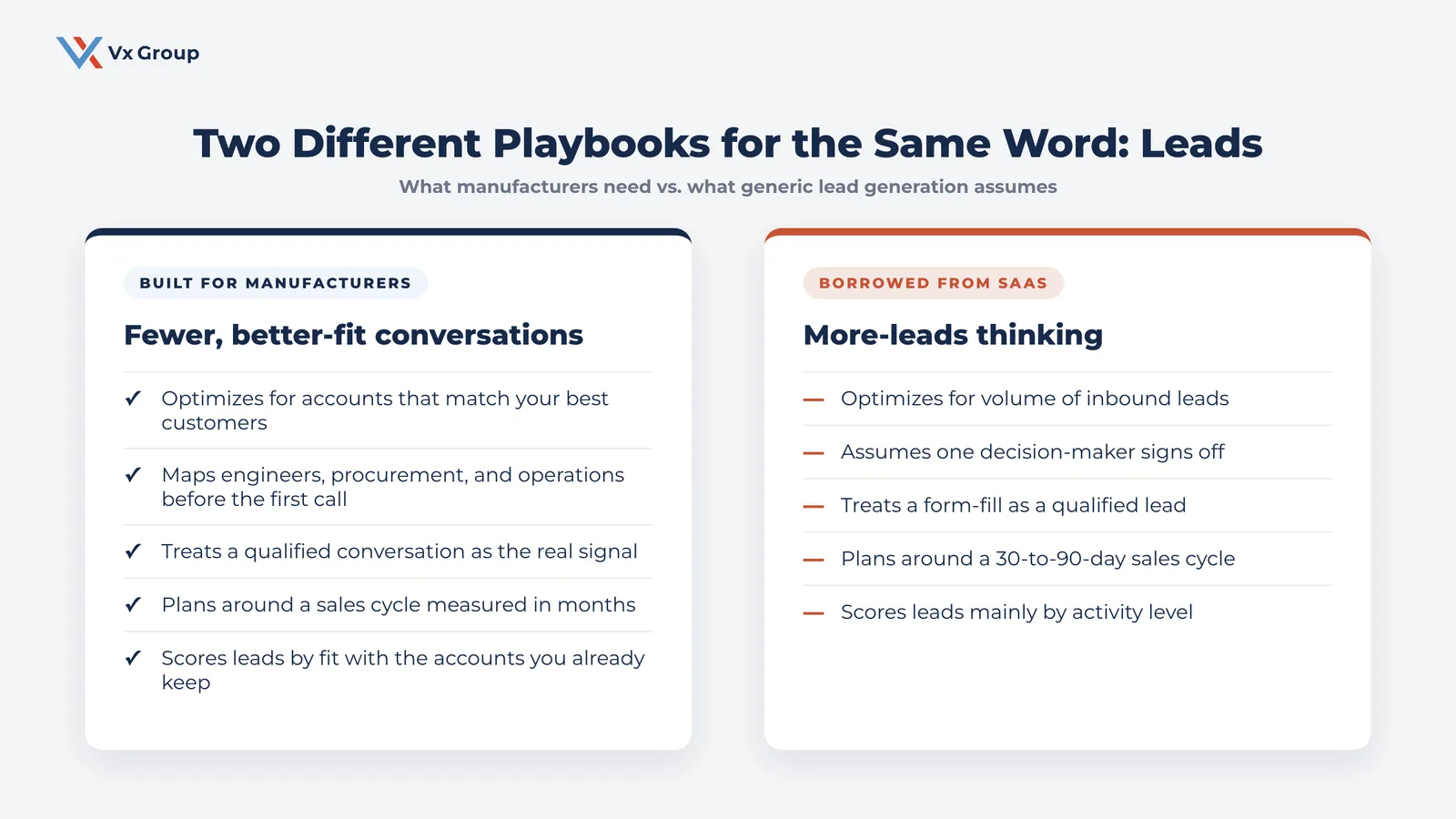
Lead generation for manufacturers works when it targets a small number of accounts that already match your best customers, by industry, program or part type, and buying process. Build a target list from that profile, earn the first conversation with the full buying committee, and qualify every account before sales spends time on it.
Most manufacturers trying to fix a thin pipeline reach for the same playbook a SaaS company would use: more traffic, more form-fills, more leads. That playbook assumes a buyer who signs alone, decides in a matter of weeks, and never needs to see or touch a part before buying it.
TL;DR
- Lead generation for manufacturers works by targeting a small number of accounts that already match your best customers.
- Build the profile from your own top accounts: industry, program or part type, buying process, and the reason they stay.
- A target list built against that profile keeps a lean sales team’s time on real opportunities.
- Manufacturing deals get decided by a buying committee of engineers, procurement, and operations, so content and outreach need to speak to all three.
- Qualifying for fit before volume keeps the pipeline clean and protects the team from chasing dead-end inquiries.
- A real handoff to sales includes the account’s story: who was involved, what they asked, and why they fit.
- Trade shows, distributor networks, and referrals still produce more manufacturing sales leads than any paid channel, and the same fit discipline applies to each one.
Manufacturing sells differently. A single deal usually needs sign-off from an engineer, a procurement lead, and someone in operations, spread across a sales cycle that can run six to eighteen months. Feed that cycle with generic, SaaS-style leads and a lean sales team drowns in noise: inquiries from the wrong industry, requests for a part your line doesn’t make, and form-fills from people gathering quotes for a school project.
Fewer leads that already match the accounts you know how to win take less time to qualify and close at a far higher rate than a flood of strangers who found your site through a keyword. That’s the entire case for building manufacturer lead generation around fit.
Long tenure with a handful of legacy accounts can hide this problem for years. A manufacturer with three 20-year customers can look healthy on paper while carrying enormous risk: a leadership change, an acquisition, or a single lost contract at any one of those accounts can erase a meaningful share of revenue overnight. Building a real target list, even while those legacy relationships are strong, is how a company protects itself against depending on too few accounts for too much of its business.
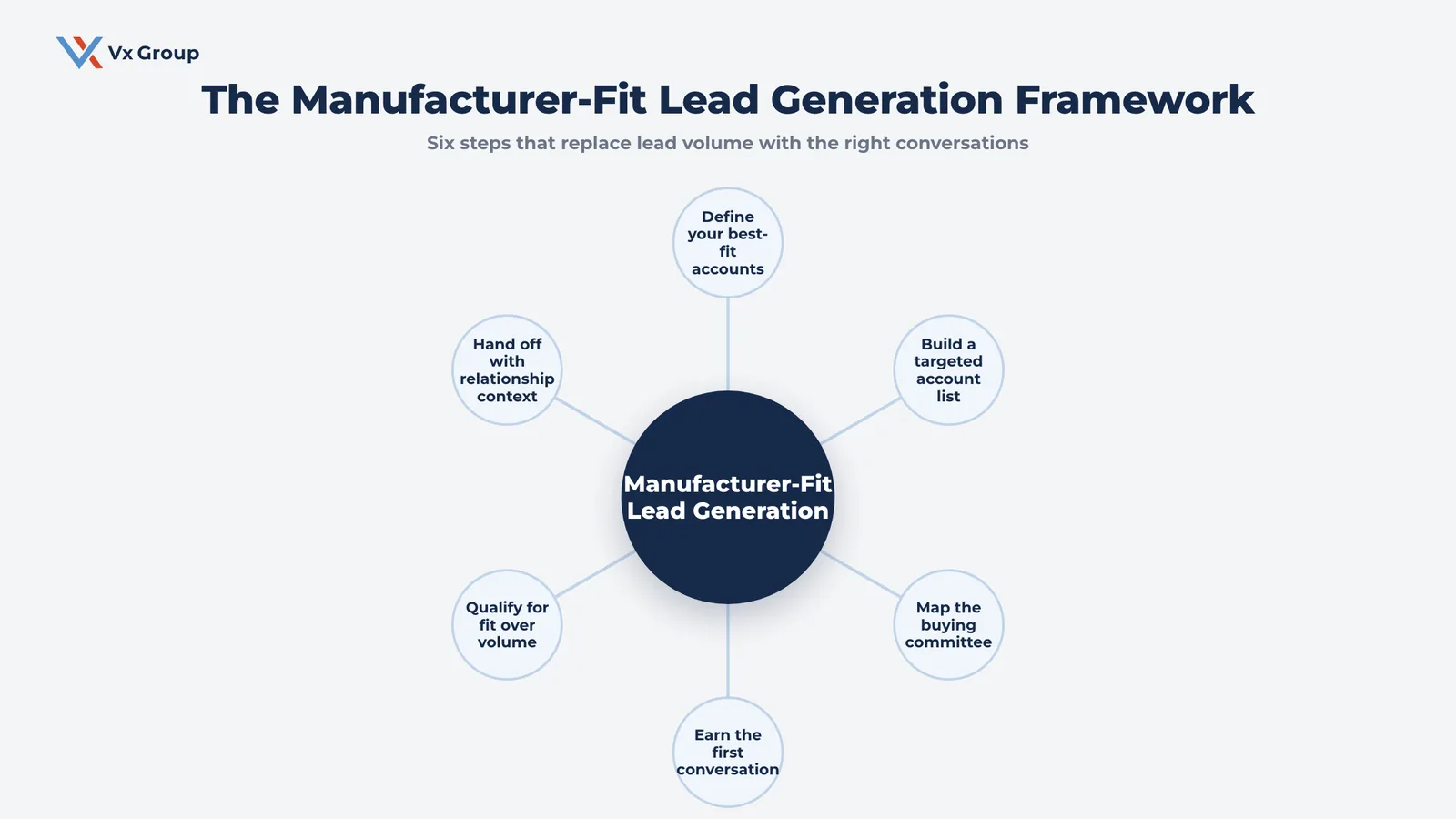
Step 1: Define your best-fit accounts by studying your current customers
The fastest way to define a best-fit account is to study the customers you already have. A hypothetical persona built from a generic industrial marketing report will describe an industry. Your own top accounts will describe the specific pattern that actually buys from you: which industries, which program or part types, and which buying process you already know how to win.
Defined Term: Best-fit account.
A prospective account that matches the specific pattern of your best current customers by industry, program or part type, buying process, and the reason they have stayed.
Study your best accounts before you set the criteria
Pull your top 15 to 25 accounts by revenue and tenure, and study each one against the same set of questions.
| What to study | What you’re looking for | Where to find it |
|---|---|---|
| Industry | The two or three industries that keep buying from you | CRM industry field, win-loss notes |
| Program or part type | The product lines or programs your best accounts actually order | Order history, product mix reports |
| Buying process | Who signed off, how long it took, and what almost killed the deal | Deal notes, sales team interviews |
| Why they stay | The real reason for renewal or reorder, in their own words if you have it | Account reviews, renewal calls, QBRs |
Most manufacturers find the pattern is narrower than they expect. A company that sells to eight industries on paper often does 70 percent of its best business in two of them, through one or two program types, with a buying process that looks nearly identical from account to account.
Write the one-page best-fit profile
Turn the pattern into a single page your whole team can use to judge a new account in under five minutes. Include the industry and sub-industry, the program or part type, the typical deal size range, the buying process (who signs, how long it takes, what stalls it), and the specific reason your best accounts give for staying. Keep it to one page. A profile that takes ten minutes to read never gets used in the field.
Stress-test the profile against your riskiest accounts
Before finalizing the profile, run it against your two or three longest-tenured, highest-revenue accounts specifically. If the profile only describes those few accounts and nothing else in your customer base looks like them, the target list in Step 2 is your best tool for building a second and third generation of accounts that can carry the same weight those legacy relationships carry today.
Step 2: Build a target list against that profile
Once the profile is written, build a list of specific, named accounts that match it: real companies you can name today, drawn from the sources below.
Source the list from channels that already know your industry
Manufacturing demand is referral-heavy and channel-dependent in a way most generic lead-gen advice ignores. Pull candidates from:
- Distributor and channel partner introductions, since your distributors already call on accounts that look like your best customers
- Trade show attendee and exhibitor lists from the shows your best accounts actually attend
- Industry association member directories in the two or three industries the profile points to
- Referral requests to your current best accounts, who usually know at least one peer company with a similar setup
- Win patterns in your own CRM: accounts that inquired before and matched the profile but never closed
Turn referral-heavy demand into a repeatable channel
Most manufacturers already get their best accounts through referrals, but few treat referrals as a channel they actively manage. Ask your best-fit accounts directly for an introduction once a year, log the referral source on every new account in the CRM, and report back to the referring account when the introduction turns into business. A referral channel that runs on a documented habit produces a steadier stream of well-matched accounts than one that runs on hoping a happy customer mentions you unprompted.
Size the list to what your sales team can actually work
Set the list size by what your team can realistically research and contact in a year. If one salesperson can meaningfully research and reach 15 to 20 new accounts a month, a list of 150 to 200 well-matched accounts gives that person a full year of runway without forcing anyone to guess who to call next. A list of 2,000 loosely matched accounts produces the same busy, unproductive quarter as a generic lead-gen campaign, just with better spreadsheet formatting.
Step 3: Earn the first conversation with the whole buying committee
A manufacturing deal is rarely decided by one person, so the first conversation has to speak to the engineer, the procurement lead, and the person in operations as three distinct audiences, each with a different question to answer before they move forward.
Map the three buyers before you write anything
Each stakeholder is answering a different question, and content aimed at only one of them stalls the other two.
| Stakeholder | Real question they’re answering | What earns their attention |
|---|---|---|
| Engineer | Will this part or program actually work in our application? | Spec sheets, tolerances, technical case studies, sample data |
| Procurement | What does this cost, and what’s the risk of switching suppliers? | Pricing structure, lead times, quality certifications, references |
| Operations | Can we actually run this without disrupting the line? | Implementation timeline, onboarding process, support model |
Build one message for each stakeholder’s real question
Build at least one piece of content or outreach angle per stakeholder: a technical spec sheet or application note for the engineer, a total-cost and risk comparison for procurement, and an implementation timeline for operations. Reference the same account by name across all three so the outreach reads as one coordinated effort aimed at the whole committee.
A procurement-focused outreach line might read: “Most of our accounts in [industry] tell us missed lead times are what actually drove them to switch suppliers. Here’s our on-time delivery record for the last four quarters and what a 90-day transition would look like for your team.” That single sentence gives procurement a concrete answer to the specific risk question they came in with.
Field Notes:
A pattern we see often: a manufacturer runs a lead-gen campaign built for volume and gets hundreds of inbound inquiries in a quarter. Sales works through the list and finds most requests come from the wrong industry, the wrong part size, or a student doing research for a class project. A handful turn out to be real. The team spends weeks chasing noise before it ever reaches the few conversations that were going to close.
The same manufacturer, working from a list of forty accounts that match its best customers, reaches the buying committee at each one directly. The quarter ends with far fewer total conversations, and most of them are worth having.
Step 4: Qualify for fit over volume
Once accounts start responding, qualify each one against the specific profile you wrote in Step 1.
Score inbound interest against your best-fit profile
Run every inquiry through a short checklist before it reaches a salesperson’s calendar:
- Does the account’s industry match the profile?
- Does the program or part type match what your best accounts actually order?
- Does the buying process fit your typical sales cycle, or is it a one-off spot-buy?
- Is there a named budget holder involved, or only a technical contact gathering information?
Turn the checklist into a simple score and a rule for what happens at each level.
| Score | What it means | What happens next |
|---|---|---|
| 4 of 4 | Full match on industry, part type, buying process, and budget authority | Moves to sales with full relationship context |
| 2 to 3 of 4 | Partial match, often missing a confirmed budget holder | Goes to a lighter-touch follow-up: one targeted email or a distributor introduction |
| 0 to 1 of 4 | Little to no match with the best-fit profile | Gets a quick, polite disqualification |
Say no to the wrong-fit inquiries quickly
Politely disqualifying a poor-fit inquiry within a day protects your sales team’s time and shapes how the account remembers your company. A manufacturer that responds quickly and honestly, even to say a request isn’t a fit, reads as more credible than one that lets every inquiry sit in a queue for two weeks before going quiet.
Step 5: Hand off to sales with real relationship context
The handoff between marketing and sales is where most of the value from Steps 1 through 4 gets lost, because a name and an email tell the salesperson nothing about the relationship already in motion.
Document the account’s story before the handoff
Before an account reaches a salesperson, document who at the account has been part of the conversation (engineer, procurement, operations, or all three), what content or questions they engaged with, and why the account matches the best-fit profile. A salesperson who opens the account already knowing the buying committee and the stated reason for interest starts the relationship three steps ahead of a cold call.
Give sales a one-page account brief template
Standardize the handoff into a one-page brief with five fields: the best-fit criteria the account matched, the names and roles of everyone involved in the buying committee so far, the specific content or question that brought them in, the account’s stated timeline if one was shared, and a suggested first talking point based on what they already engaged with. A salesperson working from this brief opens the first call already speaking to the account’s actual situation.
Set a follow-up cadence sales can actually keep
Build a cadence the team will realistically maintain: first outreach within two business days of the handoff, a second touch within the following week if there’s no response, and a defined check-in point 30 days out regardless of where the deal stands. A documented cadence, even a simple one, outperforms an undocumented one that depends entirely on one salesperson’s memory.
What to track once the framework is running
A best-fit framework earns its keep on a handful of numbers, tracked across a full sales cycle so the trend has time to show up.
- Fit score at intake. What share of inbound inquiries clear all four points on the Step 4 checklist. A rising share means the target list and content are attracting the right accounts; a falling share is the first signal to revisit the profile itself.
- Time to first qualified conversation. How long it takes a new account to move from first contact to a real conversation with the buying committee. This tends to shrink once outreach speaks to all three stakeholders from the first touch.
- Source of best accounts. Which channel, trade shows, distributor introductions, referrals, or direct outreach, actually produced the accounts that closed and stayed. Most manufacturers find this list is shorter and more concentrated than their marketing spend suggests, which is the signal to put more budget behind the channels already working.
- Referral rate from best-fit accounts. How many of your current best-fit accounts made an active introduction in the past year. A rate near zero is the clearest sign that the referral channel in Step 2 still runs on hope alone.
Industrial lead generation built this way takes longer to set up than turning on a paid campaign. It also produces a pipeline a lean sales team can actually work through in the hours they have each week. The How To Build a B2B Growth Engine in a Manufacturing Company framework covers how this fits into the rest of a manufacturer’s growth system, and the Industrial Marketing Strategy guide covers the content and channel side in more depth. A documented manufacturing sales strategy for the handoff itself closes the loop between marketing and the sales team.
Ready to grow?
See how this framework applies to your own target list and sales cycle.
About the author: David Tisdale advises manufacturers and distributors on building growth systems that survive employee turnover, ownership changes, and slow years. He works with Vx Group’s clients on turning scattered inquiries into a documented, relationship-first pipeline.
Related posts:
- How To Build a B2B Growth Engine in a Manufacturing Company
- How To Build An Industrial Marketing Strategy That Scales
- Channel Marketing for Manufacturers and Distributors
FAQs
About the Author: David Tisdale
