

How to Improve Customer Retention in a B2B Company

To improve customer retention in a B2B company, assign one person to own the growth of existing accounts, build a schedule of contact that has nothing to do with the next order, spread each relationship across multiple people on both sides, learn what the customer is actually trying to accomplish, and measure year-over-year account expansion as the primary retention metric.
TL;DR
- Give existing-account growth a dedicated owner, separate from new-business sales.
- Build a schedule of contact that has nothing to do with the next order.
- Spread each key relationship across several people on both sides.
- Learn where the customer is trying to go, then be useful getting there.
- Measure year-over-year account growth as the primary signal. Renewal rate alone hides too much.
- Watch relationship signals early. Revenue confirms what they already showed you.
Why Does Improving Retention Matter More Than Chasing New Customers?
Improving retention matters more than chasing new customers because expanding a relationship you already have is the fastest, most reliable revenue in B2B. The trust is built. The work is already understood. The customer already has a reason to buy more from you.
Defined term: Customer retention
The deliberate work of keeping and expanding the relationships a company has already earned. Retention improves when relationships grow deeper and more valuable over time. A renewed contract on its own does not guarantee that.
Winning that same dollar from a brand-new account costs more and takes longer. A new relationship starts at zero trust, a blank contract, and a sales cycle that can run six months or a year in a complex B2B sale. An existing account starts past that line already, which is exactly why it gets ignored: nothing about it feels urgent.
The villain here is acquisition tunnel vision. Budget and attention pour into new logos while the accounts already on the books drift without anyone paying attention to them. Most B2B companies can grow faster by fixing what happens after the first sale than by adding another lead source. The fastest, cheapest growth a company has is usually sitting inside accounts it has already won, unclaimed.
This is especially true in legacy B2B industries, where relationships often span decades and a single account can represent a meaningful share of revenue. Treating that account with the same attention as a first-time buyer wastes years of trust that has already been built.
The lifetime value concentrated in a handful of long-standing accounts often exceeds the total pipeline sitting in front of the new-business team. Protecting and expanding what a company already has is usually the faster path to revenue, even before a single new lead gets worked.
This article walks through five specific, sequenced moves. For the fuller picture of why retention gets undervalued and how it connects to the rest of a company’s growth strategy, see the complete guide to customer retention strategies.
Is Improving Retention the Same as Running a Loyalty Program?
Improving B2B customer retention is a different discipline than running a loyalty program, and treating it the same way misses what actually keeps a complex B2B relationship intact. Loyalty programs work on volume and small, repeatable purchases: points, discounts, and rewards that nudge a consumer toward one brand over another at the register.
B2B retention runs on a different mechanism. The purchases are large, the buying committee has several people on it, and the relationship spans years rather than transactions. A discount code does not fix a single-threaded relationship or tell you what your customer is trying to accomplish this year. Ownership, contact, multiple relationships, shared goals, and a real metric do that work.
Companies that borrow consumer loyalty tactics for a B2B relationship usually end up with a rewards program nobody asked for, sitting on top of the same unmanaged accounts underneath it.
What Are the Warning Signs of Weak B2B Customer Retention?
Weak B2B customer retention usually shows up as a set of quiet signals well before an account actually leaves. Watching for these signals, rather than waiting for a cancellation notice, is what separates a company that reacts to churn from one that prevents it.
- A key account’s activity runs through one person on your team and one person on theirs.
- Nobody on the team could describe what the customer is trying to accomplish this year.
- The only scheduled contact with the account is tied to a renewal date or an open order.
- Account-level reporting shows renewal rate but nothing about year-over-year account value.
- New-business closers are also expected to manage and grow the existing accounts on their book.
- A contact who used to respond quickly has gone quiet, and nobody has followed up to find out why.
Each of the five steps below addresses one of these signals directly.
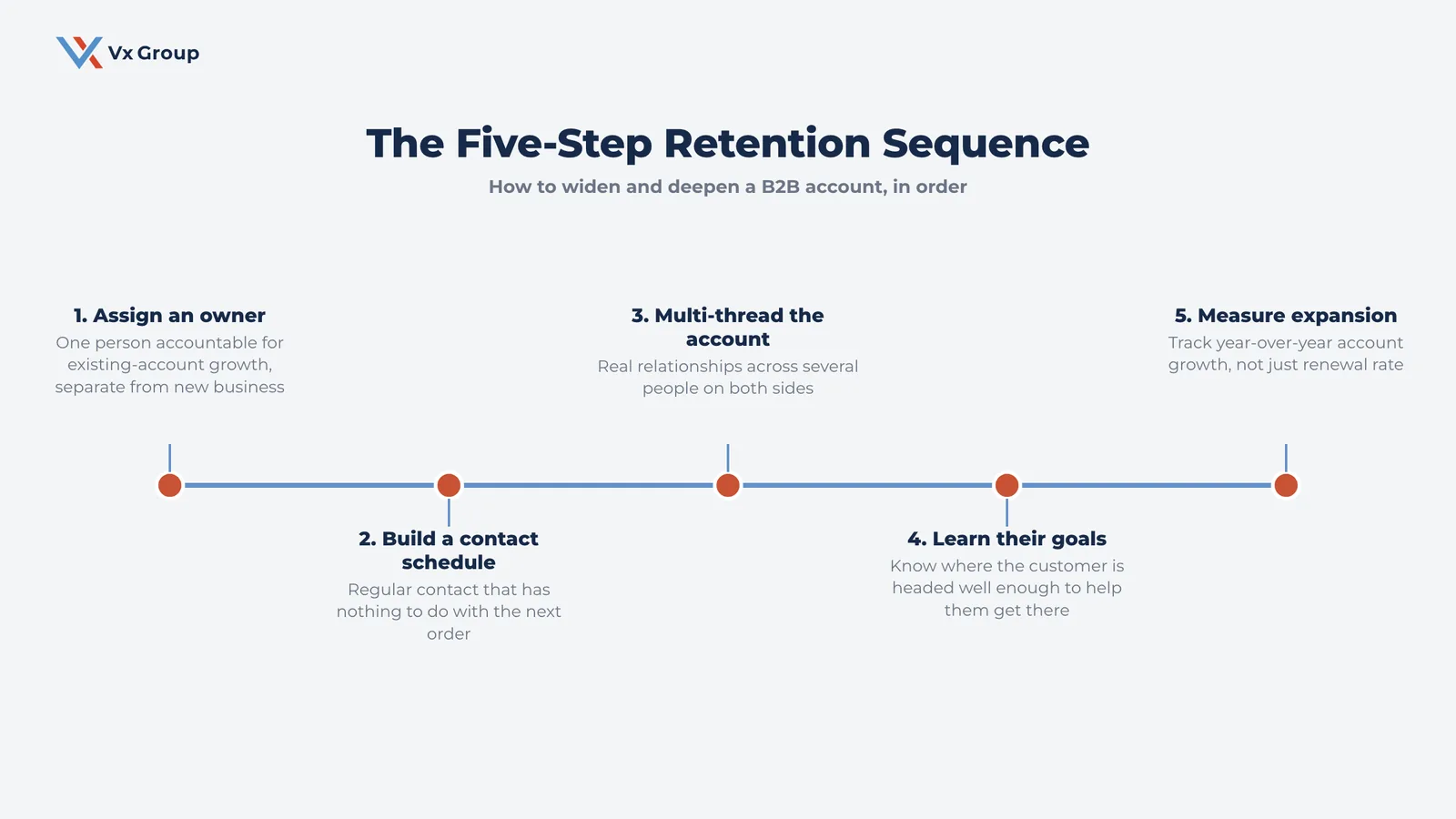
Step 1: Give Existing-Account Growth a Dedicated Owner
Assign one person to be accountable for growing the value of existing accounts, separate from whoever closes new business. This is the single most important move on this list, because retention fails by default when it belongs to no one.
Originating a new relationship and expanding an existing one are different jobs, with different instincts and different rewards. New deals carry urgency and a visible finish line. Growing an existing account is quieter work with no closing bell, so when one person owns both jobs, the existing account loses to the more urgent new deal almost every time.
Separate the Expansion Mandate From New-Business Sales
Whoever closes new deals should not also own the growth of existing accounts, even informally. The two jobs compete for the same hours, and new business will always feel more urgent because it has a deadline attached to it. A dedicated owner, even a fractional one at a smaller company, protects existing accounts from constantly losing that competition.
This does not require a new hire in most companies. It requires a decision. Someone on the team, often in account management, customer success, or operations, gets the mandate in writing and the new-business team gets told explicitly that expansion is no longer their job to protect.
Announce the change out loud, in a real meeting, where both teams hear it at the same time. A policy document buried in a shared drive changes nothing on its own. A public statement, made once, in front of the people affected, is what actually shifts behavior.
Give the Owner Real Authority
A title without authority changes nothing. The account owner needs the standing to pull in an executive for an introduction, the budget to take a client to dinner or an event, and the calendar space to actually do the work instead of squeezing it between other responsibilities.
Write the mandate down in one sentence and put it somewhere the whole company can see it: this person is accountable for the year-over-year value of these accounts. Ambiguity is what let the accounts drift in the first place, so remove it deliberately.
Pair the authority with a regular check-in with leadership, monthly at minimum, so the mandate does not quietly erode the first time someone asks the owner to help close a new deal instead. A mandate nobody checks in on tends to fade within a quarter.
Start With Your Top 10 to 20 Accounts
Do not roll this out across every account in the portfolio on day one. Start with the accounts that already carry the most revenue and the most relationship equity, usually the top 10 to 20. These are the fastest place to prove the model works, and the ones with the most to lose if they are left unattended.
Once the owner has a working rhythm with the top tier, expand the list. A dedicated owner with 15 well-tended accounts will outperform a scattered effort spread across 100.
Build the initial list from two things: current revenue and how many of the five steps in this guide are already happening informally. An account with real revenue and almost no structure around it is the highest-value place to start, because the upside is large and the current risk is high.
Step 2: Build a Schedule of Contact That Isn’t About Selling
Create a regular schedule of contact with each key account that has nothing to do with a renewal or a new order. The goal is to stay useful and present between transactions, so trust keeps compounding instead of resetting every time a contract comes up.
Most companies only contact an account when a contract is up for renewal or a problem appears. That teaches the customer the relationship is transactional, and transactional relationships get replaced the moment a competitor undercuts on price.
Put a Contact Schedule on the Calendar
Decide the rhythm in advance: monthly for top accounts, quarterly for the next tier, and put every touch on a calendar the same way you would schedule a sales call. If it is not scheduled, it competes with everything else on the account owner’s plate and it will lose.
The schedule does not need to be complicated. A recurring calendar block with the account name on it is enough to make the difference between a relationship that gets tended and one that gets remembered only when something goes wrong.
Assign a specific week of the month to each top account if the list is small enough, so the schedule survives even when the owner is busy with something else that week. A schedule that depends on memory alone tends to fail within a quarter.
Make Every Touch Useful on Its Own
Useful contact looks like sharing something relevant to their business, checking in on a goal they mentioned six months ago, or making an introduction that helps them without asking for anything back. None of it should ask for a next step. That is exactly what makes it work.
If every touch has an ask attached, the account starts to dread hearing from you. The touches that build the most trust are the ones with no ask at all, because they are the ones a vendor would never bother sending.
Keep a running list of things worth sharing with each account: an article relevant to their industry, a connection worth making, a piece of market information they would not otherwise see. Pull from that list when a scheduled touch comes up instead of starting from nothing every time.
Track the Rhythm the Same Way You Track Pipeline
Whatever system tracks new-business activity should also track existing-account contact. If a missed follow-up with a prospect gets flagged, a missed check-in with a top account should get flagged too. Visibility is what keeps the rhythm from quietly slipping once the account owner gets busy.
A simple shared tracker with account name, last contact date, and next scheduled touch is enough at most companies. The system matters less than the fact that someone other than the account owner can see whether the rhythm is actually happening.
Review the tracker in the same meeting where new-business pipeline gets reviewed, even if it only takes five minutes. Accounts that fall behind on contact are usually visible weeks before they show any sign of trouble in the revenue numbers.
Step 3: Spread the Relationship Across More Than One Person
Build real connections across several people inside each key account, and bring more of your own team into the relationship too. A relationship that runs through one contact on each side is one resignation away from collapse.
Defined term: Single-threaded relationship
An account relationship that depends entirely on one contact on each side. Single-threaded relationships feel stable because they have always worked, which is exactly what makes their sudden loss so damaging.
Map Who Actually Knows the Account Today
Before you can widen a relationship, find out how narrow it actually is. List every real contact your team has inside the account and every person on your side who has a relationship with them. Most companies are surprised by how short this list turns out to be, even on accounts they consider “safe.”
This map also tells you where the risk is concentrated. An account with one contact on each side is fragile no matter how long it has been a customer or how happy it appears.
Do this exercise for every account on the top-tier list, including the ones that feel completely safe. The safest-feeling accounts are often the most single-threaded, because nobody has ever had a reason to question how the relationship actually works.
Create Deliberate Reasons for More People to Interact
Widening a relationship does not happen by accident. Introduce colleagues on a specific pretext, invite a second contact to a working session, or bring a subject-matter expert from your team into a conversation that the account’s primary contact would find genuinely useful. Each of these is a small, engineered reason for a new connection to form.
This is also how you reduce the fragility that comes from depending on a small number of accounts or a small number of contacts inside them. Widening the relationship is risk management as much as it is growth.
Aim for at least three real relationships on each side of a key account within a year, and keep building from there once you reach it.
Treat Single-Threaded Accounts as a Standing Risk
Flag every single-threaded account explicitly, even the ones that feel completely stable. Stability built on one relationship is a debt that has not come due yet. A resignation, a reorganization, or a new buyer on the other side can erase it without warning.
Put single-threaded accounts on a short list and review it on a schedule set in advance. Waiting for something to feel off means finding out about the risk only after it has already cost you the account.
Assign single-threaded accounts a higher review frequency than the rest of the portfolio until they become multi-threaded. Ending that extra attention too early is how the risk quietly comes back.
Step 4: Learn Where the Customer Is Trying to Go
Understand each key customer’s goals for the year well enough that anyone on your team could describe them accurately. When you know where the customer is headed, you can be useful in ways a vendor never can.
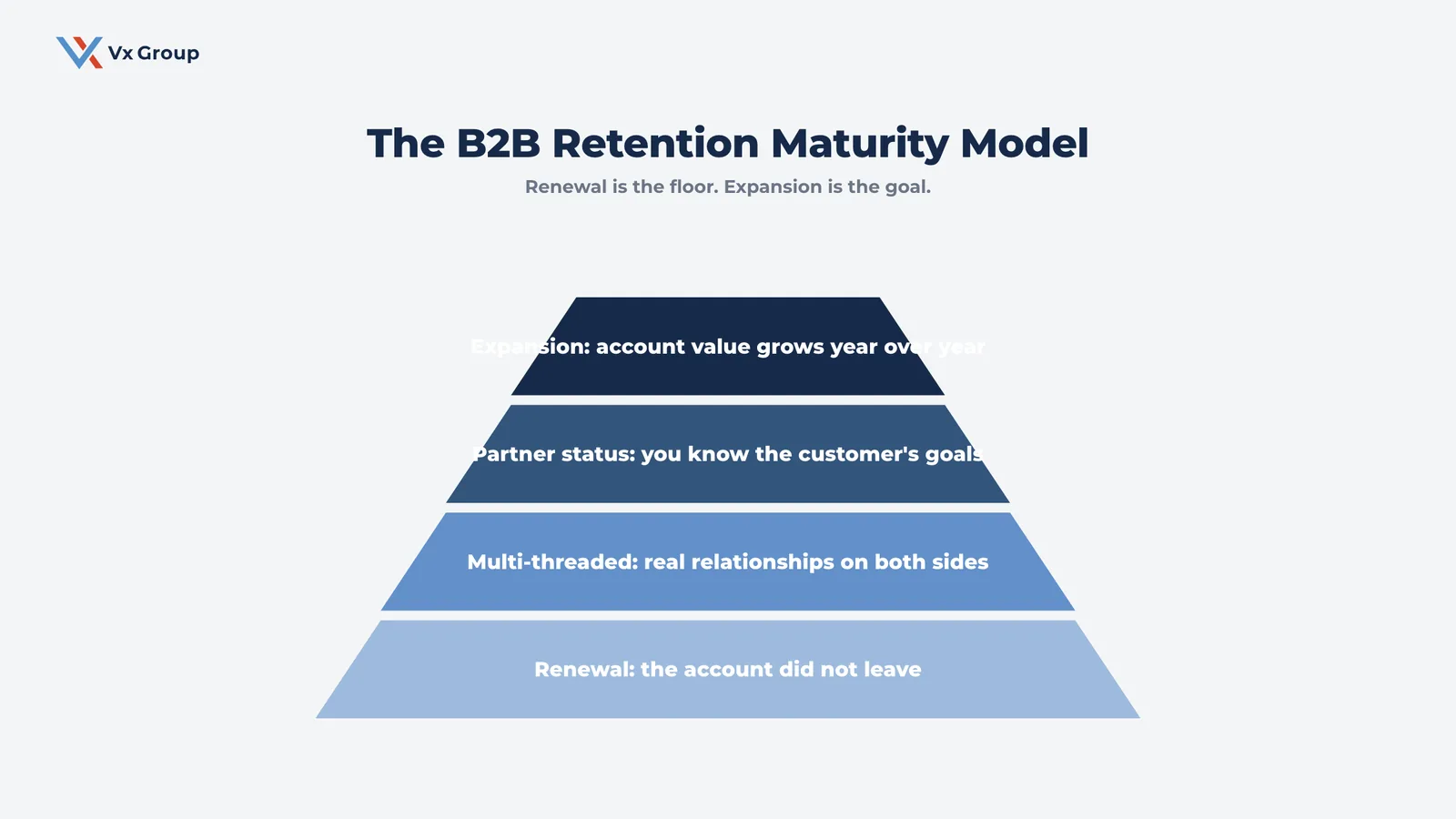
A company that cannot describe its customer’s goals is a vendor. A company that can is a partner, and partners get protected when budgets tighten and competitors start circling.
Ask the Question Directly, Then Write the Answer Down
Most companies never actually ask a customer what they are trying to accomplish this year. Ask directly, in an ordinary working conversation, the way you would ask a colleague: what does a great year look like for you? Then write the answer down somewhere the account owner can reference it later.
The answer is rarely a surprise once you hear it. What is rare is a company that bothers to ask and then does anything with the answer.
Ask again every year, even with accounts you have worked with for a decade. Goals shift with new leadership, new budgets, and new pressure from their own customers, and an answer from three years ago can be actively wrong today.
Use That Goal to Spot Real Expansion Opportunities
Once you know where the customer is headed, expansion opportunities stop feeling like upsells and start feeling like help: a specific way to get the customer closer to a goal they already told you about.
This is the difference between a pitch and a conversation the customer actually wants to have. The goal you wrote down in the last step is what makes that difference possible.
Bring the goal back into the conversation explicitly when you propose an expansion. Connect the specific ask to the specific goal the customer already shared. That connection is what keeps the conversation feeling like help instead of a pitch.
Make Sure More Than One Person on Your Team Knows It
A customer’s goals should not live only in the account owner’s head, for the same reason the relationship itself should not run through a single contact. Document it somewhere the whole team touching that account can see it, and revisit it at least once a year, since goals change.
This single habit, done consistently across a portfolio of accounts, is often the clearest difference between a company that talks about being relationship-driven and one that actually is.
Keep the goal in the account notes your team already uses, rather than a separate system nobody opens. The goal is only useful if the person picking up the phone during a transition can find it in under a minute.
Step 5: Measure Year-Over-Year Expansion
Track whether each account grows in value year over year. The metric you choose decides the behavior you get from the person accountable for it.
Renewal rate tells you an account did not leave. It says nothing about whether the relationship grew or quietly started shopping around. When the metric is expansion instead, the account owner stops waiting for renewal season and starts looking for ways to be useful all year.
Pick One Number: Year-Over-Year Account Value
Choose a single primary number: the percentage change in an account’s value from one year to the next. Simplicity here matters more than precision. A metric the account owner understands and can move is worth more than a perfect metric nobody tracks consistently.
Report this number for the top 10 to 20 accounts at minimum, on the same schedule you report new-business pipeline. If leadership only ever sees new-business numbers, existing accounts will keep losing the internal competition for attention that Step 1 was built to fix.
Resist the urge to track five metrics at once in the first year. One number, tracked consistently and reported honestly, produces more behavior change than a dashboard nobody has time to read.
Report It Next to New-Business Pipeline
Existing-account expansion and new-business pipeline are two different engines that both need fuel, and both deserve a place in the same report. Reporting them side by side, in the same meeting, on the same schedule, keeps expansion from disappearing into a status update nobody reads.
Companies that treat their top accounts as a deliberate growth strategy report on them with the same seriousness they report on the new-business funnel. That seriousness is what keeps the work from sliding.
This is also where leadership signals what actually matters. A report that only shows the new-business funnel tells the whole company, without saying it directly, that existing accounts are somebody else’s problem.
Let the Metric Change What the Owner Does All Year
A metric that only shows up once a year at review time will not change daily behavior. Review account-level expansion monthly, even briefly, so the owner adjusts course in real time instead of discovering a problem after it has already cost the company revenue.
A metric like this earns its keep through the behavior it produces once someone is accountable for moving it every month instead of explaining it once a year.
Ask the account owner one question in every monthly review: what did you do this month to grow this account’s value? A metric without that question attached becomes a number nobody feels responsible for.
| Step | The move | Why it improves retention |
|---|---|---|
| 1 | Dedicated owner for existing accounts | Expansion stops losing to new-deal urgency |
| 2 | Non-selling contact schedule | Trust compounds between transactions |
| 3 | Multi-thread the relationship | The account survives a contact leaving |
| 4 | Know the customer’s goals | Establishes partner status with the account |
| 5 | Measure year-over-year expansion | Behavior shifts from defending to growing |
What Happens If You Skip This?
Skipping this work rarely causes an account to leave overnight. It shows up first as flat expansion, then as a competitor getting further inside the account than you realize, then eventually as a renewal that quietly does not happen. By the time revenue reflects the problem, the relationship has usually been eroding for a year or more.
The cost is largest on the accounts a company has held the longest. Long tenure creates a false sense of security: the account has always renewed, so nobody questions whether it is actually growing. A dedicated owner, a real contact rhythm, multiple relationships, a clear picture of the customer’s goals, and a metric that actually gets reported are what close that gap before a competitor does.
The fix rarely comes from a single big initiative. Retention improves through the accumulation of many small, consistent actions: a scheduled call that happens instead of getting pushed, a second contact added instead of relying on one, a goal written down instead of assumed. None of these actions look dramatic in a single quarter. Over a year, they decide which accounts grow and which quietly stall.
Ready to grow?
Get a clear read on where your existing relationships are strong and where they are quietly at risk.
How Do You Know If Retention Is Actually Improving?
You know retention is improving when existing accounts grow in revenue, key relationships have more real contacts inside them, and top accounts are hearing from you usefully between transactions. These leading indicators move before renewal rate ever does.
Watch the relationship signals closely, since revenue moves last. Revenue is a lagging number. It confirms what the relationship signals already predicted months earlier: a contact went quiet, a single thread thinned out, a check-in stopped happening. A team that tracks relationship depth and contact frequency catches risk while there is still time to act on it.
When a relationship signal turns negative, the response should be immediate. If a top account loses its only real contact when a longtime buyer leaves, the account owner needs a plan to build a second connection within a month, well before the quarter closes. If a top account misses two scheduled check-ins in a row, that alone is worth a specific outreach, independent of whatever the revenue numbers still say.
None of the five steps in this guide work in isolation. A dedicated owner without a contact schedule drifts. A contact schedule without multiple threads is one resignation away from failing. Multiple threads without a shared understanding of the customer’s goals produce noise instead of trust. All of it stays invisible to leadership without a metric that gets reported on a real schedule. Run all five together, and existing accounts start behaving like the growth engine they already are.
Related Reading
- Customer Retention for Relationship-Driven B2B Companies: The Complete Guide
- Customer Concentration Risk: What It Is and How to Reduce It
- Your Top 10 Customers Are a Growth Strategy: Here’s How to Implement It
FAQs
About the Author: Beth Barbaglia
