

The B2B Enterprise Target Profile: What Criteria Actually Matter

B2B enterprise target profile criteria are the specific, measurable characteristics that define which accounts your company is most likely to win, retain, and grow. The most reliable criteria come from studying your best existing accounts rather than constructing filters from internal assumptions. They cover four categories: firmographics, relationship dynamics, buying triggers, and organizational fit.
TL;DR
- Enterprise target profile criteria define the accounts worth pursuing, built from evidence rather than assumption
- The four categories are firmographics, relationship characteristics, buying triggers, and organizational fit
- Firmographic filters are necessary but insufficient on their own
- Evidence-built profiles consistently outperform hypothesis-built ones in win rate, account lifespan, and expansion predictability
- The best source of criteria is your existing best-fit accounts: the ones you would clone if you could
- A complete profile combines thresholds across all four categories with data from actual account history
- Revisit and recalibrate your criteria at least annually as your client base evolves
The villain in most B2B growth strategies is a target profile built from guesswork.
Most companies define their enterprise targets by drawing a box around what sounds plausible: manufacturing companies with $50M or more in revenue, 100 or more employees, headquartered in the Midwest. The box feels specific. It describes hundreds of companies, many of which will never buy, never stay, and never refer anyone.
The companies that consistently win enterprise accounts have done something different. They stopped building profiles from the outside in and started building them from the inside out. Their criteria come from studying the accounts they already have: the ones they kept for a decade, the ones that expanded without being asked, the ones that refer without being prompted. Those accounts contain every signal a growth strategy needs. Most companies never look.
This guide walks through every category of B2B enterprise target profile criteria, explains what separates hypothesis-built profiles from evidence-built ones, and gives you a working framework for identifying the accounts worth pursuing.
What are B2B enterprise target profile criteria?
B2B enterprise target profile criteria are the specific, measurable characteristics that identify which accounts your company can win, retain, and grow. They go beyond a general description of your target market to define the precise signals that separate a high-probability enterprise account from a low-probability one.
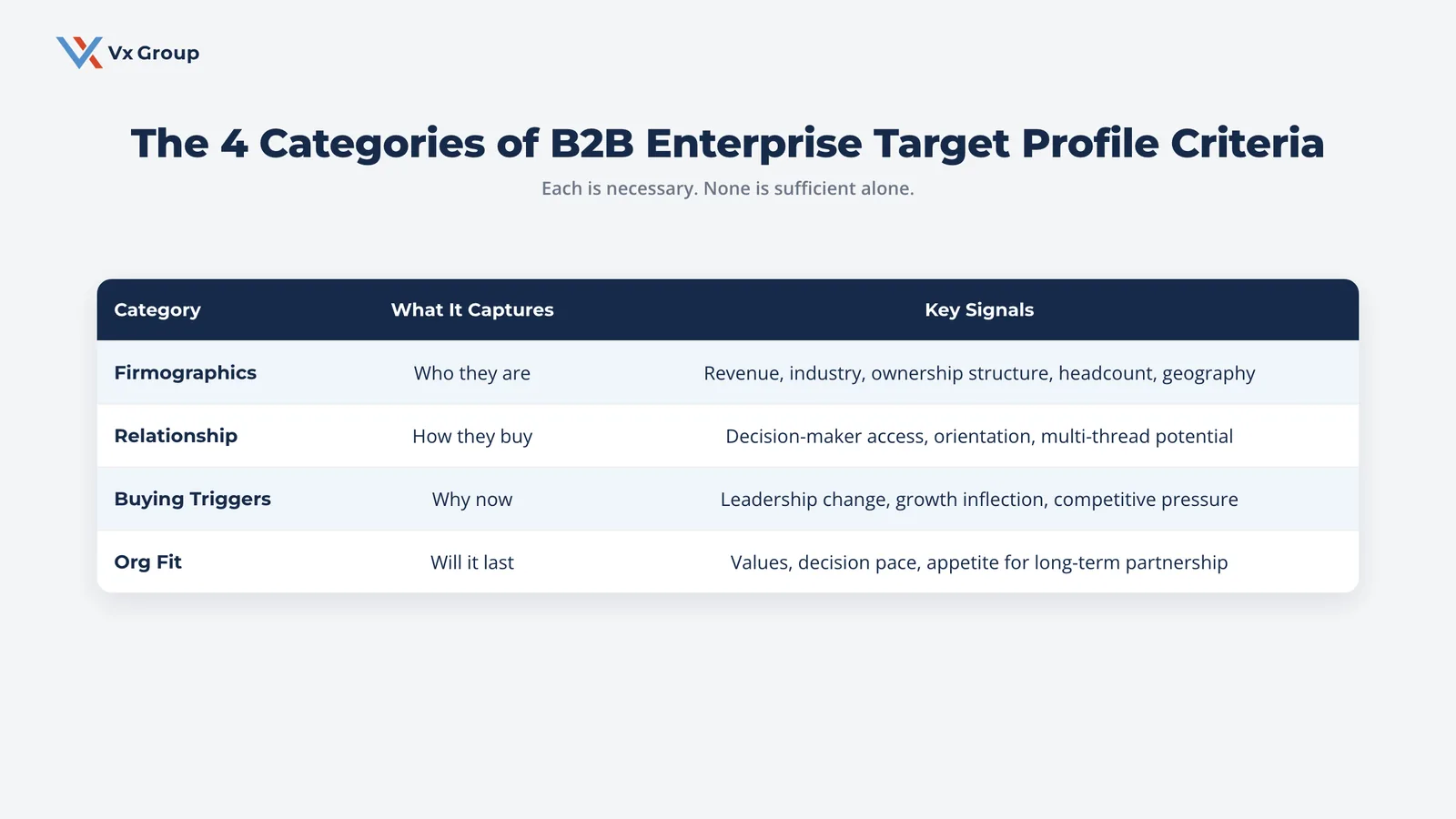
The term covers four distinct categories:
| Criteria Category | What It Captures |
|---|---|
| Firmographics | Company size, revenue, industry, geography, ownership structure |
| Relationship characteristics | How the account buys, who holds authority, decision dynamics |
| Buying triggers | Events or conditions that signal an account is ready to act now |
| Organizational fit | Culture, values, and operating style that determine long-term compatibility |
Each category is necessary. None is sufficient alone. A profile built only on firmographics misses the relational and behavioral signals that predict retention. A profile built only on relationship intuition cannot be operationalized or communicated to a sales team.
Defined Term: Enterprise target profile criteria
The set of firmographic, relational, behavioral, and organizational signals that define which B2B accounts a company is most likely to win, retain at strong margin, and grow over time. Reliable criteria come from examining existing best-fit accounts rather than constructing hypothetical filters from scratch.
Why do most B2B target profiles fail to produce results?
Most B2B enterprise target profiles fail because they are built from the inside of a conference room, not from the inside of the company’s best accounts.
The typical process: a leadership team gathers, draws parameters around the types of companies they would like to work with, writes them down, and hands them to sales. The parameters might include revenue thresholds, industry verticals, geographic territories, and headcount bands. The list looks complete. It was never tested against reality.
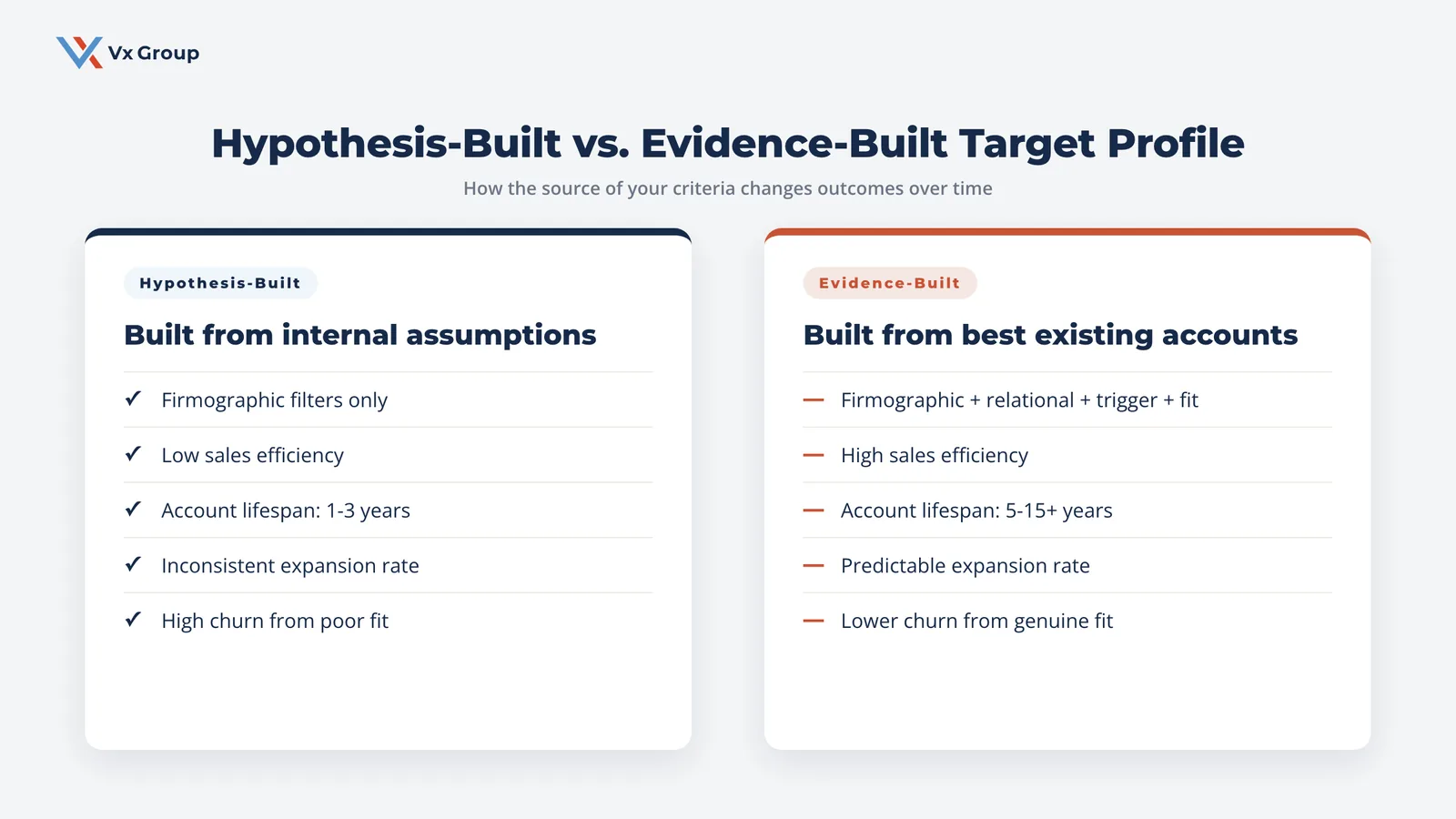
A hypothesis-built profile tells you what a target account looks like on paper. An evidence-built profile tells you what one looks like in practice, based on the accounts that already buy, stay, and expand.
The differences compound over time:
| Hypothesis-Built Profile | Evidence-Built Profile | |
|---|---|---|
| Source of criteria | Internal assumptions | Existing best-fit accounts |
| Primary filters | Firmographics only | Firmographics + relationship + trigger + fit |
| Sales efficiency | Low; high volume of mismatched conversations | High; fewer and better-qualified conversations |
| Account lifespan | 1-3 years | 5-15+ years |
| Expansion rate | Inconsistent | Predictable |
| Churn pattern | Frequent; driven by poor fit | Low; driven by genuine compatibility |
The gap between those two profiles is not a minor inefficiency. For companies with long sales cycles and high-value relationships, a miscalibrated target profile is one of the most expensive operational problems a leadership team can overlook.
Why Most B2B Companies Grow By Accident covers the full mechanics of how undisciplined targeting compounds into a larger growth problem.
What firmographic criteria actually matter for enterprise B2B accounts?
Firmographic criteria are the starting point for any enterprise target profile, and the useful ones are narrower than most companies think.
The standard firmographic filters are revenue, employee headcount, industry vertical, and geography. These are table stakes. The question that separates strong from weak target profiles is which specific thresholds actually correlate with accounts that win, retain, and expand, rather than accounts that merely fit the general description.
Revenue range
Revenue signals buying capacity and complexity. The relevant range is the one your best current accounts actually fall within. An aspirational threshold disconnected from your real win history produces little value in practice.
Industry vertical
The useful criterion here is specificity. “Manufacturing” is not a target vertical. “Custom industrial fabrication for aerospace and defense” is a target vertical. The more precisely you can name the industries where your company holds deep relationships and a clear point of differentiation, the more the criterion filters signal from noise.
Ownership structure
Family-owned, private equity-backed, and publicly traded organizations create fundamentally different buying dynamics, decision timelines, and relationship expectations. The accounts that fit your company’s relationship model will tend to cluster within one or two ownership structures. Most target profiles ignore this entirely.
Employee headcount by function
Total headcount is a blunt instrument. Headcount by relevant function is sharper. A target profile for a B2B services company focused on sales and marketing may care less about total employees and more about the size of the sales team specifically, because that is the function it is hired to serve.
The firmographic checklist
- Revenue range (derived from best current accounts)
- Industry vertical (specific, with a named sub-vertical or end-market)
- Ownership structure (family, PE, public, private)
- Geographic territory (where your relationship density is strongest)
- Employee headcount range (total and by function where relevant)
- Years in business (longevity often correlates with relationship orientation)
Firmographics set the perimeter. They do not identify who inside that perimeter is worth pursuing.
How do relationship characteristics separate real enterprise targets from wishful ones?
Relationship characteristics describe how an account makes decisions, who holds authority, and whether the way they buy aligns with the way your company sells. These criteria are harder to quantify than firmographics and are almost always absent from hypothesis-built profiles. They are also more predictive of long-term retention.
Decision-maker accessibility
Enterprise accounts where the decision-maker is genuinely accessible to your team are categorically different from enterprise accounts where decisions happen behind layers of procurement committees. The former are relationships waiting to form. The latter are cycles that consume sales resources without producing meaningful conversations.
Relationship orientation vs. vendor orientation
Some enterprise accounts want a long-term advisor who understands their business at depth. Others want an interchangeable vendor at the lowest available margin. Advisor-oriented accounts stay, expand, and refer. Vendor-oriented accounts shop you when a competitor undercuts your price by a small margin. Your target profile should filter toward the former and define what signals indicate that orientation before the first meeting.
Multi-thread potential
Accounts where your relationship rests on a single contact are structurally fragile. When that contact leaves or changes roles, the account is at risk. Target profile criteria should include whether multi-threaded relationships are achievable, meaning whether your company can hold meaningful relationships across two or more decision-makers and influencers within the same account.
Defined Term: Field Notes
A regional distribution company, working through this analysis, discovered that nearly all of its best long-term accounts shared a characteristic absent from every version of their formal target profile: the relationship had always begun through a mutual business introduction. Cold outreach had never produced a retained account in their top tier. When they added “warm introduction pathway” as a relationship criterion, their active prospect list narrowed by 40% and their win rate on the remaining conversations increased substantially. The pattern had been visible in the data for years. Nobody had written it down.
What buying triggers identify enterprise accounts ready to act?
A buying trigger is a condition or event that moves an enterprise account from passive to active. Accounts that meet your firmographic and relationship criteria are not always ready to engage. Accounts that meet those criteria and are experiencing a relevant trigger are the ones worth prioritizing in your pipeline now.
Trigger criteria answer a question that most target profiles never ask: which of these accounts is in a moment where the timing is right?
Common enterprise B2B buying triggers
| Trigger Category | Examples |
|---|---|
| Leadership transition | New CEO, new VP of Sales, new ownership group |
| Growth inflection | Significant revenue increase, new market entry, geographic expansion |
| Organizational pain | Sales team turnover, lost major account, failed growth initiative |
| Competitive pressure | New entrant in their market, losing share to a competitor |
| Compliance or regulatory shift | New industry requirements that create operational complexity |
| Technology or system change | ERP implementation, CRM migration, digital transformation project |
| Strategic shift | Acquisition, divestiture, new product line, channel change |
Not every trigger applies to every type of relationship. Part of building a strong target profile is identifying the two or three triggers that most consistently open conversations for your specific offering, based on what you observe in accounts you have already won.
Where trigger signals are visible
Triggers are observable if you know what to look for. LinkedIn announcements, press releases, trade publication coverage, conference attendance patterns, and job posting activity all surface meaningful trigger data. Companies that monitor these signals systematically convert their target lists into active pipeline at a materially higher rate than those relying on outreach volume alone.
Talk to Vx Group → to see how relationship-driven B2B companies build trigger monitoring into their growth process.
How do you assess organizational fit before the first conversation?
Organizational fit describes whether the culture, values, and internal operating style of a target account are compatible with how your company works. It is the criterion most often dismissed as subjective and the one that most often explains why technically well-matched accounts become difficult, low-margin, or high-churn relationships over time.
Values alignment
Accounts whose leadership holds similar values around quality, relationships, and long-term thinking produce better client relationships for relationship-driven service providers. This is a practical observation with measurable consequences: values-misaligned accounts generate more service friction, more strained conversations, and higher churn, regardless of how well they fit the firmographic criteria.
Decision pace and style
Some enterprise accounts deliberate carefully before committing. Others move with urgency. Some decisions require consensus across a large leadership team. Others sit with a single executive who acts quickly. Your best current accounts will cluster around a particular style, and that pattern belongs in your criteria.
Appetite for a long-term partnership
Some companies genuinely want a long-term advisor who understands their business at depth and builds with them over years. Others cycle through service providers on a fixed schedule regardless of performance. Your target profile should include observable markers of which orientation a prospect holds before the relationship begins.
Signals of organizational fit visible before the first meeting
- Average tenure of their existing key vendor relationships (long tenure signals relationship orientation)
- How they describe partnerships in public communications or on their website
- Leadership team stability and average senior tenure
- Whether they invest time understanding your firm during discovery, or focus exclusively on their own situation
- Trade association membership and community participation patterns
Ready to build yours?
Walk through your target profile criteria with a Vx Group advisor.
How do you build an evidence-based B2B enterprise target profile?
An evidence-based target profile starts with a different question. Instead of asking “what kind of company would be a good customer,” it asks: what do our best current customers have in common that we have never written down?
Step 1: Identify the accounts you would clone
Select the accounts with the longest tenure, highest margin, consistent growth in scope, and strongest relationship depth. These are your best long-term accounts: the ones that refer without being prompted and expand without being pushed. Aim for 10 to 15. If you have fewer, include all of them.
Step 2: Audit each account across all four criteria categories
For each account, document:
- Firmographics at the time the relationship began (not current state)
- The relationship pathway that produced the first conversation
- Any observable trigger that made the timing right at the outset
- The organizational characteristics that have made the relationship work over time
Step 3: Find the patterns
With 10 to 15 accounts documented, patterns surface. Your best accounts will almost certainly cluster within a narrower firmographic range than your broader target list suggests. You will also find relationship and organizational traits that have never appeared in any formal profile.
Step 4: Write the criteria as testable thresholds
Convert patterns into explicit criteria with defined thresholds. The criterion “mid-size manufacturers” becomes “manufacturers with $20-60M in revenue, family or founder-led, with a dedicated sales function of five or more.” The more specific the criteria, the more useful the profile becomes as a filter for real decisions.
Step 5: Test against your current pipeline
Run your existing pipeline against the new criteria. Accounts that score high on the profile should outperform accounts that score low on win rate, retention, and expansion. If they do not, the criteria need adjustment. This is a calibration process, and it is not one-time.
What does a complete B2B enterprise target profile look like?
A complete enterprise target profile contains criteria across all four categories, with thresholds grounded in actual account data. The example below illustrates the structure. The specific values in any real profile come from the company’s own account history.
Firmographic criteria
- Revenue: $15M-$75M
- Industry: Custom manufacturing (metal fabrication, plastics, precision components)
- Ownership: Family-owned or founder-led; private equity considered if original ownership retains operational control
- Geography: Upper Midwest; national considered if a warm introduction pathway exists
- Employees: 50-500 total; dedicated sales or business development function present
- Years in business: 15 or more
Relationship criteria
- Entry point: Warm introduction through a mutual business relationship or industry association
- Decision-maker accessibility: President or CEO accessible within the first two conversations
- Orientation: Actively manages key customer relationships; describes existing partnerships in relational terms
- Multi-thread potential: Two or more decision-influencers identifiable through initial research
Buying trigger criteria (any two of the following)
- New executive hire in sales, operations, or general management within 18 months
- Revenue growth inflection of 15% or more in a recent fiscal year
- New market entry or product line expansion underway
- Evidence of a lost or at-risk key account
Organizational fit criteria
- Existing key vendor relationships of five or more years
- Average senior leadership tenure of three or more years
- Values language around quality and long-term thinking visible in company communications
- Demonstrated willingness to invest time in a structured discovery process
The structure above transfers across industries. The thresholds come from your own accounts.
How often should you update your B2B enterprise target profile criteria?
A B2B enterprise target profile is a living document. The accounts that define your best-fit criteria evolve as your business evolves, and a profile that was accurate three years ago may be filtering for the wrong accounts today.
Annual review is the minimum standard. At minimum, revisit the profile once per year using fresh data from your current account base. Compare the firmographics, relationship characteristics, and trigger patterns of accounts that joined in the past 12 months against those in your highest-retention and highest-expansion cohorts.
Trigger a review when any of the following occurs:
- A significant new account win that does not match your existing criteria
- A pattern of high-scoring accounts that fail to convert or retain
- A strategic shift in your own service offerings or delivery model
- Expansion into a new industry or geography
- A major change in your leadership team or go-to-market approach
The accounts that define your best-fit criteria today are the ones you built relationships with over years. As those relationships deepen and new ones form, the signal they contain becomes richer. A target profile treated as a living document stays accurate. One that goes untouched for two or more years becomes a liability.
The Accounts You Would Clone Already Have the Answer
The criteria that define your best enterprise targets are not hypothetical. They exist in the relationships your company has already built and kept. The companies that consistently win high-value accounts are the ones that looked closely at those existing relationships, extracted the signal, and built their entire growth activity around it.
The four categories in this guide give you a structure for that extraction. The thresholds you set within each category come from your own account history. The profile that results is a pattern made explicit.
Applying that profile to trade show planning, prospecting strategy, and account growth decisions is a different exercise. It starts here.
FAQs
About the Author: Jacob Camhi
