

The 6-Step AI Readiness Assessment for Your B2B Company

An AI readiness assessment is a structured review of whether your business has the documented foundation AI tools need to work: a clear ideal customer profile, written playbooks, defined roles, and clean relationship data. Run it before you buy anything, because AI returns depend far more on that foundation than on the tool you choose.
TL;DR
- AI tools are only as useful as the documented context they run on. Score that context before you spend.
- Assess four areas: customer clarity, documented process, defined roles, and relationship data quality.
- Map where AI would create real value, then rank those uses against the foundation you actually have.
- A low score points you to the foundation work that should come before any AI purchase.
- The companies that win with AI built the system before they bought the software.
The usual AI rollout in a lower-middle-market B2B company goes like this. A leader reads about an AI tool, buys a few seats, asks the team to use it, and waits for the productivity gains everyone promised. Six months later the seats are mostly unused and the budget is gone.
The foundation underneath the tool usually explains the failure. AI runs on context: what your business knows about its customers, its process, and its relationships. When that context lives in people’s heads instead of in documented systems, AI has nothing solid to stand on. It produces generic output because you gave it generic input.
An AI readiness assessment fixes the order of operations. You diagnose the foundation first, then decide what to buy. Here is how to run one. This foundation, a defined ideal customer, documented playbooks, and clean relationship data, is the same investment that makes every component of a company’s B2B growth strategy more consistent and more repeatable, with or without AI tools layered on top. Think of this assessment as a health check on your business operating system: the documented architecture your company runs on, and the prerequisite for any technology to deliver reliable output.
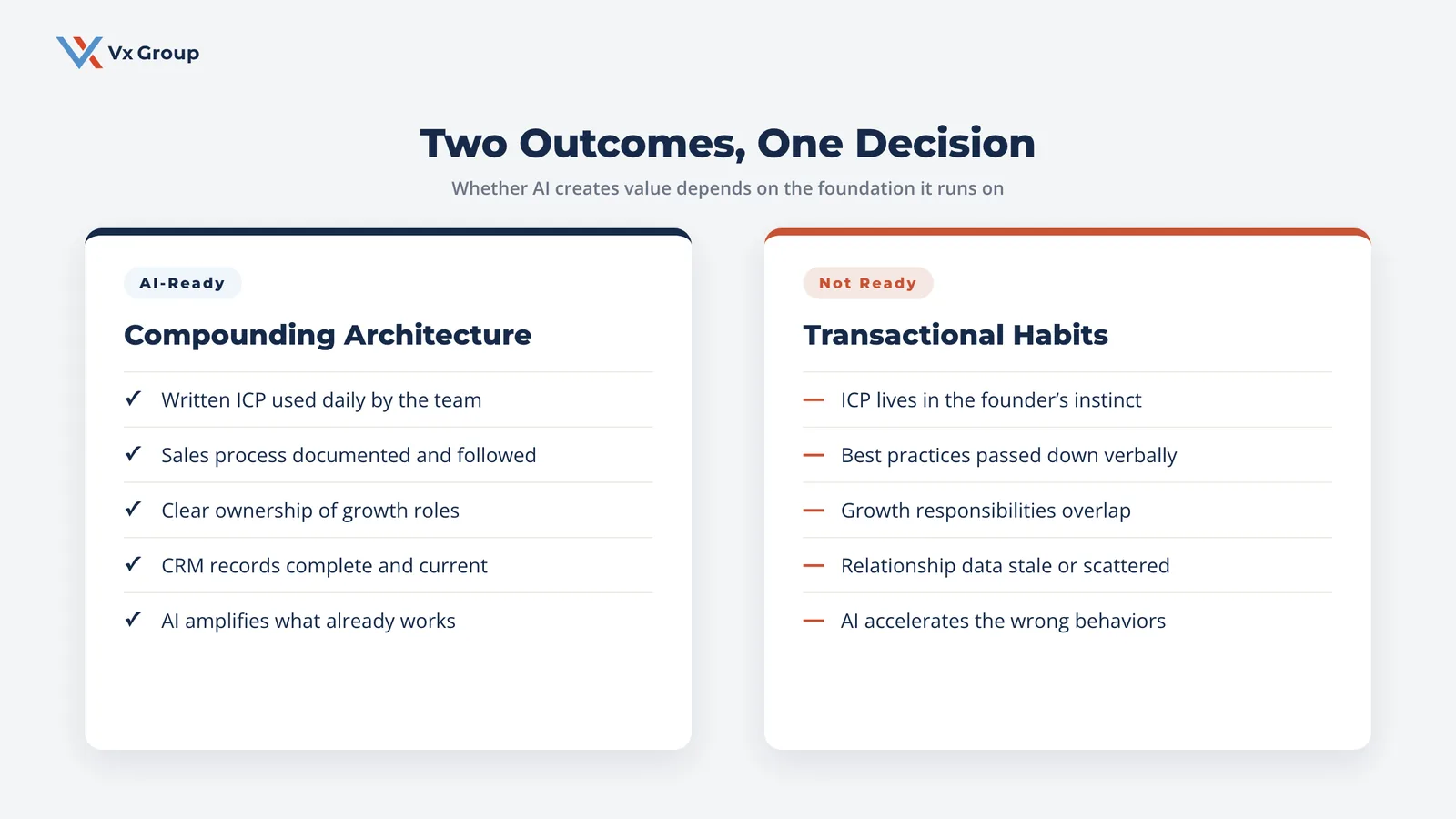
Defined term: AI readiness assessment
A structured diagnostic that scores whether a business has the documented foundation AI tools require, including a defined ideal customer profile, written processes, clear role ownership, and clean relationship data. It identifies where AI will create value and where it will waste money.
Step 1: Score how clearly you have defined your best customers
Start by measuring how specifically your company can describe who it serves best. AI tools that touch sales, marketing, or outreach need this definition to produce anything useful. Feed an AI a vague audience and it gives you vague work.
Pull up whatever you have that describes your ideal customer. Then test it against a hard question: could a new hire read it and correctly identify which of two prospects is the better fit, and explain why? If the answer lives only in a founder’s instinct, you are working from intuition rather than a documented definition, and intuition does not transfer to software.
Rate your customer clarity on three points
Score each from one to five.
- Do you have a written ideal customer profile that names industry, size, ownership type, and the specific situations that make a prospect a strong fit?
- Can you point to the shared traits of your ten best accounts?
- Do the people doing outreach actually use that profile to decide who to pursue?
A company scoring four or five here can hand an AI tool real targeting logic. A company scoring one or two will get plausible-sounding output that misses the customers who actually drive revenue.
Step 2: Audit how much of your process lives in documentation versus people’s heads
Next, measure how much of your sales and delivery process is written down. This is the single biggest predictor of whether AI will help you. AI learns your way of doing things from your documented way of doing things. When the process is undocumented, there is nothing for the tool to learn from.
Walk through your core revenue process from first contact to closed deal. At each stage, ask whether the steps, the language, and the decision points are written somewhere a tool or a new employee could read them. Most lower-middle-market companies discover that their best practices live entirely in the memory of two or three long-tenured people. That knowledge is valuable and completely invisible to any AI system.
Defined term: documented playbook
A written record of how your company actually wins, including the steps in your sales process, the language that works, the questions that qualify a prospect, and the standards for proposals and follow-up. It is the raw material AI uses to replicate your best work.
Count what would survive a key person leaving
Run a simple test. If your most experienced salesperson or operator left on Friday, how much of what they know would still exist on Monday? The percentage that survives is the percentage an AI tool can work with today. Everything else has to be captured before AI can do anything with it. This is also why the assessment pays off even if you never buy a single AI tool: documenting the process protects the business from the risk of losing the people who hold it together.
Step 3: Check whether roles and ownership are clearly defined
Assess whether the people in your business have clearly defined responsibilities and decision rights. AI tools change who does what. When roles are already blurry, dropping a tool into the mix makes the confusion worse, not better.
Look at your growth-related roles specifically. Who owns finding new prospects? Who owns deepening existing accounts? Who owns the data that tracks all of it? In many legacy companies these jobs overlap, trade hands informally, or all funnel back to the founder. A tool cannot fill a role that no human owns. If nobody is accountable for keeping prospect data current, an AI tool built on that data inherits the mess.
Define the role first, then decide where a tool supports the person in it. The order matters because AI amplifies whatever system it lands in, so a clear system gets sharper while a chaotic one simply moves faster.
Step 4: Assess the state of your relationship data
Examine how complete, current, and consistent your customer and prospect data actually is. AI tools that promise insight from your data can only return the quality you give them. Stale and scattered data produces stale and scattered output.
Open your CRM, or whatever you use to track relationships, and look honestly. How many records are missing key fields? How many contacts have not been touched or updated in a year? Are deals tracked consistently, or does every salesperson log things their own way? Is critical relationship history sitting in individual email inboxes where no tool can reach it?
Defined term: relationship data
The complete record of your interactions with customers and prospects: contact details, history, deal stages, communication notes, and account context. Clean relationship data lets AI surface real opportunities. Incomplete data produces guesses dressed up as insight.
Grade three dimensions of data quality
Score completeness, currency, and consistency.
Completeness asks whether the important fields are filled in.
Currency asks whether the information reflects reality today.
Consistency asks whether everyone records data the same way.
A company strong on all three has a real asset for AI to work with. A company weak on all three should fix the data before spending on any tool that depends on it, because the tool will only make bad data more confidently wrong.
Step 5: Map where AI would actually create value for your business
Identify the specific places in your business where AI could remove real friction, then match those against the foundation you scored in the first four steps. General enthusiasm for AI leads to scattered spending. A short list of high-value, well-supported uses leads to results.
List the work that eats your team’s time and follows a repeatable pattern: drafting proposals, researching prospects, summarizing calls, keeping records updated, preparing for meetings. These are the places AI tends to help most. Then overlay your readiness scores.
A high-value use that depends on documented process and clean data, both of which you scored well, is a strong early candidate. A high-value use that depends on data you scored poorly is a trap. It will look promising in the demo and disappoint in practice.
This mapping turns AI from a vague ambition into a ranked list of decisions tied to what your business can actually support right now.
Step 6: Score your overall readiness and decide what comes first
Total your scores across the four foundation areas and use the result to sequence your next moves. A single pass-or-fail grade would miss the real value here, which is knowing what to fix and what to buy first.
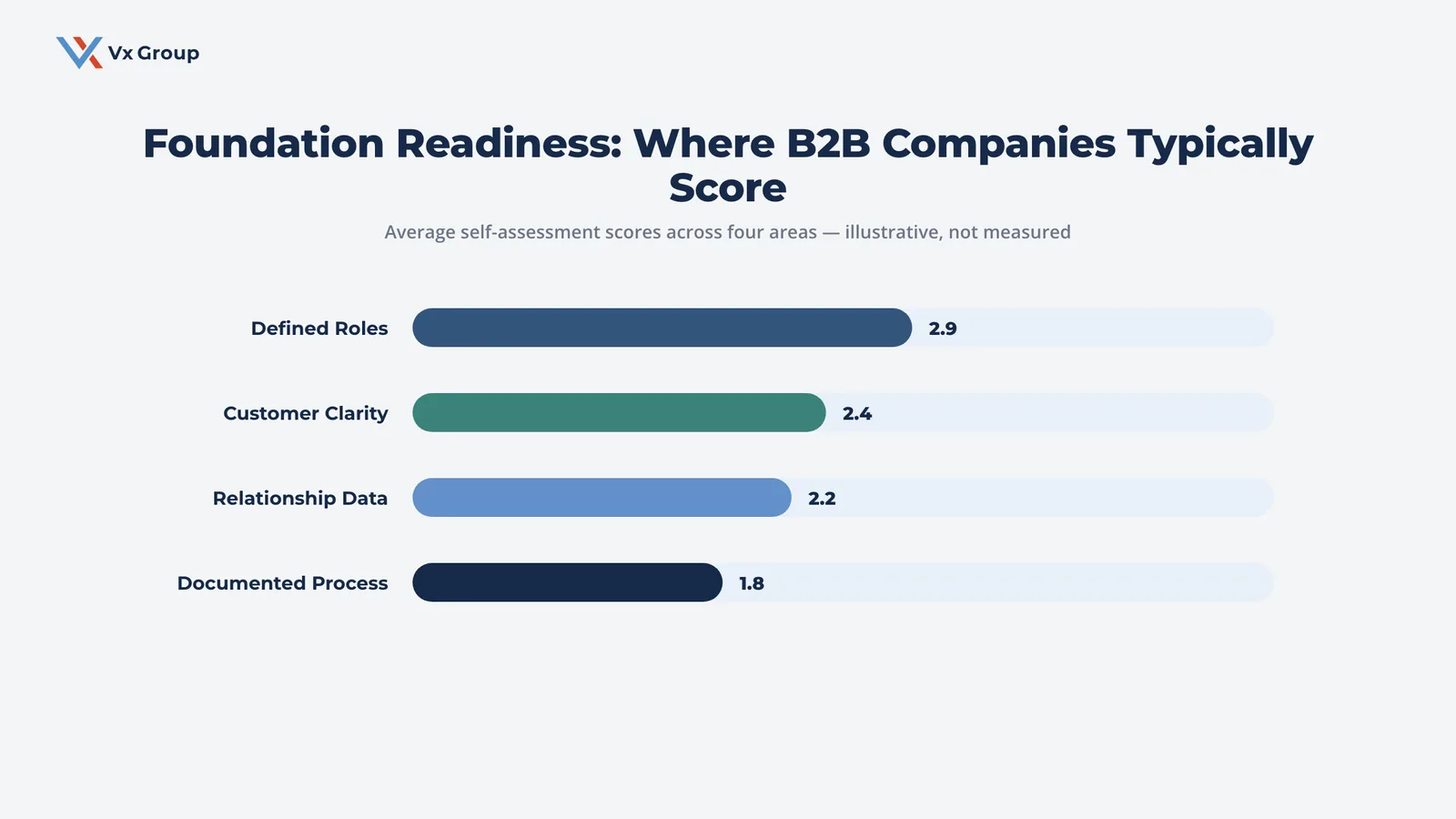
Companies that score high across customer clarity, documented process, defined roles, and clean data have what we call Compounding Architecture: a foundation where every documented relationship and process makes the next AI investment more valuable.
They are ready to buy and deploy with confidence. Companies that score low are running on transactional habits, where knowledge lives in individuals and growth depends on memory. For them, the right first investment is the foundation itself. AI spending without that foundation produces the lowest return of any growth dollar they could spend. The same foundation also makes B2B demand generation more precise: a documented ideal customer and a clean relationship dataset give every growth activity, AI-assisted or not, something real to work from.
Defined term: Compounding Architecture
A documented business foundation where clear customer definitions, written processes, defined roles, and clean relationship data reinforce each other. Each new tool or hire plugs into a system that already knows how the company wins, so investments build on each other instead of starting from zero.
Turn the score into a sequence
Use your lowest foundation score to set your first priority. If customer clarity is weakest, define the ideal customer profile before anything else. If documentation is weakest, capture the process that lives in Your Top people.
If data is weakest, clean it before you connect a tool to it. The companies that get the most from AI are usually the ones that built the foundation first, bought second, and watched the same dollar go further because of it.
Where to start
The companies that get real returns from AI are the ones that built the foundation before they bought the software. The assessment above tells you where your foundation is strong, where it is thin, and what to fix first so that your next AI dollar goes further than your last one did.
If you want to see how relationship-driven B2B companies are building that foundation and putting AI to work on top of it, join one of our live sessions.
—
FAQs
About the Author: Beth Barbaglia
