
Trade Show Booth Ideas That Get You More Meetings
The best trade show booth ideas for a B2B manufacturer start with the meetings you want to have. Plan those first, then build the booth around them. Seat your top accounts at a real table. Put a product they can pick up within reach. Write down a next step after every conversation. Booth size and graphics come after that.
TL;DR
- Make a list of the people you want to see at the show. Design the booth for those conversations.
- This guide has ten ideas. Each one has a single goal: see current accounts, meet new decision makers, show your work, or keep in touch after the show.
- A 10 x 10 booth can do two jobs well. A 10 x 20 can do four.
- A simple one-page note after each conversation gives you better follow-up than a badge scan.
- Count meetings held, next steps finished, and pipeline 90 to 180 days out. Badge counts only tell you how busy the booth was.
Most booth idea lists online come from exhibit builders. They read like photo galleries. You see glowing walls, giant screens, and clever giveaways. They’re fun to scroll through. They say very little about who walked in or what happened next.
If you exhibit at a handful of industry shows each year, you have a different problem. You pay for the space, the travel, the shipping, and a week of your best people’s time. You want that money to buy conversations with accounts that matter. Most companies end up in what we call the badge scan trap.
Defined Term: Badge scan trap.
Judging a trade show by the number of badges scanned. A high count means the booth was busy. It says nothing about whether you spent time with the customers and prospects you came to see.
This guide gives you ten booth ideas. Each one has a job, and each job leads to a real conversation. We also cover which ideas fit a 10 x 10, a 10 x 20, or an island booth. Then we show you how to tell whether any of it worked.
If you want the bigger picture on planning shows around relationships, read what trade show marketing is first, then come back.
What makes a good trade show booth idea for a B2B company?
A good trade show booth idea makes a specific conversation easier to have. It helps you see someone you planned to see. Or it helps you meet someone you want to know, show your work, or keep in touch after the show.
That test rules out most of the flashy ideas. A big LED wall may stop people in the aisle. It does nothing for the purchasing manager from your second-largest account who has fifteen minutes between sessions.
Ask these four questions about every idea before you spend money on it:
- Which person does this help me talk to?
- What will we say or show once they stop?
- Where does the conversation happen, and is it quiet enough to have it?
- How do we record what was said and what happens next?
If an idea has no answer to the first question, skip it. All ten ideas below have one.
How should you lay out a trade show booth for meetings?
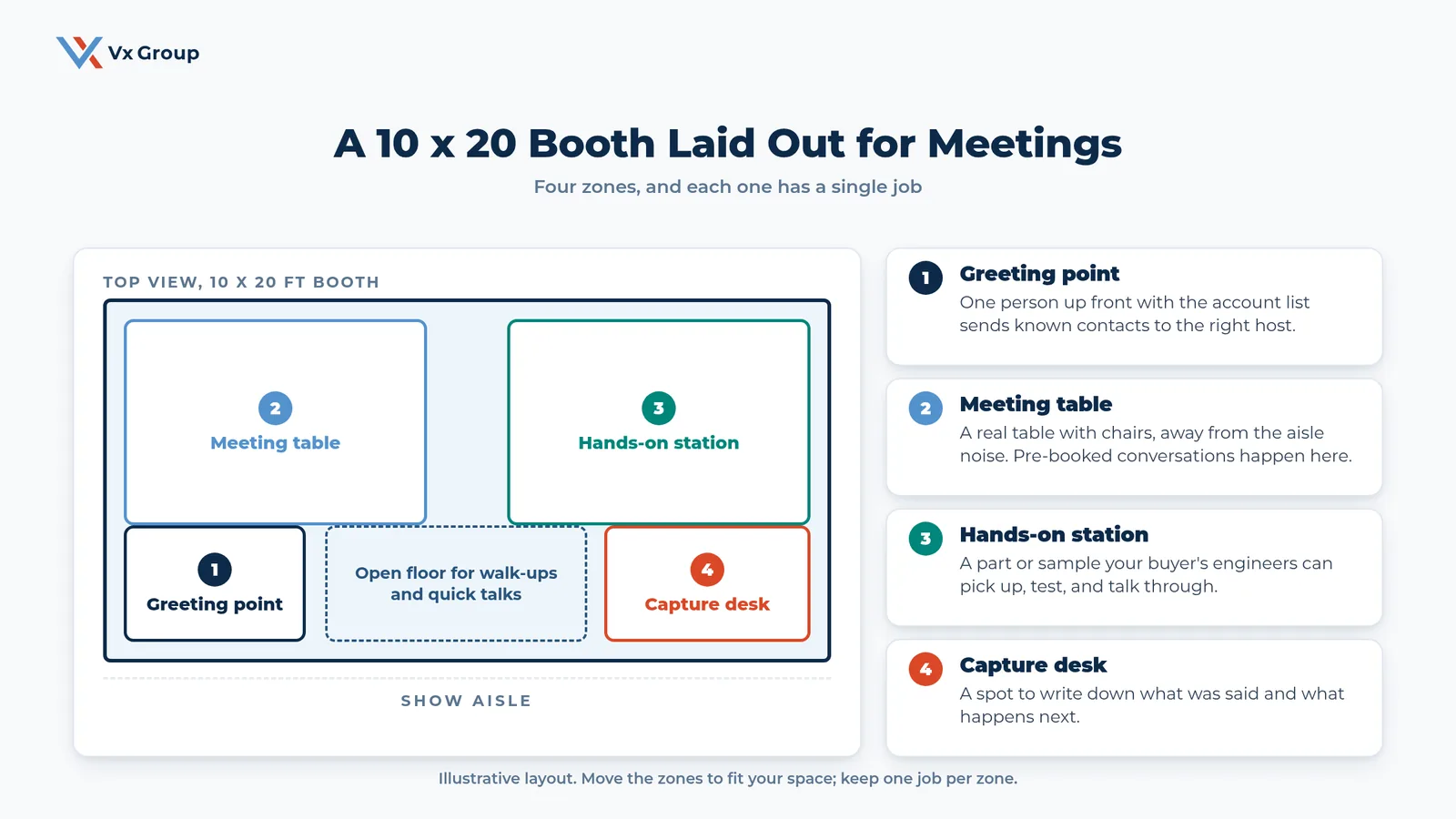
A booth laid out for meetings has four zones. Each zone has one job: a greeting point, a meeting table, a hands-on station, and a capture desk. The diagram above shows them in a 10 x 20 space. You can fit the same four jobs into a 10 x 10, as idea 6 explains.
Put the meeting table at the back, away from the aisle. A talk about lead times or spec changes needs some quiet. Put the greeting point at the front, where you meet the people you didn’t expect. The hands-on station gives engineers something to pick up. The capture desk goes near the booth exit, so your team writes notes before people move on.
The rest of this guide covers the ten ideas that fill those zones, and the planning around them.
1. Book meetings before you book the booth
The first booth idea happens weeks before the show. Make a list of the accounts and prospects you want to see. Then invite them to specific times. A booth with a full meeting schedule has a purpose before the doors open.
Build the list from three groups: your largest current accounts, customers who could buy more from you, and companies you want to win. If you’ve already named your top accounts, your top ten customers are a good place to begin.
Send the invitation from the person who knows them best. Keep it short and offer two or three time slots:
Hi Dana, we’ll be at booth 412 at the show on the 18th and 19th. I’d like 30 minutes with you at our table to hear how the new line is going. Would Tuesday at 10:00 or Wednesday at 2:00 work?
Send it three to four weeks out. Follow up once the week before. Put every confirmed meeting on one shared calendar so the whole booth team can see it.
2. Build a real meeting area
A real meeting area has a table, chairs, and enough quiet to hear each other. For a company that sells through relationships, it’s the most useful booth upgrade you can make.
Many booths fill the space with counters and screens. Then every conversation happens standing up in the aisle. A seated conversation lasts longer and goes deeper. People talk about budgets, schedules, and problems at a table that they would never bring up at a counter.
A working meeting area needs these things:
- A table for four people, with chairs that are comfortable for 30 minutes.
- A spot at the back or side of the booth, away from the busiest aisle traffic.
- Water and coffee within reach, so the host doesn’t leave mid-conversation.
- A small sign or tablet that shows today’s scheduled meetings, so staff know who is coming.
- A rule that lets you invite walk-ups to sit down once the table is free.
If you only have room for one idea from this list, build this one.
3. Staff a greeting point that routes known contacts
A greeting point is a spot at the front of the booth where one person welcomes everyone. That person sends each visitor to the right host. Your most important visitors never end up waiting at the edge of the booth while staff talk to someone else.
The greeter needs the meeting schedule and a short list of the accounts you care about most. When someone walks up, the greeter asks for a name and checks the list. Then the greeter calls over the right person. A known customer should never have to explain who they are to a stranger.
Give the greeter three simple steps:
- Ask for a name and company before anything else.
- Check the schedule and the account list.
- Send the visitor to the host who knows them, or to the open floor for a quick talk.
Pick someone friendly and organized for this role. The greeter doesn’t have to be your most senior person. They do need to know the accounts and the team.
4. Set up a hands-on station engineers can test
A hands-on station is a table or stand with a real part or sample that visitors can pick up and try. Engineers and buyers trust what they can handle more than what they see on a screen.
Pick something that tells its story in under two minutes. A cut-away of a component shows how it’s built. A sample next to a competitor-style part shows tolerance or finish. A fixture that people can work by hand lets them feel the difference.
Staff the station with someone who can answer technical questions. A salesperson who can’t explain the part wastes the visit.
Add one small card that says what the item is and what problem it solves. Keep the wording plain. If a visitor wants more, the host brings them to the meeting table.
5. Display one real customer project
Show one customer project, with the customer’s permission. It does more than a wall of product shots. It tells visitors that someone like them trusted you with something that mattered.
Choose a project that matches the people you want to meet. If you want more aerospace buyers, show an aerospace part. Include a photo of the finished work, a short note on the problem, and what changed for the customer.
Ask the customer before you use their name or image. Many will say yes, and some will help you tell the story. If they say no, describe the project without naming them.
Keep the display small and let your team tell the longer story. A project on a stand-up sign gives your hosts something specific to point to when the talk turns to what you’ve done before.
Ready to grow?
Plan your next trade show around the accounts you most want to see.
6. Give a 10 x 10 booth two jobs
A 10 x 10 booth can’t do everything. Pick two jobs and drop the rest. For most manufacturers, the two best jobs are a small meeting spot and a hands-on station.
A booth this size has about 100 square feet of floor. A table with two or three chairs takes a large share of it. A pedestal for a part takes more. What’s left is walking room.
Here is a simple way to choose your two jobs:
- If your goal is to see current accounts, pick the meeting spot and the capture note.
- If your goal is to meet new decision makers, pick the greeting role and the hands-on station.
- Assign one person to each job before you leave the office.
Skip the extras. Six features in 100 square feet crowd the space and get in the way of the conversations you came for. Two clear jobs leave room for people to step in and talk.
7. Write the booth sign for your buyer's problem
The sign at the back of your booth should name a problem your buyer has. Use the words they would use. Most booth signs show a company name and a tagline. That tells a passing visitor nothing about why to stop.
Write a headline from a real customer problem. “Custom castings that ship when you need them” speaks to a buyer who has been burned by late shipments. “Tight-tolerance machining for medical devices” tells the right engineer they’re in the right place.
Test the sign with one question. Could a stranger read it from ten feet away and know whether you can help them? If the answer is no, rewrite it.
Keep the sign to one headline and one short line below it. Make your logo small. Put your booth number where people can find it. Visitors can read your full story on your website after the show.
8. Host a short session for your top accounts
A short hosted session gives your best customers a reason to spend time with you away from the noise of the floor. Coffee before the doors open works. So does dinner after they close.
Pick a time when your accounts are already in town. Invite six to ten people. Include someone from your leadership team and someone from engineering. Plan one useful topic, such as a product change or lead times. Leave most of the hour open for conversation.
Send the invitation in the same message as your booth meeting request, so your top accounts see both options. Many will take the meeting and skip the session. Others will do both.
Afterward, write down what each person said while it’s fresh. These sessions can give you some of the most honest feedback you’ll hear all year.
9. Add a capture desk and a one-page note
A capture desk is a spot in the booth where your team writes down what was said and what happens next. They do it right after each conversation. That turns a pleasant chat into something your team can act on.
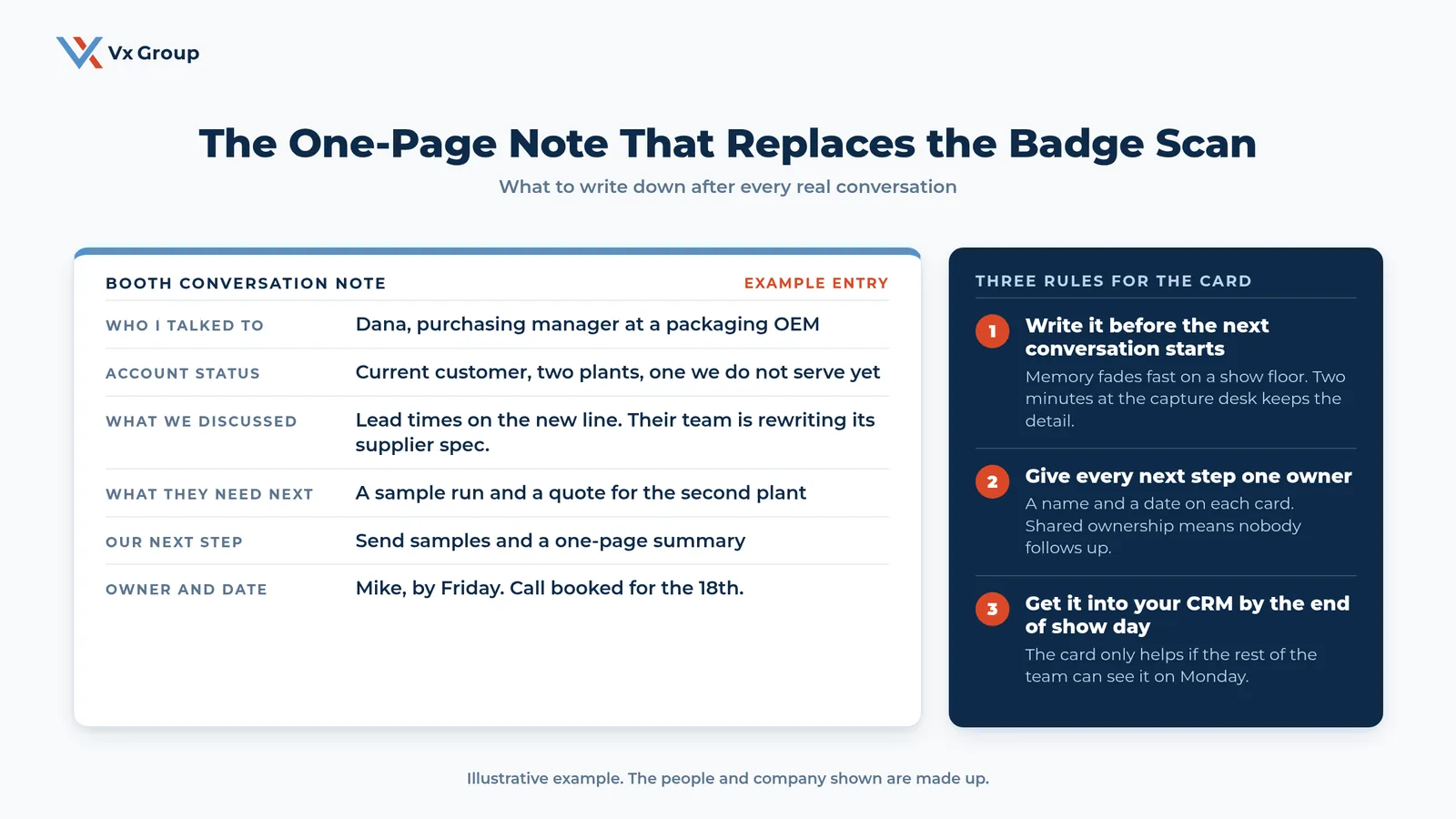
The note in the graphic has six fields: who you talked to, the account status, what you discussed, what they need next, your next step, and an owner with a date. It takes about two minutes to fill out. Three rules keep the habit going. Write the note before the next conversation starts. Give every next step one owner. Get it into your CRM by the end of show day.
A badge scan records a name and an email address. Your follow-up depends on what was said, so the note records that. If your team struggles to keep records current, our piece on CRM adoption shows how to make the habit stick.
A paper card, a shared form on a tablet, or a note in your CRM app all work. Pick one before the show and use the same one across the whole team.
10. Book the next call before the conversation ends
The best follow-up starts at the booth. Before a visitor leaves the meeting table, put a call, a plant visit, or a sample review on both calendars.
Keep a tablet or laptop at the table with your team’s calendar open. When a conversation ends with “let’s talk next week,” the host asks for a time and sends the invite on the spot. A booked call has a much better chance of happening than a promise to “reach out.”
Then follow up in writing within two days. Send a short summary of what you discussed and the next step you agreed on. Our guide to a sales follow-up email shows what to put in it.
Review the notes from the capture desk each evening of the show. By the last day, every next step should have an owner and a date.
How do you choose which booth ideas to use at your next show?
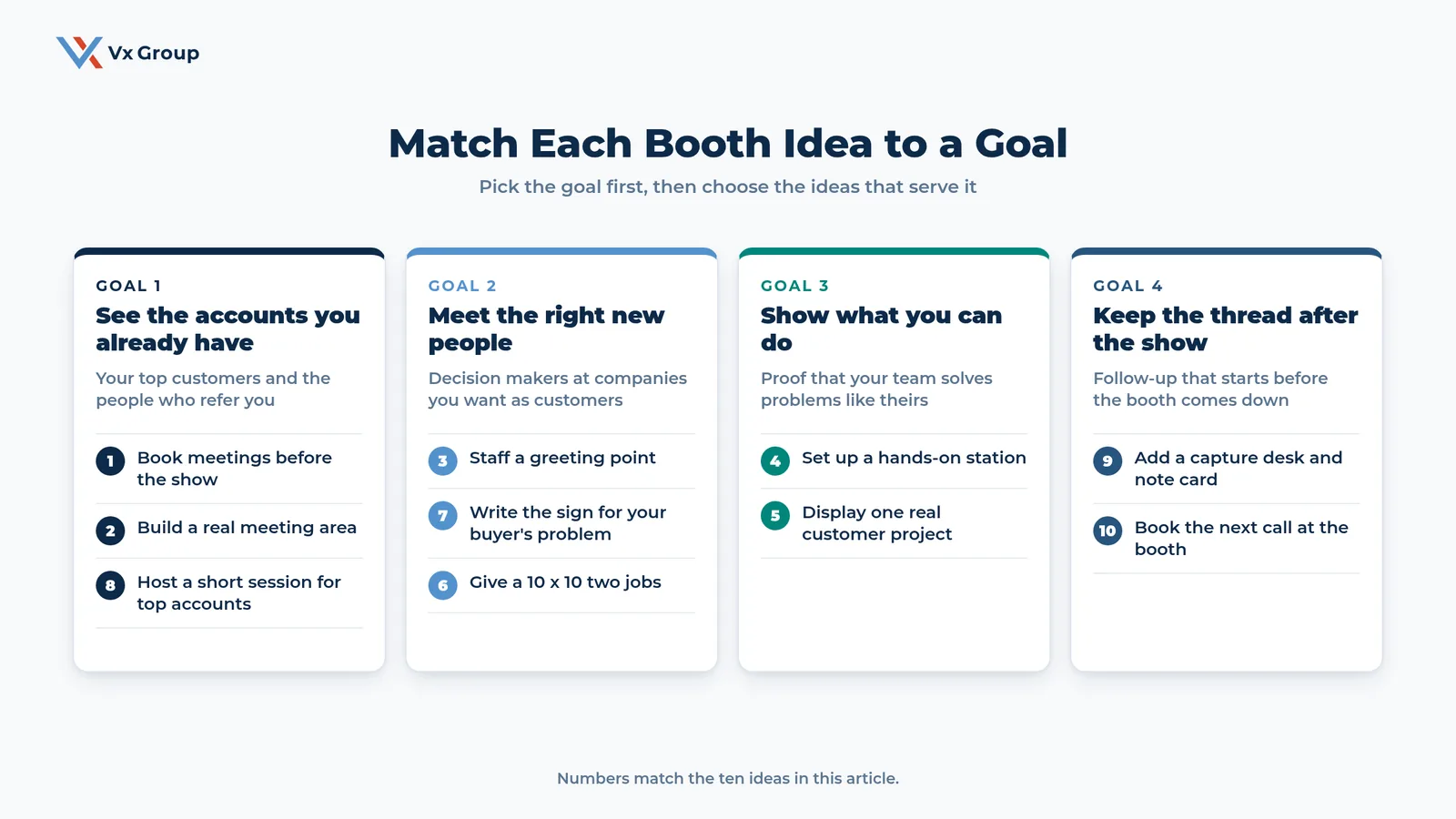
Pick a goal first, then choose the ideas that serve it. The graphic above groups the ten ideas under four goals. Ideas 1, 2, and 8 help you see current accounts. Ideas 3, 6, and 7 help you meet new decision makers. Ideas 4 and 5 show what you can do. Ideas 9 and 10 keep you in touch after the show.
Most shows can support one main goal and one second goal. If your biggest customers will be at the show, lead with goal one. If you’re entering a new market, lead with goal two.
Write your goal on one line before you plan the booth. Then pick the ideas that serve it and drop the rest. A booth that tries all four goals at once usually does none of them well.
Share the goal with everyone on the booth team. People who know what the booth is for make better calls when the day gets busy.
Which booth ideas fit a 10 x 10, a 10 x 20, or an island booth?
Booth size sets how many jobs your space can hold. A 10 x 10 holds two jobs and a 10 x 20 holds four. An island booth has room for all of them plus a private meeting space.
The table below gives a good starting point for each size.
| Booth size | Jobs to keep | Ideas to start with |
|---|---|---|
| 10 x 10 | Two | Meeting spot (2), hands-on station (4), capture note (9) |
| 10 x 20 | Four | Meeting table (2), greeting point (3), hands-on station (4), capture desk (9) |
| Island | Four plus a private room | All of the above, plus a hosted session (8) and a customer project display (5) |
Pre-show meetings (1), a buyer-focused sign (7), and booking the next call (10) cost very little and fit any size. Do all three at every show.
If an exhibit company rents or builds your booth, share the four jobs with the designer before they start. A designer who knows you need a quiet table and a capture spot will plan around them.
How do you know your booth ideas worked?
Your booth ideas worked if you can count meetings held, next steps completed, and pipeline created in the months after the show. Badge counts and foot traffic only tell you how busy the booth was.
Track these four numbers for every show:
- Meetings held, compared with meetings you booked before the show.
- New contacts at accounts you named as targets.
- Next steps finished within ten days of the show.
- Pipeline and revenue tied to show conversations after 90 to 180 days.
The last number takes patience. Relationship-driven sales cycles run long. A conversation in November may turn into a quote in the spring.
To go further on the numbers, read our guides on trade show metrics, how to measure trade show effectiveness, and trade show ROI.
Plan the booth after you plan the meetings
Start your next show plan with a list of names. Decide who you want to see, what you want to say, and how you’ll follow up. Then pick the booth ideas that make those conversations easy to have.
Pick three ideas from this guide and put them on the plan for your next show. A meeting table, a hands-on part, and a note card for every conversation is a good start. Add the rest as your team gets comfortable.
Our other guides on trade show ROI and trade show metrics show how to prove the results to your leadership team.
Ready to grow?
Build your next trade show plan around the accounts you want to see.
FAQs
About the Author: Jacob Camhi
