

What Is Keyword Stuffing (and Why It Now Hurts You in AI Search)

Keyword stuffing is the practice of repeating a target phrase on a page far more often than a person would write it, in the hope of ranking for that phrase. In AI search it backfires. A 2024 KDD study found stuffed pages became about 9% less visible in AI answers, and pages with figures, quotes and sources became more visible.
TL;DR
- Keyword stuffing means repeating a phrase, or a list of phrases, to signal relevance to a search engine.
- A 2024 KDD paper on generative engine optimization tested stuffing against other rewrites. Stuffing made pages about 9% less visible in AI answers.
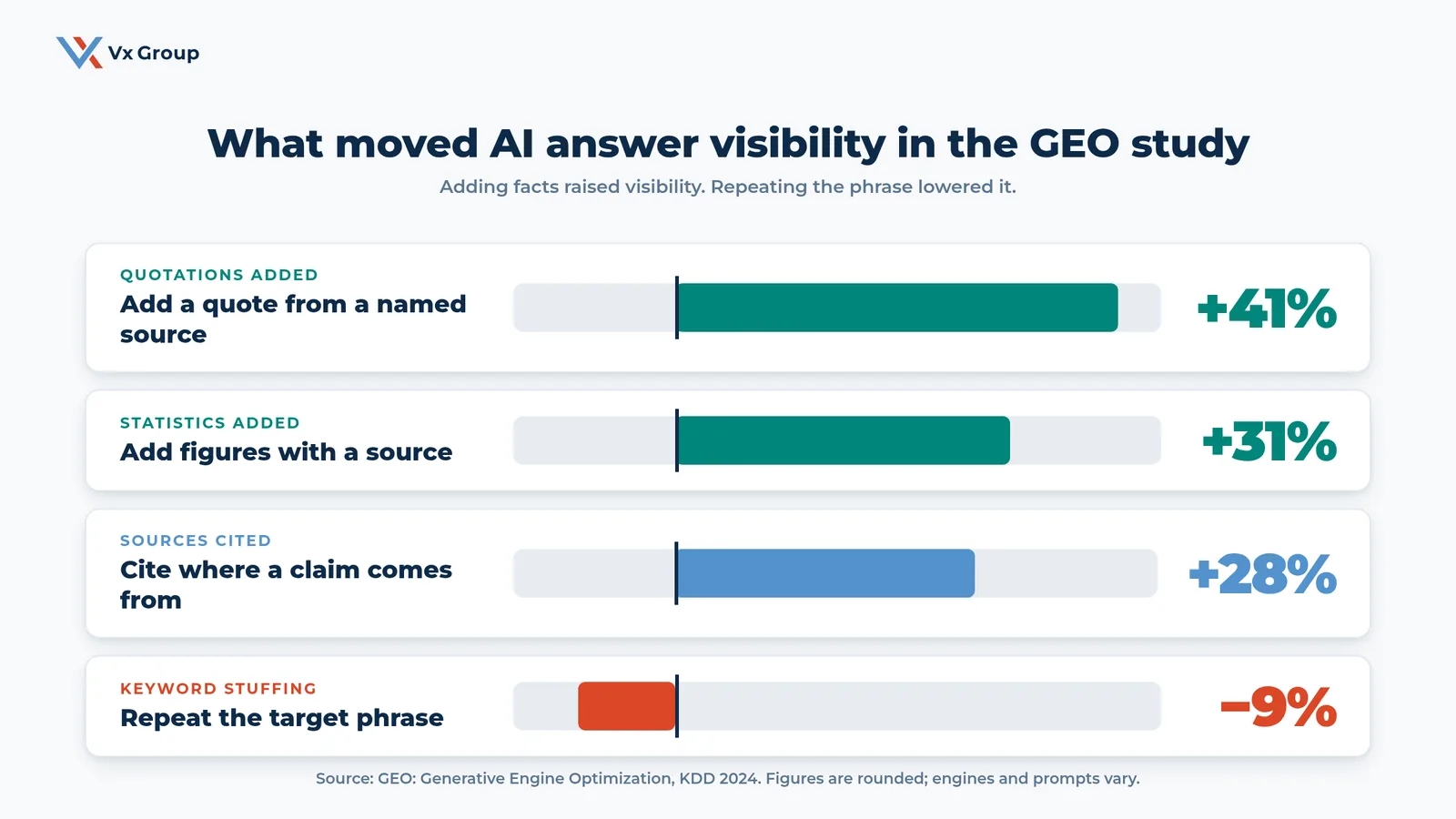
- The same study found that adding quotations (about +41%), statistics (about +31%) and cited sources (about +28%) raised visibility.
- AI tools pull passages that answer a buyer’s question. A page that repeats one phrase 40 times gives them nothing to pull.
- Audit your top 10 pages this week, cut the repeats, and replace each one with a spec, a number, a named source or a customer quote.
What is keyword stuffing?
Keyword stuffing is loading a page with the same word or phrase, or a long list of near-identical phrases, so that a search engine sees the page as relevant to that phrase. The repetition reads awkwardly to a person because nobody talks that way.
Defined Term: Keyword stuffing.
Repeating a target keyword, or lists of keyword variations, on a page, in a footer, in alt text or in hidden text, at a density no person would use when writing naturally. Google’s spam policies name it as a violation.
Here is what it looks like in practice on a manufacturer’s website:
- A homepage that says “precision CNC machining” in the headline, the first paragraph, three subheads and the closing line.
- A footer with 40 city names (“CNC machining Milwaukee, CNC machining Madison, CNC machining Green Bay…”).
- Image alt text that reads “CNC machining parts CNC machining shop CNC machining company.”
- A product page where the model name appears in every sentence and the specs appear nowhere.
- White text on a white background listing every phrase the owner hoped to rank for.
Most owners did not choose to do this. An agency, a plugin or a freelancer wrote the pages in 2012 or 2016, when the advice was to hit a keyword density target. Those pages are still live, and AI tools read them today.
Why did keyword stuffing work for so long?
Early search engines counted words. A page that used a phrase more often looked more relevant to that phrase, so repetition moved rankings. Agencies sold keyword density targets, and owners paid for them.
Google began fighting this practice more than a decade ago, and its spam policies now list keyword stuffing by name. Rankings in traditional search moved away from raw repetition long before AI search arrived. Plenty of old pages survived anyway because nobody went back to clean them up.
That history matters for an owner today. If your site was built or rewritten between roughly 2010 and 2019, there is a fair chance some stuffing is still on it. The pages may rank for a few phrases, so nobody touched them. AI search now reads the same pages with a different question in mind.
What did the 2024 GEO study find about keyword stuffing?
The 2024 KDD paper on generative engine optimization tested nine ways of rewriting web content and measured how much each one changed a page’s visibility inside AI-generated answers. Keyword stuffing, the oldest SEO habit in the test, made pages about 9% less visible than leaving them alone.
Three other changes raised visibility:
| Change to the page | Approximate effect on AI answer visibility |
|---|---|
| Add quotations from a named source | about +41% |
| Add statistics | about +31% |
| Cite sources for claims | about +28% |
| Repeat the target keyword (stuffing) | about −9% |
The researchers reported gains of up to about 40% for the best methods. The figures above are rounded, and the exact numbers shift with the engine, the topic and how visibility is scored. Treat them as direction only.
One more caveat. The study measured how much of an AI answer drew on a page and how prominently, which is a lab measure. Your own results will vary by market and engine, and the direction fits what we see when we run buyer prompts against client sites.
The paper is public. Search for “GEO: Generative Engine Optimization” and the KDD 2024 listing, and read the results table yourself before you pass the numbers along.
Why does AI search punish repeated phrases?
An AI tool answering a buyer’s question looks for passages that contain something it can use: a spec, a price basis, a lead time, a named result. A stuffed page repeats the question and supplies no answer, so the tool has nothing to take from it.
Three things happen when a buyer asks ChatGPT, Gemini or Perplexity for a supplier:
- The tool breaks the buyer’s prompt into several smaller searches. We cover that process in LLM SEO: how AI finds, reads and compares B2B suppliers.
- It pulls passages from the pages that come back and checks them against the details in the prompt: material, run size, tolerance, region, certification.
- It writes an answer from the passages that matched the most details, and it names the suppliers behind them.
Repetition adds no new detail at step 2. A page that says “custom steel fabrication” 30 times matches the phrase once and every other detail zero times. A competitor’s page with one sentence on plate thickness, weld certifications and a 3-week lead time matches the prompt on several details. That competitor gets named.
The tool also compares what a page says with what the rest of the web says about you. Stuffed copy tends to be vague, so there is little for outside sources to confirm. We walk through that cross-checking in how to rank in ChatGPT when you sell to other businesses.
Field Notes:
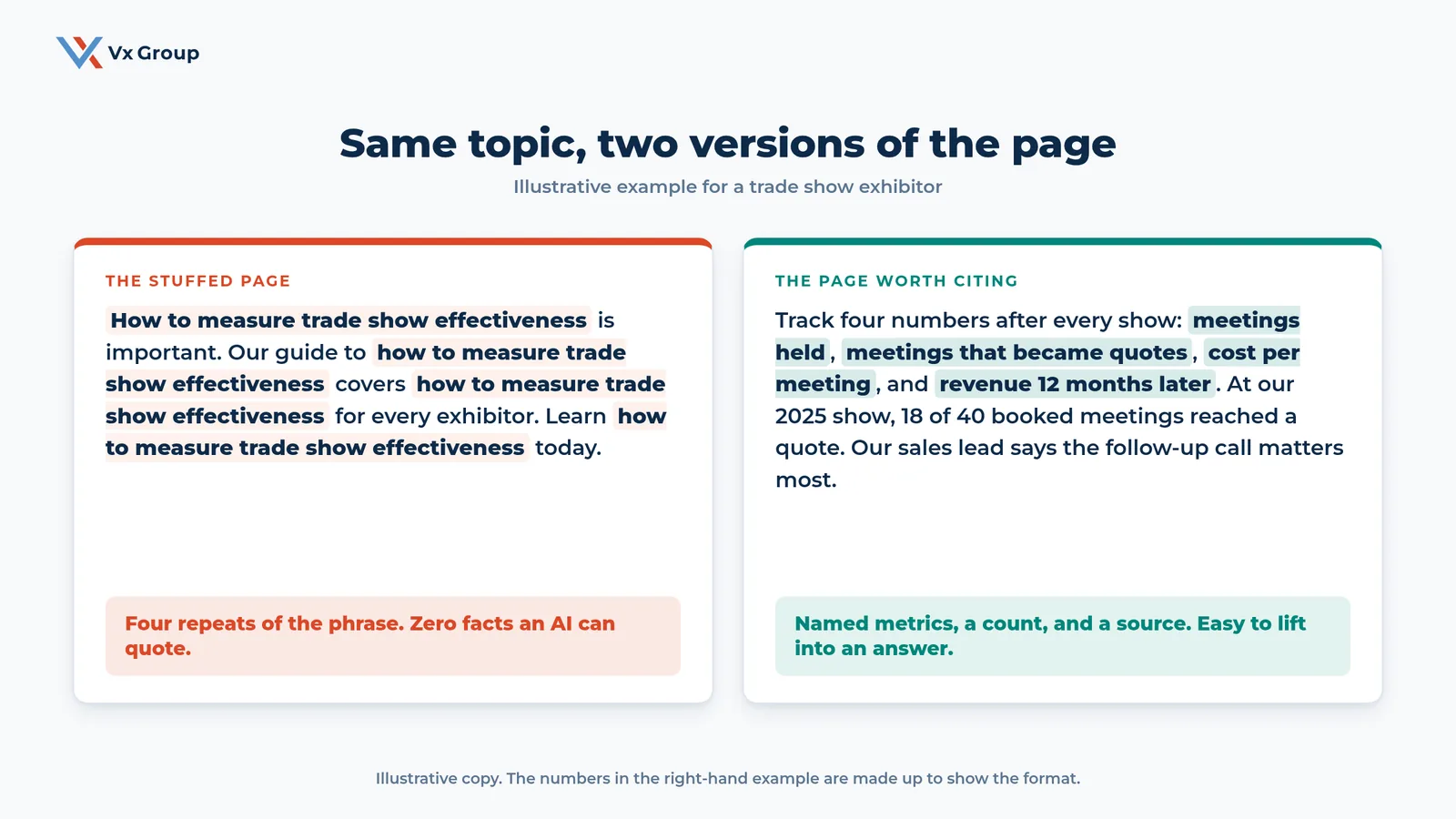
In our October 21 webinar, “How to Make AI Buy From You,” we used a trade show example. Take the phrase “how to measure trade show effectiveness” and repeat it 40 times on one page. A decade ago that might have nudged a ranking. Today an AI tool reading the page finds one idea, stated 40 times, with no metric, no example and no source. The page loses to a shorter page that names four metrics and gives a real number.
Does keyword density still matter for Google?
Treat keyword density as a spot check and set no target number. Google has said for years that there is no ideal percentage, and its spam policies treat unnatural repetition as a violation. The keyword still matters as a topic signal. Your page should say what it is about, in the words a buyer uses, once or twice in the headline, the opening and a subhead where it reads naturally.
For an owner, that gives a practical rule. If a sentence sounds odd when your sales manager reads it aloud to a customer, the keyword is in there for a search engine. Rewrite it for the customer.
Traditional search and AI search now reward the same habit from different directions. Google’s systems look for pages that help a person. AI tools look for passages that answer a prompt. A page written for a real buyer question satisfies both, which is why we say the fundamentals did not change. We explain that in SEO vs AEO: what changed and what still works.
What does keyword stuffing look like on a manufacturer's website?
Manufacturers run into the same five patterns. Check each one against your own site.
Look for the headline that repeats the service line
A homepage headline such as “Industrial Fabrication | Custom Fabrication | Metal Fabrication Company” tells a buyer nothing. One clear sentence works better: what you make, for whom, and the range you hold. For example, “Welded steel assemblies for agricultural and construction OEMs, 50 to 5,000 units a run.”
Look for the city list in the footer
Footers that list 30 towns were a common 2010s tactic. AI tools read the footer as one more block of repeated words. If you serve a region, say so once in plain language and name the two or three places where you have real customers and shipping lanes.
Look for alt text and file names that repeat the phrase
Alt text should describe the image. “Operator checking a 6061 aluminum housing on the CMM” gives a tool something to read.
Look for product pages that repeat the model name and skip the specs
A page that says “the X200 is the best X200 for X200 applications” has plenty of keywords and no specifications. Buyers and their AI tools want dimensions, materials, ratings and lead times in text on the page. If those specs sit in a PDF, read PDF SEO: why AI skips the specs in your product catalog.
Look for generic capability copy
“Quality solutions for every industry” is a cousin of stuffing. It repeats the category words and says nothing specific enough to match a prompt. We cover how AI reads copy like this in SEO for manufacturing companies: what AI needs from your website.
Ready to grow?
We can run your buyers’ prompts through the major AI tools and show you which pages are being skipped and why.
How do you find keyword stuffing on your own site?
You can audit your ten most important pages in an afternoon without any software. Start with the pages that carry the most revenue: the homepage, your top product or service pages, and the pages your best customers visit before they call.
Count the target phrase on each page
Open the page, press Ctrl+F (Cmd+F on a Mac) and search for the main phrase. Write down the count next to the word count. A 600-word page with the phrase 12 times is stuffed. A page that uses it two or three times and varies the wording around it reads like a person wrote it.
Read each page aloud to someone who sells for you
Ask a sales manager or a long-time rep to read it out. They will stumble on the sentences written for a search engine. Mark each stumble. Those are your rewrites.
Check the footer, the alt text and the page source
Look at the bottom of every page. Open a few images and read the alt text. Ask whoever manages your site whether any text is hidden, set in a tiny font or colored to match the background. Hidden text is the most serious version, and it can trigger a manual action from Google.
Ask an AI tool what it knows about you
Open ChatGPT, Gemini or Perplexity and type the question a buyer would ask, with the details included: material, quantity, region, certification. Note whether your company appears, which pages the tool cites, and what it says about you. A weak or empty answer on a topic you have a stuffed page for is the clearest evidence that the page is not working.
Log the results in one table
Use a simple sheet so you can compare pages and track the cleanup:
| Page | Target phrase | Count | Words | Facts on the page (specs, numbers, sources) | Action |
|---|---|---|---|---|---|
| Homepage | custom steel fabrication | 14 | 650 | 0 | Rewrite |
| Product page A | X200 housing | 9 | 400 | 2 | Add specs |
| About page | steel fabricator Milwaukee | 6 | 800 | 1 | Light edit |
The table above is an example of the format. Fill it in with your own pages and counts.
What should you put on the page in place of repeated phrases?
Replace each repeat with a fact a buyer, or a buyer’s AI, can use. The GEO study points at three kinds of fact. Each one is something a manufacturer already has.
Add one figure with its source
Every page should carry at least one number that belongs to your company: years in business, parts shipped last year, on-time delivery rate, scrap rate, typical lead time. Say where the number comes from (“our 2025 shipping records”). A figure with a source gives an AI tool something it can quote and attribute.
Add a named customer quote
A sentence from a purchasing manager or plant engineer, with their name, title and company, carries weight with buyers and with AI tools. Ask three long-term customers for one sentence each. Most will say yes. Get permission in writing and keep the wording as they gave it.
Cite the outside source behind your claim
If you say a coating meets a standard, name the standard. If you cite an industry figure, link to where it came from. Pages that show where their claims come from give an AI tool a way to check them, and the study measured a lift of about 28% for that habit.
Write specs in plain text, in a table
Put dimensions, materials, tolerances, certifications, minimum order quantities and lead times in a table on the page. Tables are easy for AI tools to read and for buyers to compare. Each row is a detail a prompt can match.
Answer the buyer's question in the first two sentences
Start each section with the direct answer, then support it. This is the layout AI tools lift from, and it helps a human reader who skims. Our guide on how to rank in ChatGPT walks through a seven-step version of this.
How do you rewrite a stuffed page in an afternoon?
You can rewrite one page in 60 to 90 minutes if you gather the facts first. Work through these steps in order.
- Pick the buyer question. Write the one question this page should answer, in a buyer’s words. “Who can machine stainless housings in runs of 500 with PPAP documentation?” is better than “stainless machining.”
- Delete every repeat past the third. Keep the phrase in the headline, the opening paragraph and one subhead, where it reads naturally.
- Add the facts. Insert the specs table, one company figure with its source, one customer quote and one outside citation.
- Rewrite the opening. Lead with the direct answer in two sentences.
- Clean the extras. Fix the alt text, trim the footer and delete any hidden text.
- Retest. Ask the same question in two or three AI tools after Google has re-crawled the page, which can take a few weeks, and record what changes.
Here is a before-and-after example for a fictional stainless fabricator. The numbers are made up to show the format.
| Element | Before | After | |
|---|---|---|---|
| Headline | “Stainless Steel Fabrication | Stainless Fabrication Company” | “Stainless housings and enclosures, 100 to 2,000 units a run, with PPAP documentation” |
| Opening | “We are a leading stainless steel fabrication company offering stainless steel fabrication services.” | “We fabricate stainless housings for food equipment OEMs. Typical lead time is 4 weeks from approved drawing.” | |
| Proof | None | Named customer quote, on-time delivery rate with its source, ISO certificate number | |
| Specs | None | Table of gauges, finishes, tolerances and minimum order | |
| Footer | 25 city names | One line naming the region and shipping lanes |
What mistakes do owners make when they clean up stuffed pages?
Four mistakes show up again and again.
- Deleting the phrase everywhere. The topic still has to be clear. Keep the phrase in the places a person would use it.
- Swapping one stuffed phrase for another. Replacing “CNC machining” with “precision machining services” ten times repeats the problem.
- Inventing numbers. Every figure must come from your own records or a source you can name. A made-up statistic will damage trust with buyers and with AI tools that cross-check.
- Rewriting 200 pages at once. Start with the ten pages that carry revenue, measure the result, and move on from there.
Owners also ask whether to delete the old pages. Leave a page in place if it carries links or traffic, rewrite it, and keep the same URL. Remove a page only when it has no purpose, and set up a redirect when you do.
Where should an owner start this week?
Start with an audit of your top ten pages and fix the worst three first. The whole job takes one person about a week alongside normal work.
- Monday: List your ten highest-value pages and count the target phrase on each.
- Tuesday: Run five real buyer prompts in ChatGPT, Gemini and Perplexity. Save the answers.
- Wednesday: Collect your facts: three figures, three customer quotes, the standards you meet.
- Thursday: Rewrite the three worst pages using the steps above.
- Friday: Publish, and set a reminder to rerun the same prompts in three weeks.
If your website is a decade old, this review often turns up more than stuffing. Slow pages, specs buried in PDFs and thin product pages tend to travel together. B2B website redesign: what to fix first covers how to decide between a cleanup and a rebuild, and AI for manufacturing covers where else AI is showing up in your buyers’ day.
What this means for your company
Keyword stuffing was a common bet in 2012, and the evidence now says it costs visibility. Buyers ask AI tools for suppliers, and the tools name the companies whose pages hold specific, checkable facts.
Your company already has those facts. Your customers, your shipping records, your certifications and your engineers know things that a stuffed page never says. Put them on the page and your site has a real chance of being named in the answer.
Ready to grow?
Tell us which pages carry your revenue and we will show you what an AI tool says about them today.
Related posts
- LLM SEO: How AI Finds, Reads, and Compares B2B Suppliers
- How to Rank in ChatGPT When You Sell to Other Businesses
- SEO vs AEO: What Changed and What Still Works
FAQs
About the Author: David Tisdale
