

EOS Implementer: What They Do, What They Cost, and Whether You Need One

An EOS implementer is a certified, independent facilitator who runs the Traction system’s quarterly and annual sessions for a leadership team. The role is right for a generalist small business that needs baseline operating discipline installed fast. It covers less ground for a company whose growth actually runs on a small number of long-term relationships, which is a different problem than the implementer’s toolset is built to solve.
TL;DR
- An EOS implementer is a certified, independent facilitator who teaches and runs the Traction system’s Six Key Components inside a leadership team, then leaves the daily operating discipline to the team.
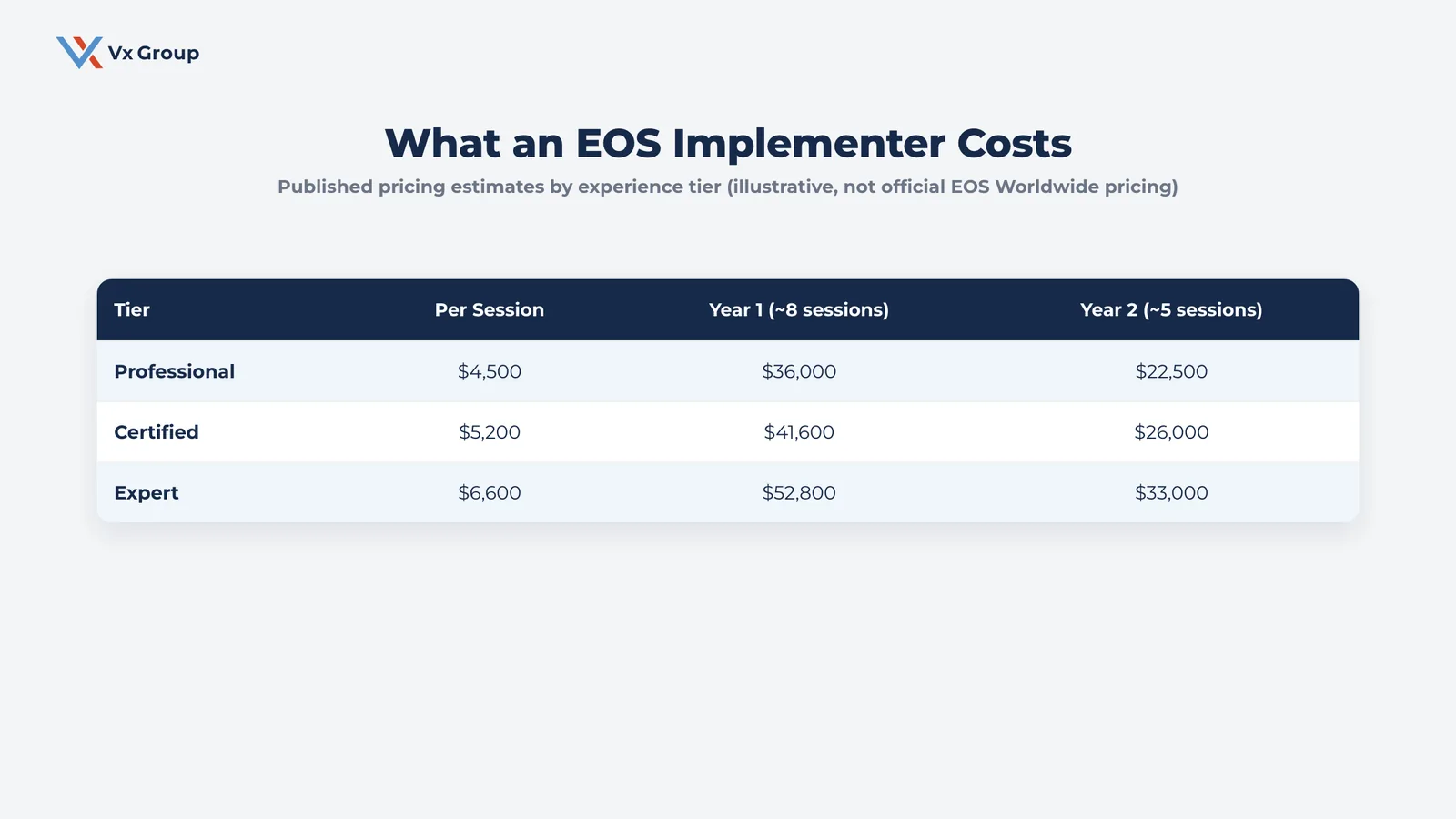
- Published pricing estimates put a full-day session at $4,500 to $6,600, with year one typically running $36,000 to $52,000 and a full two-year engagement landing between $58,000 and $86,000.
- An implementer installs meeting structure and accountability. It does not install a system for growing revenue out of your best existing relationships, which is a separate constraint for long-cycle B2B companies.
- The clearest signal you need one: your leadership team argues in circles, meetings run long, and nobody owns follow-through. The clearest signal you need something else: your growth ceiling is a handful of relationships nobody is actively managing.
- Many relationship-driven B2B companies eventually run two systems side by side: one for operating discipline, one for growth.
What is an EOS implementer?
An EOS implementer is a person certified by EOS Worldwide to install the Entrepreneurial Operating System, the operating framework from Gino Wickman’s book *Traction*, inside a company’s leadership team. The implementer is independent, runs their own practice, and is not an employee of the company they work with.
The certification process itself takes years. EOS Worldwide requires candidates to have run EOS as a client first, then complete a multi-year apprenticeship under a licensed implementer before earning the credential themselves. That path is part of why the role carries real credibility in the market: every implementer has personally sat through the sessions they now run for other companies.
The job is narrow and specific. An implementer teaches the Six Key Components of EOS, runs the recurring session cadence that keeps a leadership team using the tools, and holds the team accountable to the process. What the implementer does not do is sit inside the business day to day. They show up for sessions, then leave the team to run the system between visits.
Defined Term: EOS implementer.
A certified, independent facilitator who teaches and runs the Entrepreneurial Operating System’s structure (vision setting, quarterly and annual planning, the weekly Level 10 meeting format) inside a leadership team, without taking an operating role in the business.
This distinction matters more than it sounds. A company hiring an implementer is hiring a teacher and a referee. That is by design. EOS is built to be run by the leadership team itself once the implementer has installed the habits, and the fee reflects that the implementer’s job is to make themselves progressively less necessary.
Defined Term: Six Key Components.
The six areas EOS organizes a business around: Vision, People, Data, Issues, Process, and Traction. An implementer’s job is to strengthen all six until the leadership team can run them independently.
What does an EOS implementer do during an engagement?
An EOS implementer’s engagement follows a fixed sequence: an introductory meeting, a two-day Focus Day and Vision Building session, then a recurring cadence of quarterly and annual planning sessions that continues for as long as the company keeps the implementer on retainer.
Book the 90-minute introductory meeting first
Every engagement starts with a free 90-minute conversation where the implementer and the leadership team assess fit. This is where fees, timeline, and the team’s current operating gaps get discussed directly. Treat this meeting as a real evaluation. Bring pointed questions: how many other EOS companies does this implementer currently run, what does their typical client look like, and what happens if the fit turns out to be wrong six months in.
Sit through the two-day Focus Day and Vision Building session
The first working session is where the leadership team builds its Vision/Traction Organizer, the core EOS document that captures the company’s long-term vision and the concrete plan to get there. This is the most intensive part of the engagement and typically runs two full days.
Run the quarterly and annual sessions on schedule
After the initial setup, most engagements settle into four quarterly sessions plus one annual planning session each year, roughly eight full-day sessions in year one and five in year two as the cadence matures. Each session revisits the Vision/Traction Organizer, reviews the leadership team’s scorecard, and works through the Issues List using EOS’s IDS process (Identify, Discuss, Solve).
Expect the implementer to leave between sessions
The implementer does not run your Level 10 meetings, does not sit in on daily operations, and does not manage your team. Between sessions, the leadership team is on its own to run the weekly meeting format and keep the Issues List moving. A company that expects a hands-on operator between visits should look at a fractional integrator or a fractional COO. Both roles work inside the business on an ongoing basis and both cost significantly more than a quarterly implementer visit.
How do you find and vet an EOS implementer?
Vetting an implementer is closer to hiring a key contractor than picking a vendor off a list. The certification guarantees a baseline process. It does not guarantee fit with your industry, your leadership team’s personality, or the pace you need to move at. Two implementers with identical certifications can run very different practices: one might specialize in fast-growing tech-adjacent companies used to quarterly OKRs, another might spend most of their time with third-generation family manufacturers where the leadership team has never used a scorecard before. Neither is better in the abstract. The fit depends entirely on which one has actually worked with companies that look like yours.
Ask for client references in your industry and revenue range
An implementer who has run EOS inside a dozen manufacturing companies between $10 million and $50 million in revenue brings pattern recognition an implementer whose client base is mostly professional services firms will not have. Ask for two or three references specifically in your size and industry range, and call them.
Check certification status directly with EOS Worldwide
EOS Worldwide maintains a public directory of licensed implementers. Confirm any candidate’s certification directly rather than taking a website’s word for it, since the term “EOS” gets used loosely by consultants who have read the book but never completed the certification path.
Get the fee schedule and cancellation terms in writing before day one
Ask exactly what is included in the quoted fee (which sessions, whether travel is separate, whether the software subscription is bundled) and what happens if the engagement isn’t working after the first two quarters. A reputable implementer will answer both questions directly and put the terms in writing before the Focus Day is scheduled.
What does an EOS implementer cost?
Published estimates from firms that track EOS implementer pricing put a full-day session at $4,500 to $6,600, depending on the implementer’s experience tier, with most companies spending $58,000 to $86,000 across a typical two-year engagement.
EOS Worldwide’s own materials do not publish a fixed price list. Every implementer runs an independent practice and sets their own fees, and the official guidance is to ask directly during the 90-minute introductory meeting. That said, third-party pricing analyses that track a broad sample of implementer engagements converge on a consistent range, which is useful for budgeting even though your specific quote will vary.
Defined Term: Business growth operating system.
A structured framework that makes growth intentional and repeatable inside a B2B company, giving leadership a shared language, clear priorities, and a process for developing the relationships and markets that generate long-term revenue. EOS is one version of an operating system, focused on installing operating discipline, meeting structure, accountability, and a shared process for solving issues, inside a leadership team. Growth shows up inside it as a scorecard metric and a quarterly rock. Read the full breakdown of what a business growth operating system is →
Budget $4,500 to $6,600 per full-day session
Reported rates split roughly into three tiers: a Professional-tier implementer around $4,500 per session, a Certified-tier implementer around $5,200, and an Expert-tier implementer around $6,600. At the Certified tier, that works out to roughly $650 an hour across an eight-hour session day.
Plan for $36,000 to $52,000 in year one
Year one is the heaviest, with roughly eight full-day sessions covering the Focus Day, Vision Building, and the first full cycle of quarterly and annual planning. At the Professional tier, that lands around $36,000. At the Expert tier, it can run closer to $52,000.
Expect ongoing costs of $22,500 to $33,000 per year after that
Once the initial build-out is done, the cadence settles into roughly five sessions a year, which is where the $22,500 to $33,000 annual range comes from. EOS Worldwide’s own data points to an average client tenure of about two years, though some companies stay on longer and others wrap up sooner.
Add software and travel as separate line items
Most EOS engagements run alongside a per-seat software subscription for tracking the scorecard and Issues List, which adds a four-figure annual line for a typical ten-person leadership team. If the implementer travels to your office, add $1,000 to $3,000 per visit for flights and hotel. Ask for a written, itemized quote before the Focus Day is scheduled so the software line and travel line don’t show up as a surprise after the contract is signed.
Ready to grow?
Bring your numbers and we will help you map the real cost of each path against what your growth actually depends on.
Is an EOS implementer worth it for a relationship-driven B2B company?
An EOS implementer is worth the cost when the problem is operational: a leadership team that argues in circles, meetings that run long without decisions, and no shared process for solving issues. It covers less ground when the growth ceiling is relational: a business whose revenue concentrates in a handful of long-standing accounts that nobody is actively developing.
Traction was built to bring structure to a generalist small business, and it does that well. The Six Key Components apply to almost any company regardless of industry, sales cycle, or customer concentration. That is the framework’s strength and also the source of its blind spot for a certain kind of company: EOS treats “grow the business” as one line item inside the Traction component, covered by a scorecard metric and a rock on the quarterly plan. It does not have a built-in method for managing the specific relationships a long-cycle B2B company’s revenue actually depends on.
The pattern shows up most clearly in companies that grew for a decade or two on reputation and a handful of long-standing relationships, then hit a ceiling. Hiring an implementer to fix that ceiling installs a generic system on top of a problem the system was never designed to see. The meetings get better. The scorecard turns green. The concentration in the top accounts, and the risk that comes with it, stays exactly where it was before the engagement started.
Weigh whether your growth problem is operational or relational
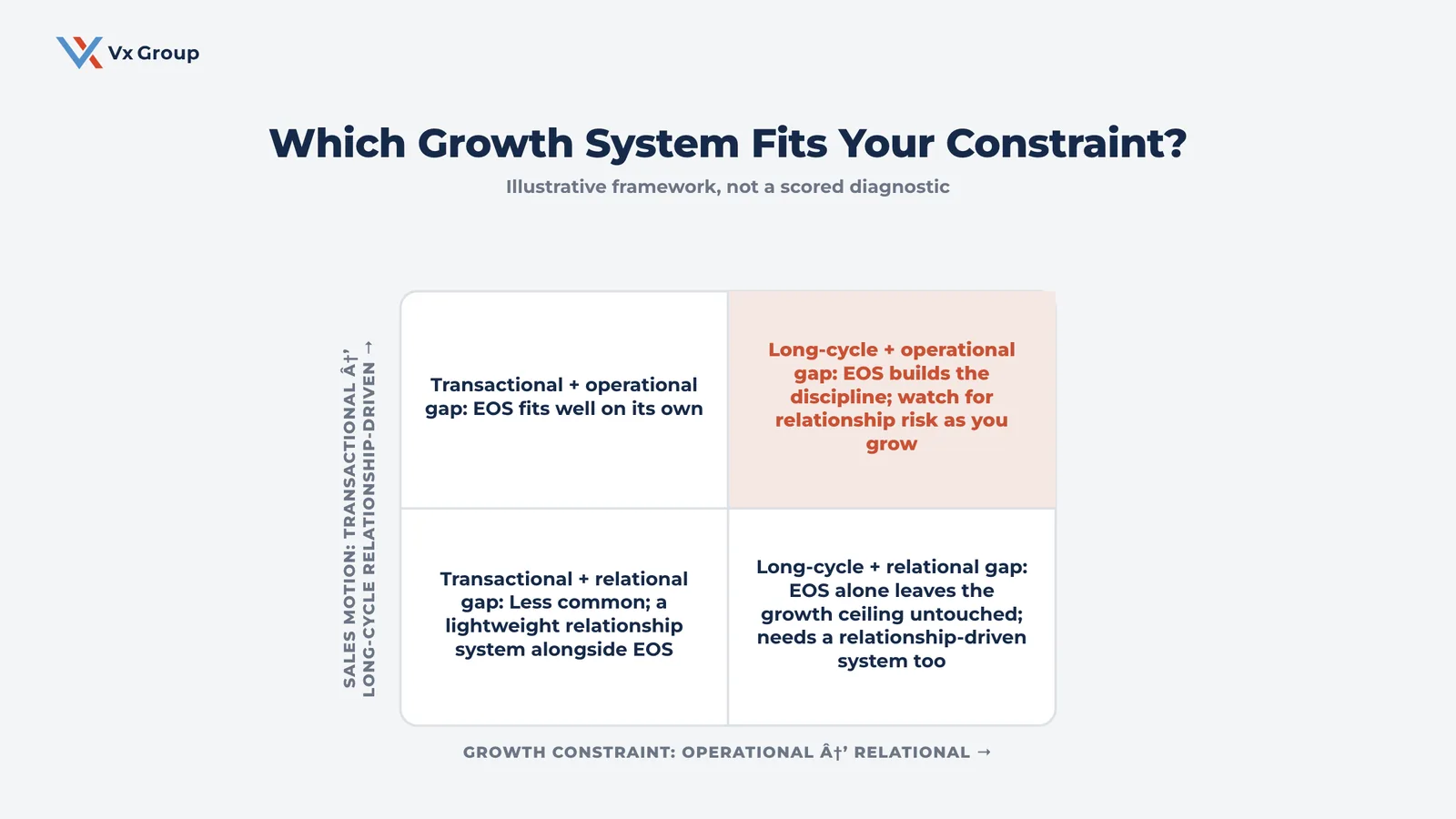
Ask which of these two statements is closer to true right now: “Our leadership team can’t agree on priorities and nothing gets finished,” or “Our leadership team agrees on priorities just fine, but our growth has been flat because our best customer relationships are underdeveloped and nobody owns them.” The first statement points toward EOS. The second points toward a growth-specific system.
Check whether your sales cycle runs longer than 90 days
A short sales cycle with a high volume of transactional deals benefits enormously from operating discipline: a scorecard, a weekly meeting, a clear Issues List. A long sales cycle built on trust and relationship depth, the kind common in manufacturing, industrial services, and other legacy B2B categories, needs that same discipline plus a system for managing which relationships to invest in and how.
Count how much revenue sits with your top 10 relationships
If a small number of long-standing accounts represent an outsized share of revenue, that concentration is itself a growth strategy question, and it is worth answering before signing a multi-year implementer contract built around a generalist framework. A company in that position often needs both: EOS-style discipline for how the business runs, and a relationship-specific system for how it grows.
What's the difference between an EOS implementer and an EOS coach?
“EOS implementer” and “EOS coach” describe the same certified role. EOS Worldwide’s official title for the position is Implementer. “EOS coach” is the informal term many business owners search for and use in conversation, and vendors sometimes use it interchangeably in marketing copy. There is no separate, lesser-certified “coach” tier sitting below the implementer credential, and no additional certification a person can earn to call themselves a coach instead.
Real variation between implementers comes down to tenure and specialization. Some have run EOS inside dozens of companies over a decade. Others are newly certified and building their first client base. Some specialize by industry (manufacturing, professional services, family-owned businesses) and bring pattern recognition specific to that world, while generalists bring a wider range of company types to draw comparisons from. When evaluating candidates, client count and industry mix are the two data points that actually predict fit. What a person calls themselves on their website is not one of them.
How do you decide between an EOS implementer and a relationship-driven growth system?
Start by naming the actual constraint on your growth before you hire anyone. A generic operating system installed on a business whose real problem is undeveloped relationships will produce better meetings and the same flat revenue, because the tool was never built to solve that problem.
Field Notes:
We regularly talk with companies eighteen months into an EOS engagement whose Level 10 meetings run cleanly and whose scorecards are green across the board, and whose revenue still tracks two or three of the same accounts it did three years ago. The operating discipline worked exactly as designed. It was never going to touch the relationship concentration underneath it, because that was never what it was built to fix.
Map your six key components against your actual growth constraint
Walk through Vision, People, Data, Issues, Process, and Traction, and for each one, name whether your gap is about running the business or growing it. Most companies find four or five of the six are genuinely operational gaps that a system like EOS addresses well. Growth itself is usually the exception: a company can score high on discipline and still have no method for deciding which relationships deserve the next dollar of investment.
Ask whether the gap is operational discipline or relationship risk
Operational discipline shows up as: meetings that run long, decisions that don’t stick, and no shared vocabulary across the leadership team. Relationship risk shows up as: one salesperson holding the entire history of your biggest account in their head, no documented plan for expanding wallet share with existing customers, and a new-business pipeline that depends entirely on referrals. These are different diagnoses and they call for different tools.
Get a second opinion before you sign a multi-year contract
A two-year EOS engagement is a real commitment, both in dollars and in the leadership team’s attention. Before signing, get an outside read on whether your actual constraint is operational or relational. Ask a peer who has been through an implementer engagement what changed and what didn’t. Ask specifically whether their revenue concentration or account risk looked any different eighteen months later than it did on day one. Read how to pick the right operating system for your business → walks through both paths side by side, and EOS Alternatives: 7 Systems for B2B Growth → covers the other frameworks worth knowing about before you commit to one.
Many relationship-driven B2B companies land on running two systems at once: EOS or a comparable framework for day-to-day operating discipline, and a separate, dedicated system for developing the relationships that growth actually depends on. Neither replaces the other, and treating them as competing choices is usually the wrong frame.
Where to start
An EOS implementer solves a specific, well-defined problem: a leadership team without shared operating discipline. If that is your actual constraint, hiring one is a reasonable, well-priced decision with a known cost range and a proven process behind it.
If your growth ceiling is a small number of relationships that nobody actively manages, an implementer will make your meetings better and leave that ceiling exactly where it was. The two problems require different tools, and knowing which one you actually have is worth figuring out before you sign anything.
Ready to grow?
Tell us where your growth is actually stuck and we’ll help you map it against the right system, EOS, a relationship-driven approach, or both.
FAQs
About the Author: David Tisdale
