

ICP Marketing: How to Turn Your Ideal Customer Profile Into Growth

ICP marketing applies the ideal customer profile to every part of go to market, including messaging, account selection, outreach, events, and expansion. It turns the profile into an operating input other departments actually use when deciding who to pursue and how to reach them.
TL;DR
- ICP marketing operationalizes your ideal customer profile across messaging, account selection, outreach, events, and expansion.
- Most companies already have an ICP. Few have one that touches how sales, marketing, and customer success actually behave day to day.
- A working ICP ranks accounts by relationship economics, the value each one holds over time, using firmographics only as the first filter.
- Message architecture, account scoring, outreach sequencing, trade show planning, and account expansion should all reference the same profile.
- Disqualifying criteria matter as much as qualifying criteria. Knowing who is not a fit protects the team’s time.
- ICP marketing compounds. Each cycle through messaging, selection, and outreach should feed back into a sharper profile.
- The goal is aligning the whole company around the relationships worth building.
Most relationship-driven B2B companies have an ICP. It usually lives in a sales deck, a slide from a strategy offsite, or a filter inside an ad platform. It describes company size, industry, and maybe revenue. Nobody argues with it. Nobody uses it either.
Call this the ICP slide. It’s a real document that describes a real target customer, and it changes nothing about how the company actually goes to market. Marketing keeps writing generic copy. Sales keeps chasing whatever inbound lead shows up. The trade show team keeps working the floor without a target list. Everyone nods at the ICP slide once a year, then goes back to doing what they were already doing.
ICP marketing is the fix for that gap. It takes the profile off the slide and puts it to work everywhere the company touches a customer: the words on the website, which accounts get a call this week, what the outreach sequence says, who gets a booth invitation, and which existing customers deserve a deeper investment. The profile stops being a description and starts being an operating input.
What is ICP marketing?
ICP marketing is the practice of building every go-to-market decision around a documented ideal customer profile, so that messaging, targeting, outreach, and account planning all point at the same set of relationships.
Defined Term: Ideal Customer Profile (ICP)
a documented description of the accounts a company serves best and should prioritize, ranked by fit and by the value of the relationship over time, with firmographic traits like size or industry as one input among several. For a full breakdown of the concept, see what is an ideal customer profile and the ICP template built to score fit.
An ICP by itself is research. ICP marketing is what happens when that research shows up in five places at once:
- Messaging. The words on the homepage, in a sales deck, and in an email sequence speak directly to the ICP’s specific problem, using the buying committee’s own language.
- Account selection. The accounts sales prioritizes, the ones marketing targets with content, and the ones customer success watches for expansion are the same accounts, chosen from the same profile.
- Outreach. Cold and warm outreach sequences vary by ICP tier, chosen deliberately before a single email goes out.
- Events. Trade show and event planning starts with a target list built from the ICP, naming specific accounts and buying-committee members before the show opens.
- Expansion. The accounts already on the books get re-scored against the same profile, so the company knows which relationships deserve more investment.
A company doing ICP marketing well can point to specific accounts and say why each one made the list. A company without it can only describe its ICP in the abstract.
Why does ICP marketing usually fail in relationship-driven B2B companies?
ICP marketing fails when the profile stays inside the marketing team and never reaches sales, customer success, or leadership. It becomes an artifact: referenced in a pitch deck, absent from the meetings where accounts actually get chosen.
This is the natural output of random acts of marketing: a scattered, tactic-first approach where each channel runs its own version of “good customer” with no shared definition. Marketing targets by job title. Sales prioritizes by whoever answers the phone. Customer success reacts to whoever complains loudest. Three departments, three definitions, zero alignment.
The ICP slide problem shows up in a few consistent ways:
- The profile is too broad to be useful. “Manufacturing companies with $10M to $500M in revenue” describes thousands of accounts and prioritizes none of them.
- The profile ignores relationship economics. It ranks accounts by size or industry, criteria that say nothing about what a relationship is actually worth once retention, referrals, and expansion enter the picture.
- Nobody owns keeping it current. The profile was built once, during a strategy exercise, and nobody has revisited it since the market shifted.
- It has no teeth. There’s no consequence for chasing an account that doesn’t match. The team pursues whoever shows interest, ICP or not.
The fix isn’t a better slide. It’s building the profile so it functions like an operating input every department references before it acts, the same way a pricing sheet or a product spec gets referenced before a quote goes out.
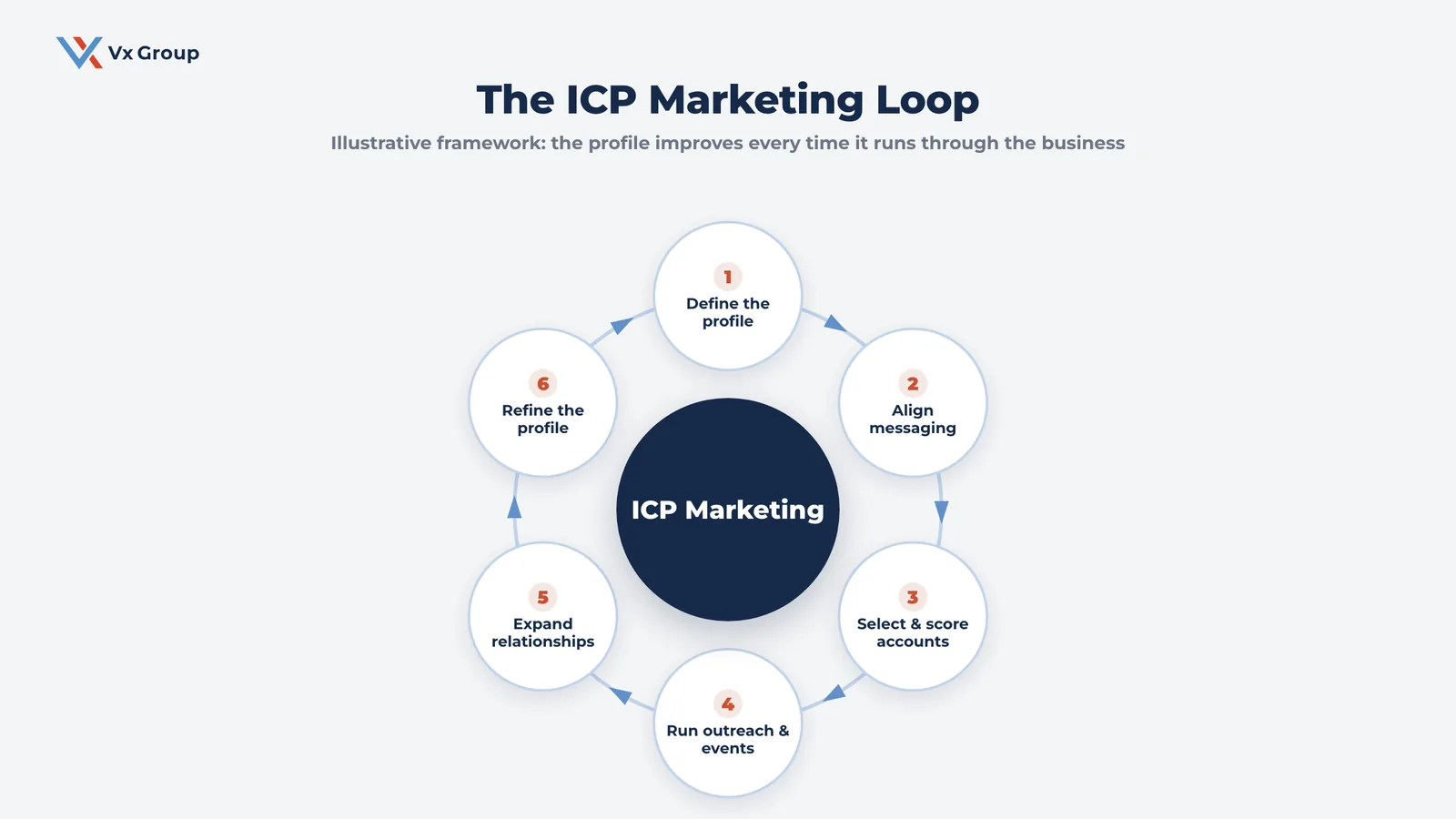
The loop above is the difference between an ICP that decorates and an ICP that operates. Each stage feeds the next, and the last stage (refining the profile) feeds back into the first. A company that only completes the first stage, defining the profile, has done the least valuable part of the work.
Ready to grow?
See how a documented ICP could reshape your messaging, account list, and outreach in one pass.
How do you build an ICP that actually operates?
Building an operating ICP starts with writing a profile specific enough that a salesperson could use it to decide whether to pursue a lead in under thirty seconds, then ranking the accounts that match it by what the relationship is actually worth.
Write the one-page profile
Put the entire profile on one page. If it takes more than a page to describe, it’s too complicated for anyone to use in the moment they need it, typically a sales call or a target list meeting, often on short notice.
The one-page profile should answer:
- Firmographics. Industry, revenue range, employee count, geography. The basic filter, kept intentionally narrow.
- Buying committee. Who is actually involved in the decision, by role, and who has final say.
- The problem they have. The specific operational or growth problem this account is trying to solve, described using the words they’d use themselves.
- Proof of fit. What an account looks like when it’s a strong match: a signal, a trigger event, or a characteristic that shows up before the deal even starts.
- Relationship potential. What this account could be worth over five or ten years if the relationship goes well, including referrals and expansion beyond the first contract.
Keep the language plain. Compare the two options below. “A $40M contract manufacturer whose plant manager is worried about losing a key customer relationship when their VP of Sales retires” works because a salesperson could act on it in a single call. “Mid-market manufacturing organizations experiencing succession-related revenue risk” describes the same account but gives nobody anything to act on.
Rank criteria by relationship economics
Two accounts can share identical firmographics and be worth completely different amounts to the business. A $50M distributor that refers three other distributors a year and stays for two decades is worth more than a $50M distributor that switches suppliers on price every eighteen months.
Rank the criteria in the profile by how much each one predicts long-term relationship value:
| Criterion | What it predicts | Easy to filter? |
|---|---|---|
| Industry and revenue | Basic fit, deal size range | Yes |
| Buying committee stability | Whether the relationship survives a champion leaving | No |
| History of referrals in their peer group | Compounding pipeline beyond the first deal | No |
| Retention pattern of similar accounts | Whether the relationship lasts | Sometimes |
| Trigger event (succession, capacity expansion, new plant) | Timing and urgency | No |
The criteria that are hardest to filter for in a database (buying committee stability, referral behavior, retention patterns) are usually the ones that predict the most value. Firmographic filters still matter as a first cut. The deeper criteria are what should carry the most weight in the final score.
Name the disqualifiers as clearly as the qualifiers
Every ICP needs a disqualifier list as specific as its qualifier list. Without one, the team keeps chasing accounts that technically fit the firmographics but drain time without ever closing or sticking around.
Common disqualifiers in relationship-driven B2B companies:
- A buying process driven entirely by lowest bid, with no relationship component
- A single decision maker with a documented history of vendor-hopping
- A deal size below the threshold where the relationship pays for the cost to acquire and serve it
- An account whose growth trajectory depends on a customer relationship the company itself doesn’t control (see what is a generational customer for how concentrated dependency shows up on the other side of this same problem)
Writing the disqualifiers down does something the qualifiers alone can’t: it gives the sales team permission to walk away from a lead early, before three months of chasing produces nothing.
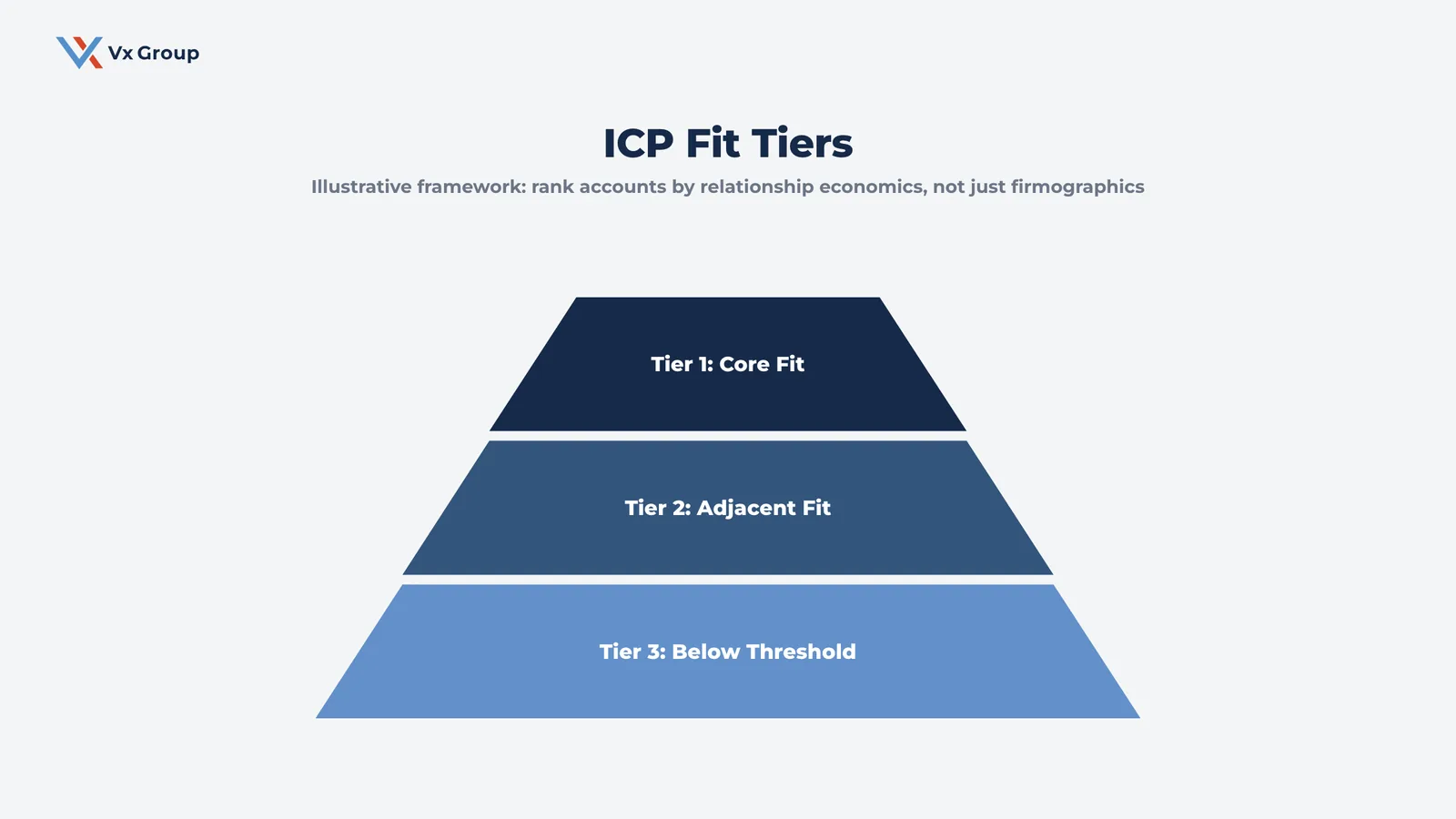
Defined Term: ICP Tier
a ranked bucket of accounts based on how closely they match the ideal customer profile and how much relationship value they represent. Tier 1 gets the most direct, personalized attention. Tier 3 either gets a lighter-touch nurture track or gets disqualified outright.
How do you align your messaging around your ICP?
Messaging aligns with an ICP when it speaks to the specific problem that profile’s buying committee actually has, using their own language and their own stakes.
Build a message architecture from ICP language
A message architecture is the documented set of proof points, language, and positioning a company uses consistently everywhere: the website, sales conversations, proposals, and content. Build it directly from language you can point to: real phrases pulled from real conversations with accounts that already fit.
Pull the language from three sources:
- Sales call transcripts with accounts that already match the ICP, listening for the exact phrases they use to describe their problem.
- Customer success conversations with the best-fit accounts, listening for what they say when asked why they stayed.
- The disqualifier list, inverted. If a bad-fit account complains about price, the message architecture for a good-fit account should emphasize relationship and reliability instead.
The result should read like it was written by someone who has sat in the room with this exact buying committee, because the language came from that room.
Cut the value props that try to fit everyone
A value proposition built to apply to every possible customer ends up specific to none of them. Reread the current homepage and sales deck and cut any sentence that would sound equally true if the company sold something completely different.
“We help companies grow” applies to every business that has ever existed. “We help mid-market manufacturers protect the top ten customer relationships that carry sixty percent of their revenue when a key contact retires” applies to one company’s ICP. The second version costs the company some readers who aren’t the target. It’s supposed to. Losing the wrong readers is the point of a message architecture built around a real profile.
How do you select and score the accounts that match your ICP?
Selecting accounts against an ICP means scoring both the current customer base and the prospect list against the same criteria, then dividing the result into tiers that determine how much attention each account gets from sales, marketing, and customer success.
Score your current book against the profile
Before building a new target list, score the accounts already on the books. This surfaces two things most companies haven’t looked at directly: which current customers are actually the best fit (and therefore deserve more investment), and which current customers are quietly draining time and margin because they never matched the profile in the first place.
Run the existing customer list through the one-page profile’s criteria and sort into the three tiers:
- Tier 1 (Core Fit). Matches the firmographics, has a stable buying committee, and shows signs of long-term relationship value (referrals, low churn risk, expansion potential).
- Tier 2 (Adjacent Fit). Matches on some criteria but not all. Worth a lighter nurture track than Tier 1.
- Tier 3 (Below Threshold). Technically a customer, but doesn’t match the profile and likely never will. Often the accounts consuming disproportionate support time relative to revenue.
Build the target account list
With the current book scored, build the prospect-side target list the same way, using the same tiers. This is where ICP marketing overlaps directly with account-based selling. A typical lead list gets built from whoever downloaded a piece of content. A target list gets built from accounts chosen because they match the profile, then approached deliberately. See account-based selling versus volume selling for how that approach compares to broader lead generation, and the enterprise target profile criteria for a deeper breakdown of what belongs in the scoring model at the larger end of the market.
Keep the target list small enough that sales and marketing can actually execute against it with the personalization the ICP calls for. A list of forty accounts that gets real attention beats a list of four hundred that gets a templated email blast.
How do you run outreach that reflects your ICP?
Outreach reflects an ICP when the sequence, the offer, and the level of personalization change based on which tier an account falls into.
Segment outreach by ICP tier first
Job title is a common way to segment outreach, and it’s a weak one on its own. A VP of Operations at a Tier 1 account and a VP of Operations at a Tier 3 account have the same title and completely different value to the business. Segment first by tier, then by role within that tier.
Tier 1 accounts warrant highly personalized outreach: a specific reference to their situation, a named trigger event, direct outreach from a senior person on the team. Tier 2 accounts can run through a more templated but still relevant sequence. Tier 3 accounts, if pursued at all, get the lightest-touch nurture track available, since the relationship economics don’t justify heavier investment.
Match the offer to where the account sits in the relationship
An account early in awareness needs a different offer than an account that has already had three conversations with sales. Map the content and offers used in outreach to both the ICP tier and the relationship stage:
- Early stage, Tier 1: a specific, research-backed piece of content that speaks directly to their trigger event
- Mid stage, Tier 1: a direct conversation, often with a case study from a comparable account
- Any stage, Tier 2 or 3: broader nurture content, lower-touch, automated where appropriate
Defined Term: Field Notes
A pattern we see often in manufacturing and distribution clients: the accounts a sales team spends the most time chasing are rarely the Tier 1 accounts. They’re the Tier 2 or 3 accounts that respond fastest, because responsiveness gets mistaken for fit. Scoring the account first, before investing outreach time, catches this before a quarter gets spent on the wrong relationships.
How should trade shows and events reflect your ICP?
Trade shows and events should be planned around a target list built from the ICP, with specific accounts and buying-committee members identified before the show opens.
Trade shows work best as relationship events. A booth that scans five hundred badges and books zero follow-up meetings with Tier 1 accounts has had a worse show than a booth that scans fifty badges and books ten meetings with the right people.
Build the pre-show target list from your ICP
Before the show, pull the list of Tier 1 and Tier 2 accounts likely to attend, using the show’s own registration or exhibitor data where available. Assign each one to a specific person on the team and set a goal measured in qualified conversations with people who match the buying committee described in the profile.
Script the follow-up by ICP tier
Follow-up after a show is where most of the relationship value either gets built or gets lost. Script it by tier before the show starts, so nobody is improvising who gets what kind of follow-up:
- Tier 1 contacts get a personal follow-up within 48 hours referencing the specific conversation
- Tier 2 contacts get a follow-up within a week, still personalized but less resource-intensive
- Tier 3 or unqualified contacts go into a general nurture sequence, if they go anywhere at all
Ready to grow?
Talk through how your next show or event could run against a real target list built from your ICP.
How do you use your ICP to grow the accounts you already have?
Using an ICP for expansion means re-scoring the current customer base on a fixed schedule and treating the highest-fit accounts as growth opportunities worth active investment beyond the renewal date.
The lifetime value concentrated in a company’s top ten relationships often exceeds the entire pipeline of new prospects. That means the ICP shouldn’t only point outward at new logos. It should point inward, at the accounts already generating revenue, to identify which ones deserve a deeper investment of time, a broader set of services, or an introduction to a decision maker the relationship hasn’t reached yet.
Re-score existing accounts on a set schedule
Set a recurring cadence, quarterly or twice a year, to re-run the current book through the ICP scoring model. Relationships change. An account that was Tier 2 last year might have gone through a leadership change that moved it to Tier 1, or might have quietly drifted the other direction after a champion left.
Fold expansion criteria into the profile itself
Expansion potential should be one of the criteria scored directly inside the ICP, reviewed by sales and customer success together. An account with strong retention, a stable buying committee, and unaddressed needs in an adjacent product or service line is a Tier 1 account for expansion purposes even if it looks ordinary on the original acquisition criteria. See account expansion for a fuller breakdown of how to find and prioritize that growth inside accounts already on the books.
How do you measure whether ICP marketing is working?
ICP marketing is working when pipeline, win rate, and revenue increasingly concentrate in Tier 1 and Tier 2 accounts, and when the accounts the company closes and retains match the profile more closely over time.
Track each of these broken out by tier:
- Pipeline by tier. What share of active pipeline sits in Tier 1 versus Tier 2 versus Tier 3. A healthy trend moves toward Tier 1 over time.
- Win rate by tier. Tier 1 accounts should close at a meaningfully higher rate than Tier 3 accounts. If they don’t, the scoring model needs revisiting.
- Retention and expansion by tier. Tier 1 accounts should show the strongest retention and the most expansion revenue. This is the clearest signal the profile is actually predicting relationship value.
- Sales cycle length by tier. Tier 1 accounts, matched correctly, often move faster because the fit reduces internal friction on their side of the deal.
- Referral rate by tier. Referrals are one of the strongest signals of relationship health, and they should skew heavily toward Tier 1 accounts if the profile is accurate.
A company that only tracks total leads or total pipeline has no way to see whether ICP marketing is actually changing who the company works with. Tracking by tier is what turns the ICP from a document into a measurable operating system.
Turning the profile into growth
Most of the work in ICP marketing isn’t writing the profile. Companies that have been in business for years usually already know, in general terms, who their best customers are. The work is building the habits that keep every department referencing the same profile: the message architecture that speaks to it, the scoring model that ranks accounts against it, the outreach that varies by tier, the event strategy built from a real target list, and the recurring discipline of re-scoring the accounts already on the books.
Done consistently, this is what separates a company that grows by accident from one that grows on purpose. The profile stops being something the team agrees with once a year and becomes something the team uses every week.
Ready to grow?
Bring your current ICP, and we’ll help you turn it into a working system across messaging, accounts, and outreach.
Related reading:
- What Is an Ideal Customer Profile (and Why Most B2B Companies Get It Wrong)
- The Ideal Customer Profile Template Every B2B Marketer Should Use
- Account-Based Selling vs. Volume Selling: Which Wins in Relationship-Driven B2B?
- The B2B Enterprise Target Profile: What Criteria Actually Matter
- Account Expansion: The Growth Hiding in Your Best Accounts
FAQs
About the Author: Jacob Camhi
