

Channel Marketing for Manufacturers and Distributors

Channel marketing is how a manufacturer generates demand through the distributors, reps, and dealers who actually sell to the end customer. It differs from direct B2B marketing in one major way: the partner owns the relationship with the buyer, so the manufacturer’s real job is to protect and multiply trust it doesn’t hold directly.
TL;DR
- Channel marketing is demand generation that runs through partners (distributors, reps, dealers, integrators) instead of straight to the buyer.
- The partner owns the end relationship, which makes trust your most valuable and most fragile asset.
- Most channel budgets get spent on portals, co-op funds, and MDF with no owner and no outcome attached, so the money disappears and the trust still walks.
- A working channel strategy names a relationship owner at every tier, segments partners by economics, and ships a real enablement kit before asking for revenue.
- Split your effort into “to-partner” marketing (winning the partner’s attention) and “through-partner” marketing (helping them sell).
- Measure partner-sourced revenue and partner engagement rather than co-op spend or portal logins.
- The manufacturers that win the channel treat it as a relationship discipline first and a software problem a distant second.
A manufacturer can spend a year standing up a portal and funding a co-op program and still have no idea which partners are selling, which are coasting, and which are one retirement away from taking a million dollars of relationship value to a competitor. None of that software is the real lever. The lever is the relationship you route through, and it lives inside the distributor or the rep long before it lives in any platform you buy.
This guide is written for manufacturers and distributors managing a multi-tier go-to-market rather than software buyers comparing PRM vendors. If you sell through people who carry your name into rooms you’re not in, this is written for you.
What is channel marketing?
Channel marketing is the set of activities a manufacturer uses to create demand and drive sales through third-party partners rather than selling directly to the end customer. Those partners include distributors, independent sales reps, dealers, resellers, value-added resellers (VARs), and integrators. The manufacturer supplies the product, the brand, the training, and often the marketing funds. The partner supplies the local relationship, the last-mile trust, and the actual close.
Defined Term: Channel marketing
Demand generation and sales enablement delivered through partners who own the end-customer relationship, rather than through a manufacturer’s own direct sales and marketing motion. Its central challenge is that the manufacturer must influence a sale it cannot see and a relationship it does not control.
The reason channel marketing is its own discipline, rather than B2B marketing with more middlemen, comes down to who holds the trust. In a direct model, your sales team builds the relationship and your marketing feeds it. In a channel model, a distributor’s rep has spent fifteen years earning a purchasing manager’s confidence, and your brand rides on that confidence whether you have earned it independently or not. You are marketing to a customer you never speak to, through a partner whose priorities are not identical to yours.
Get that dynamic right and the channel becomes the most efficient growth engine you have. Get it wrong and you are funding activity that produces nothing you can measure.
How is channel marketing different from direct B2B marketing?
The single difference that drives all the others is ownership of the end relationship. In direct B2B marketing you own the customer; in channel marketing your partner does, and every downstream decision about metrics, risk, and where you spend changes because of it.
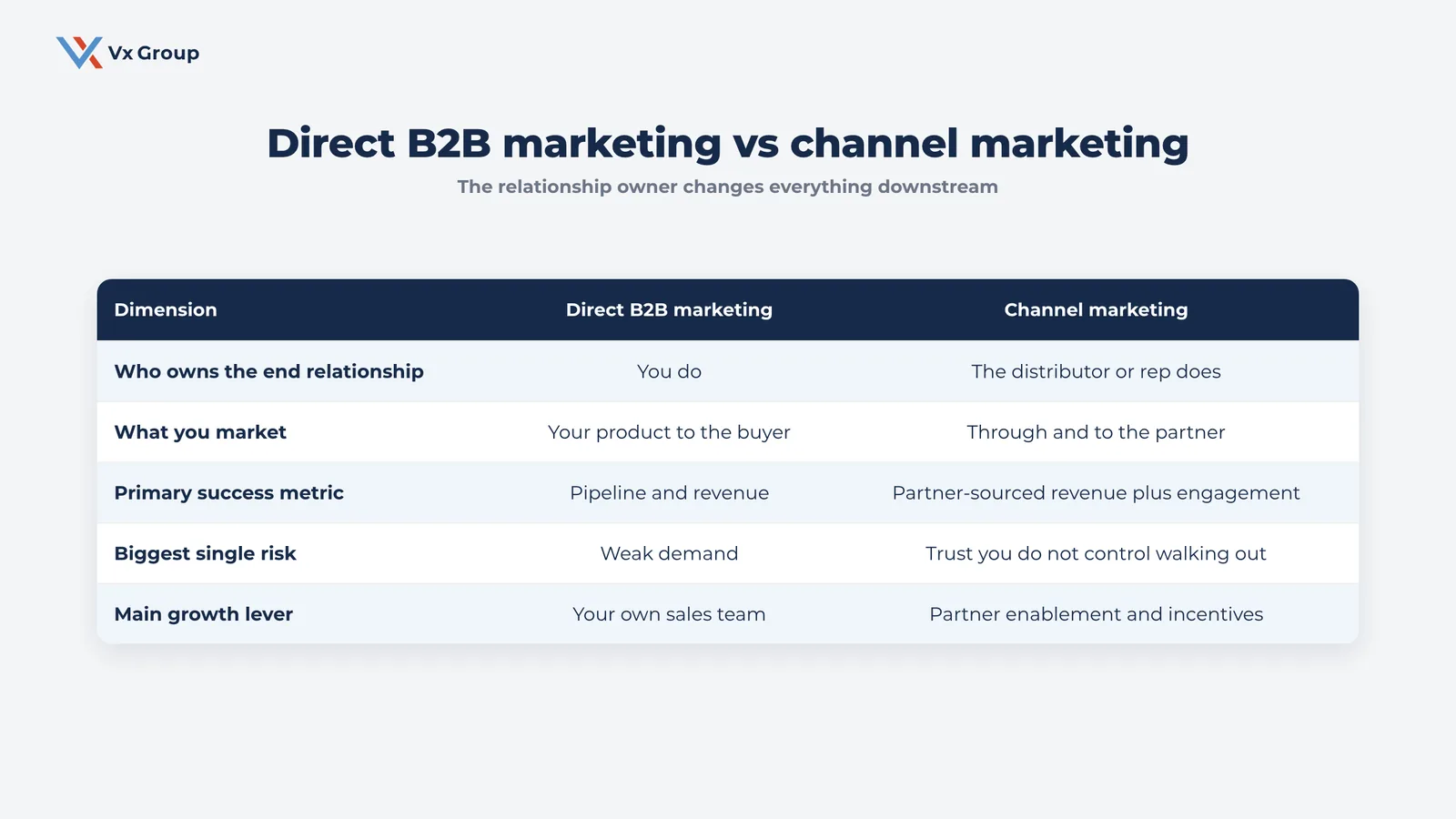
Here is how the two models diverge across the decisions that matter:
- Who owns the relationship. Direct: your team. Channel: the distributor or rep. This is the root of everything else.
- What you are marketing. Direct: your product to a buyer. Channel: two audiences at once, the partner and the partner’s customer.
- How demand travels. Direct: from you to the market. Channel: from you to the partner, then from the partner to the market, with a handoff in the middle where most programs break.
- What you can see. Direct: your full funnel. Channel: whatever the partner chooses to report, which is usually a fraction of the real picture.
- Where the risk sits. Direct: soft demand. Channel: concentration risk, because the trust and the account knowledge live with a partner who can leave.
- Your main lever. Direct: your own sales and marketing. Channel: partner enablement and incentives, because you cannot force a sale you do not participate in.
A manufacturer that runs channel marketing as if it were direct marketing with extra steps will over-invest in broad brand campaigns at the top of the funnel and under-invest in the enablement, incentives, and relationship management that actually move partner behavior. The partner is the audience that decides whether your quarter works, more than the end buyer ever does.
Why does channel marketing matter for manufacturers and distributors?
Channel marketing matters because for most manufacturers the channel is the growth itself, and the trust that carries it is both the largest asset on the books and the least managed. A single distributor relationship can represent years of accumulated account knowledge, local credibility, and repeat revenue that no campaign can replicate and no competitor can easily see.
That value tends to be invisible until it is at risk. When a top rep retires, when a distributor gets acquired, when a regional principal decides your competitor’s margins look better, the manufacturer discovers how much of its revenue was actually resting on one person’s relationships.
This is the same pattern we see across relationship-driven B2B: the growth hiding in existing accounts is worth more than most new-customer pipelines, and channel relationships are existing accounts with an extra layer of dependency baked in.
For manufacturers and distributors specifically, three forces make the channel decisive:
- Reach you could never build directly. A mid-sized manufacturer cannot put feet on the ground in every region and vertical. A distributor network does it in one stroke, with relationships already in place.
- Trust transfer. When a trusted local partner recommends your product, you inherit credibility you did not have to earn from scratch. That transfer is the entire economic argument for the channel.
- Concentration risk. The same trust transfer that makes the channel powerful makes it fragile. Revenue concentrated in a few partner relationships, with no documented plan for what happens when they change, is one of the most common and most expensive exposures in legacy B2B.
Channel marketing, done as a relationship discipline, is how you turn that dependency into an asset you can protect and grow instead of a liability sitting quietly on your revenue statement.
What are the tiers of a channel go-to-market model?
A channel go-to-market model is a layered set of partners between the manufacturer and the end customer, and each layer owns a different piece of the relationship. Naming those layers, and naming who owns the relationship at each one, is the first thing a serious channel strategy does.
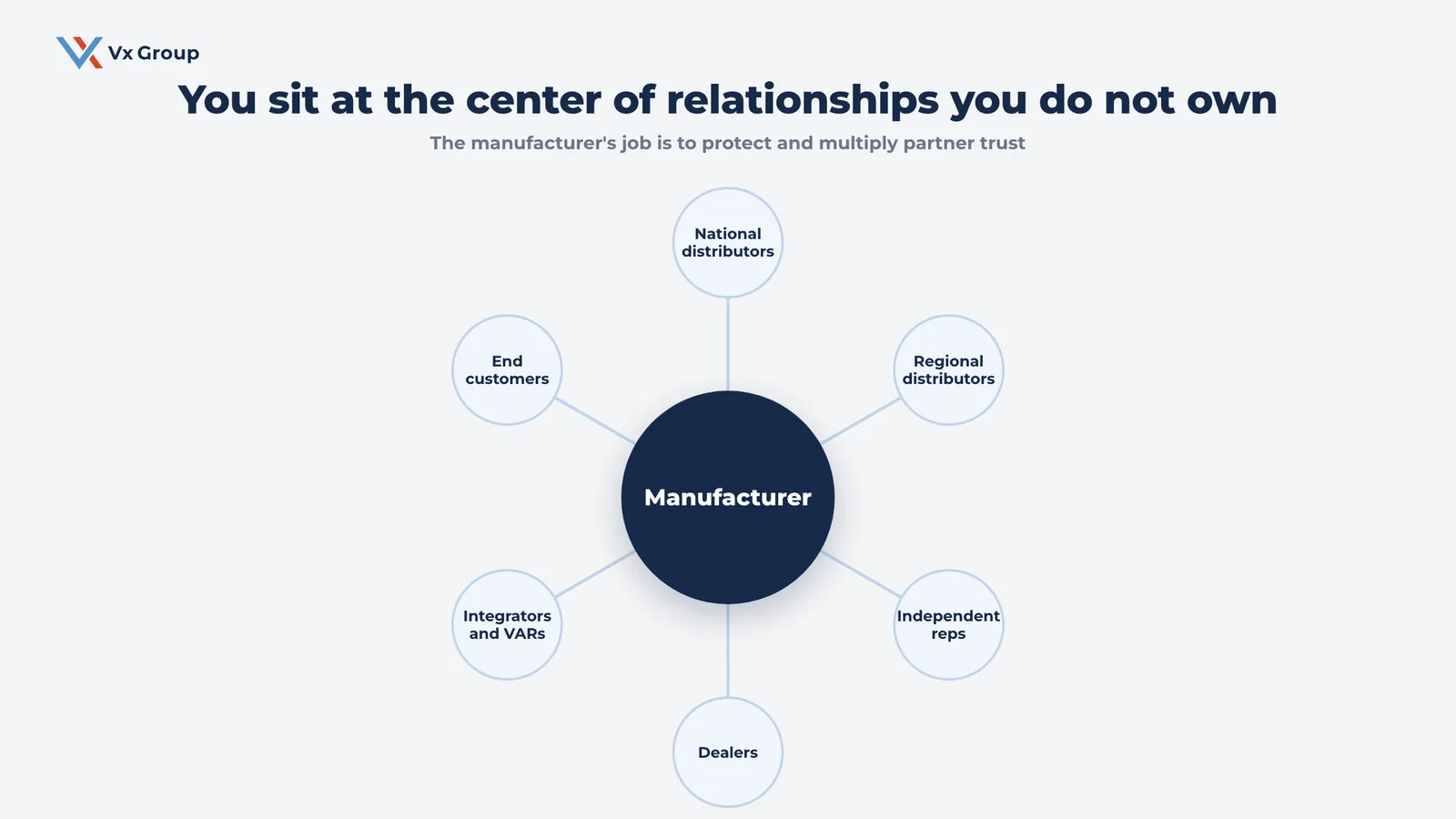
The common tiers in a manufacturer’s channel:
- National and regional distributors. They warehouse, finance, and move volume. They often own the commercial relationship with mid-market and enterprise buyers, and they carry competing lines, so your share of their attention is never guaranteed.
- Independent sales reps and rep firms. They carry a bag of complementary but non-competing products into a defined territory. Their relationships are personal and portable, which makes them powerful and risky in equal measure.
- Dealers. They sell and often service your product locally, frequently to smaller end customers who value proximity and hands-on support.
- Integrators and VARs. They embed your product into a larger solution. The end customer may barely know your brand is in the room, which is its own marketing problem to solve.
- End customers. The people who actually use the product. You rarely control this relationship, but you can influence it through the brand, through end-user demand generation, and through the experience you design into the product itself.
Defined Term: Two-tier distribution
A model where the manufacturer sells to distributors, who sell to dealers or end customers, adding a layer of reach and financing but also a layer of distance between the manufacturer and the buyer. Every added tier increases reach and decreases visibility, which is the trade the manufacturer is managing.
The strategic point runs deeper than the org chart: trust and information degrade at every tier boundary. Your job in channel marketing is to reduce that degradation: to make sure your brand, your message, and your product knowledge survive each handoff intact, and to keep a thread of your own relationship running all the way to the end customer even when a partner sits in between.
How do you build a channel marketing strategy?
You build a channel marketing strategy by naming the relationship owner at every tier, segmenting partners by economics, and shipping a real enablement kit before you spend a dollar on demand. The sequence matters. Most programs fail because they start with a co-op budget and a portal instead of with clarity about which partners deserve investment and what those partners actually need to sell. Work the steps below in order.
Map every tier and name the relationship owner
Draw your actual channel, tier by tier, and write a specific person’s name next to every relationship that matters. Not “the distributor,” but the principal, the branch manager, and the counter reps who influence what gets recommended. If a relationship has no name attached on your side, it has no owner, and unowned relationships are the ones that quietly walk.
The output of this step is a living map: each tier, each key partner, the individuals who hold the trust, and the person on your team responsible for each one. This is the same discipline that underpins a coherent go-to-market strategy, applied to a market you reach through other people.
Rank partners by long-term value
Sort your partners by the long-term value of the relationship rather than last quarter’s order size. Build a simple ranking that weighs revenue, margin, growth trajectory, strategic fit, and switching risk. A high-volume distributor with razor margins and a foot out the door is worth less than a smaller partner growing 30 percent a year in a segment you want to own.
The output is a tiered partner list, usually three tiers, that tells you where to concentrate enablement, co-marketing dollars, and executive attention. You cannot treat every partner the same, and pretending you can is how the best partners end up under-served.
Write the one-page partner profile
For every priority partner, write a single page that captures who they are and how you will grow with them. Include: the named relationship owners on both sides, their territory and verticals, the product lines they carry (yours and competitors’), their last four quarters of performance, the one growth objective you share this year, and the specific support you have committed to. Keep it to one page so it actually gets used.
This profile becomes the reference document for every conversation, every co-marketing decision, and every quarterly review. When a rep leaves, the profile is what keeps the relationship from resetting to zero.
Split your plan into to-partner and through-partner marketing
Decide, for each priority partner, what you will do to win their attention and what you will do to help them sell. To-partner marketing earns a bigger share of their attention: onboarding, training, incentives, and the case that your line is worth prioritizing over the competing lines in their bag. Through-partner marketing arms the partner to generate demand in their own market under a co-branded banner.
Write both plans explicitly. Most manufacturers do one and forget the other, then wonder why an enthusiastic partner still cannot move product, or why a well-equipped partner has no reason to choose them.
Build the enablement kit before you ask for revenue
Assemble everything a partner needs to sell your product well, and deliver it before the first revenue conversation. A partner who has to build their own sales sheet, guess at pricing, and improvise the pitch will deprioritize you for the vendor who made selling easy.
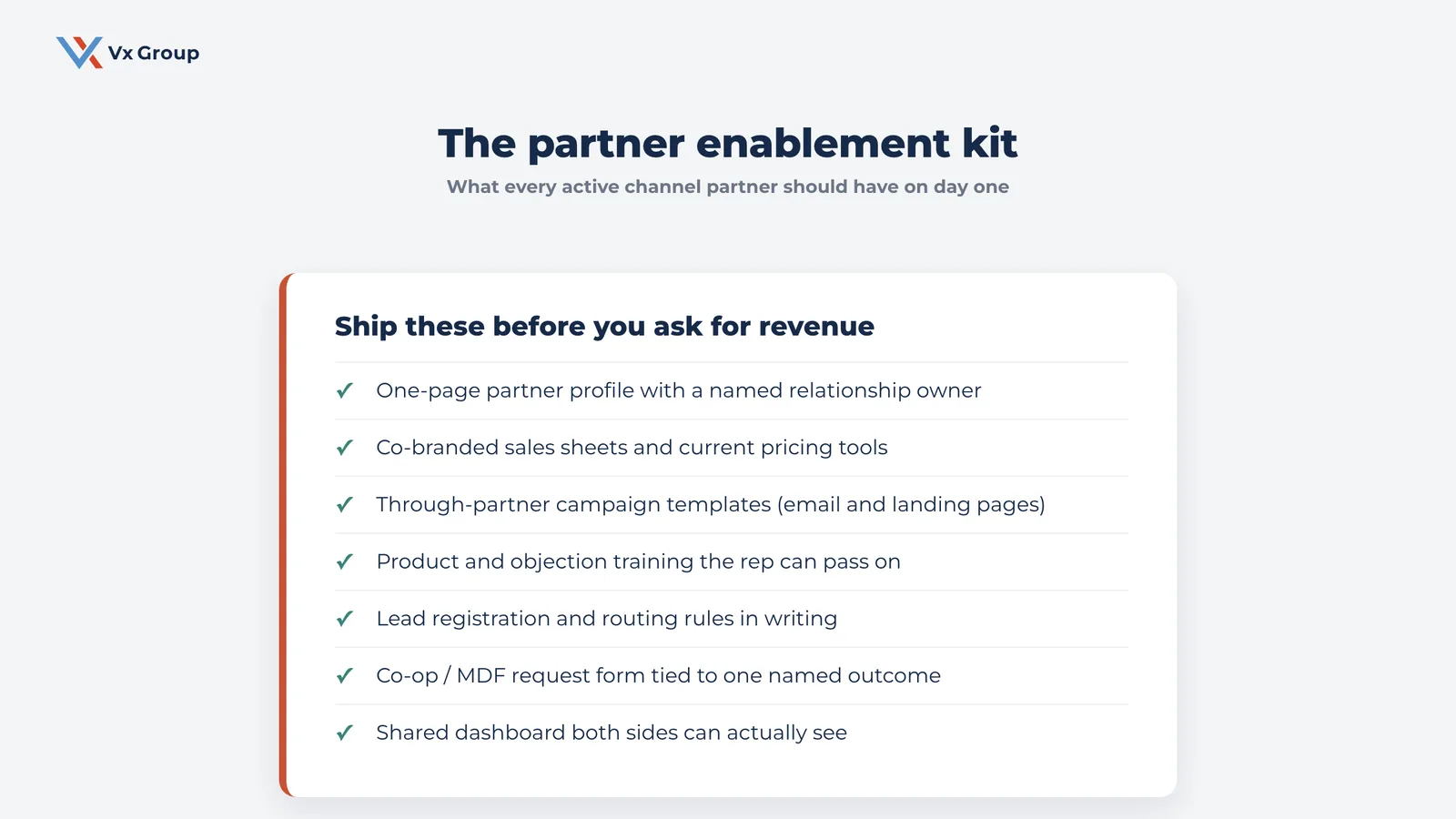
At minimum, the kit contains a one-page partner profile with a named owner, co-branded sales sheets and current pricing tools, through-partner campaign templates the partner can run under their own name, product and objection-handling training the rep can pass on to a buyer, written lead registration and routing rules, a co-op or MDF request form tied to one named outcome, and a shared dashboard both sides can see. The test for the kit is simple: could a brand-new rep at your partner sell your product competently on their second day using only what you handed them? If not, keep building.
Tie every co-op and MDF dollar to a named outcome
Rewrite your co-op and market development funds so no dollar is released without a specific, measurable outcome attached to it. The default channel funding model, a percentage of purchases the partner can spend on loosely defined “marketing,” is where budgets go to die.
Replace it with a request that names the activity, the target audience, the expected result, and the reporting the partner will provide. Fund a co-branded email campaign to 400 named accounts with tracked registrations instead of a vague line item like “Q3 marketing support.”
The output is a funding pipeline you can actually evaluate, where you can see which partners turn a dollar of MDF into ten dollars of pipeline and which turn it into branded golf balls.
Get visibility into the funnel you can actually see
Put reporting in place at every handoff so you are not flying blind past the first tier. You will never have the visibility of a direct funnel, but you can insist on deal registration, shared pipeline reviews with priority partners, and end-customer demand signals you generate yourself.
The output is a channel dashboard that shows partner-sourced pipeline, registration-to-close rates by partner, enablement adoption, and engagement trends. Even partial visibility is worth a lot, because it turns “we think the channel is working” into “these five partners drive 60 percent of sourced revenue and these are the two we are about to lose.”
Ready to grow?
See how a relationship-first channel strategy would map onto your own distributor and rep network.
What is through-partner marketing and how do you run it?
Through-partner marketing is demand generation you design and fund but the partner executes under their own name, so the end customer experiences it as a local, trusted recommendation rather than a manufacturer’s ad. It is the highest-return activity in the channel because it borrows the partner’s credibility, which is the one thing your own marketing cannot manufacture.
To run it well:
- Build campaigns partners can run in an afternoon. Templated emails, landing pages, social posts, and event kits a partner can run with a logo and a send, since most partners have no marketing team standing by.
- Co-brand, do not white-label away your identity. The end customer should see both names: the local partner they trust and the manufacturer whose quality stands behind it. That dual signal is the trust transfer working in both directions.
- Fund it against outcomes. Tie the campaign to registrations, meetings, or sourced pipeline, and give the partner the reporting so they see it working too.
- Make the follow-up part of the kit. A campaign that generates interest the partner does not know how to work is wasted. Include the call script, the objection guide, and the offer, so the partner can carry the consultative selling conversation the campaign starts.
The manufacturers that win here treat their best partners as an extension of their own marketing team, resourced and measured accordingly, rather than as a mailing list for product announcements.
How do you measure channel marketing?
You measure channel marketing by partner-sourced revenue and partner engagement rather than by activity metrics like co-op spend or portal logins. The wrong metrics make a dormant channel look healthy; the right ones tell you where the trust and the revenue actually are.
The metrics that matter, in rough priority order:
| Metric | What it tells you | Why it beats the vanity version |
|---|---|---|
| Partner-sourced revenue | Revenue you can trace to a specific partner | Beats total channel revenue, which hides who is actually selling |
| Partner-sourced pipeline | Future revenue by partner | Beats registered deals alone, which stall silently |
| Registration-to-close rate | How well each partner converts | Beats lead volume, which rewards busywork |
| Enablement adoption | Whether partners use what you ship | Beats portal logins, which measure curiosity rather than selling |
| Partner engagement trend | Whether a relationship is warming or cooling | Beats last-quarter revenue, which is a lagging signal |
| Revenue concentration | Share of channel revenue in your top partners | Beats a single growth number, which hides fragility |
The concentration metric deserves special attention. If a small number of partners drive most of your channel revenue, that is not automatically a problem, but not knowing it is. Tracking concentration turns an invisible risk into a managed one, and it tells you exactly which relationships warrant a documented succession plan for the day the principal or the rep moves on.
Ready to grow?
Ask us how to build a channel scorecard that measures relationship health alongside order volume.
How do you keep distributors and reps engaged?
You keep distributors and reps engaged by making your line the easiest and most rewarding one in their bag to sell, and by managing the relationship as an ongoing commitment rather than a quarterly order. Engagement is the result of being consistently useful to a partner who has other options, and no one owes you loyalty by default.
The levers that actually move partner engagement:
- Be easy to do business with. Fast quotes, clean pricing, reliable delivery, and responsive support beat a bigger co-op check almost every time. Friction is the quiet reason partners drift to a competitor.
- Make them money on your line. Protect their margins, register their deals, and do not compete with them through your own direct channel without a clear rule set. Channel conflict is the fastest way to lose a partner’s trust.
- Invest in the people behind the account. Train the reps, recognize the top performers, and know the names of the people who recommend you. Relationship value that lives only in a contract evaporates when the people change.
- Review the relationship on a schedule. Quarterly business reviews with priority partners, built around the one-page profile, keep the shared objective alive and surface problems while they are still small. This is the same discipline that drives customer retention in B2B, applied to the partners who carry you to market.
A documented approach to dealer engagement and rep relationships is what separates a channel that compounds from one that slowly erodes as individual relationships age out. Systems here do not replace the human relationship; they protect it, so a single departure does not reset years of trust to zero.
Field Notes
A regional building-products manufacturer we studied believed its channel was thriving because total distributor revenue was flat-to-up year over year. When they finally tracked partner-sourced revenue by individual partner, they found that two aging rep relationships drove nearly half of it, both with principals inside five years of retirement, and neither with a documented successor or a second relationship inside the firm. The flat top-line number had hidden a concentration problem serious enough to threaten the business. The fix had nothing to do with a new portal. They put a named owner on each at-risk relationship, developed a second contact inside each rep firm, and ran a quarterly review that made the exposure visible to leadership every ninety days. The revenue did not change overnight, but the risk profile changed immediately.
What are the most common channel marketing mistakes?
The most common channel marketing mistakes all share one root: treating the channel as a distribution mechanic instead of a relationship you are responsible for. The specific failures follow predictably from that mistake.
- Buying a platform and calling it a strategy. A portal or PRM tool organizes a channel program; it does not create one. The relationship work still has to happen.
- Funding co-op with no outcome attached. Undirected marketing money produces undirected marketing, and you lose the ability to tell a great partner from a lucky one.
- Treating every partner the same. Equal treatment starves your best partners to subsidize your weakest ones. Segment by economics and invest accordingly.
- Ignoring concentration risk. Not knowing how much revenue rides on how few relationships is the exposure that turns a single retirement into a crisis.
- Marketing to the partner but not through them. Winning a partner’s attention without arming them to sell leaves enthusiasm stranded with no way to convert.
- Letting relationships live in one head. When the account knowledge and the trust sit entirely with one rep or principal, you own none of it, and you find out the hard way.
Every one of these is fixable, and none of the fixes is software. They are the unglamorous disciplines of naming owners, segmenting honestly, enabling generously, funding against outcomes, and reviewing on a schedule.
Conclusion: the channel is a relationship you are responsible for
Channel marketing rewards the manufacturers and distributors who treat it as what it is: a system for protecting and multiplying trust that lives outside your own walls. The portals and the co-op funds serve that work; they do not stand in for it.
When you name a relationship owner at every tier, segment partners by real economics, ship enablement before you ask for revenue, fund against outcomes, and measure partner-sourced revenue and engagement instead of activity, the channel becomes the most efficient and most durable growth engine you have.
The manufacturers who lose the channel usually have a perfectly good product. What they lack is ownership, so years of relationship value sit unmeasured until a competitor, or a retirement, makes the exposure obvious. The work in this guide is how you make sure that never describes you.
Ready to grow?
Let’s map your channel, find the concentration risk hiding in it, and build the relationship discipline that turns your distributors and reps into a durable growth engine.
Subscribe to Insights → Get practical B2B growth guidance like this in your inbox.
FAQs
About the Author: David Tisdale
