

Sales Cycle Stages: How to Move a Complex B2B Deal Forward

The stages of a complex B2B sales cycle are qualifying the relationship, surfacing a real opportunity, presenting a tailored solution, and earning the commitment. Each stage advances only when you have done the work to deepen trust, so moving a deal forward is a matter of advancing the relationship rather than pressing for the close.
Defined Term: Sales cycle
The full sequence of stages a B2B relationship moves through from first contact to closed business. In a complex, high-trust sale, the cycle runs long and each stage marks a real change in the relationship rather than a status update in a CRM.
TL;DR
- A complex B2B sale moves through four stages, and each one opens only when trust has deepened enough to earn it.
- Stage 1: qualify the relationship, confirming a real person, real interest, and real fit before you invest.
- Stage 2: surface a real opportunity by being useful until the customer names what they actually need.
- Stage 3: present a solution built line by line around what they surfaced, previewed before it is final.
- Stage 4: earn the commitment, which arrives as the natural result of the first three stages done well.
- Every stage has a meeting that fits it. Skip ahead and the deal stalls; the fix is almost always upstream.
Why do the stages of a B2B sales cycle matter?
The stages matter because they tell you what work the relationship needs next, instead of leaving the seller guessing or defaulting to pressure. In a long, high-trust sale, pushing for the close before the relationship is ready is the single most common way deals die. Named stages replace that instinct with a sequence that builds toward commitment on purpose.
The villain is the seller who treats every conversation as a chance to close. In a complex B2B cycle, that pressure reads as self-interest and erodes the trust the sale depends on. A stage model gives the seller something better to do at each step than push, which is why teams that work the stages deliberately win more long-cycle deals than teams that improvise. This is the operator-level companion to the B2B sales funnel, which frames the same journey at a strategic level.
What are the stages of a complex B2B sales cycle?
A complex B2B sales cycle has four stages, each gated by a threshold of trust the relationship has to cross before the next stage is real: qualify the relationship, surface an opportunity, present a solution, and earn the commitment. Each stage has a job for the seller and a meeting type that fits it.
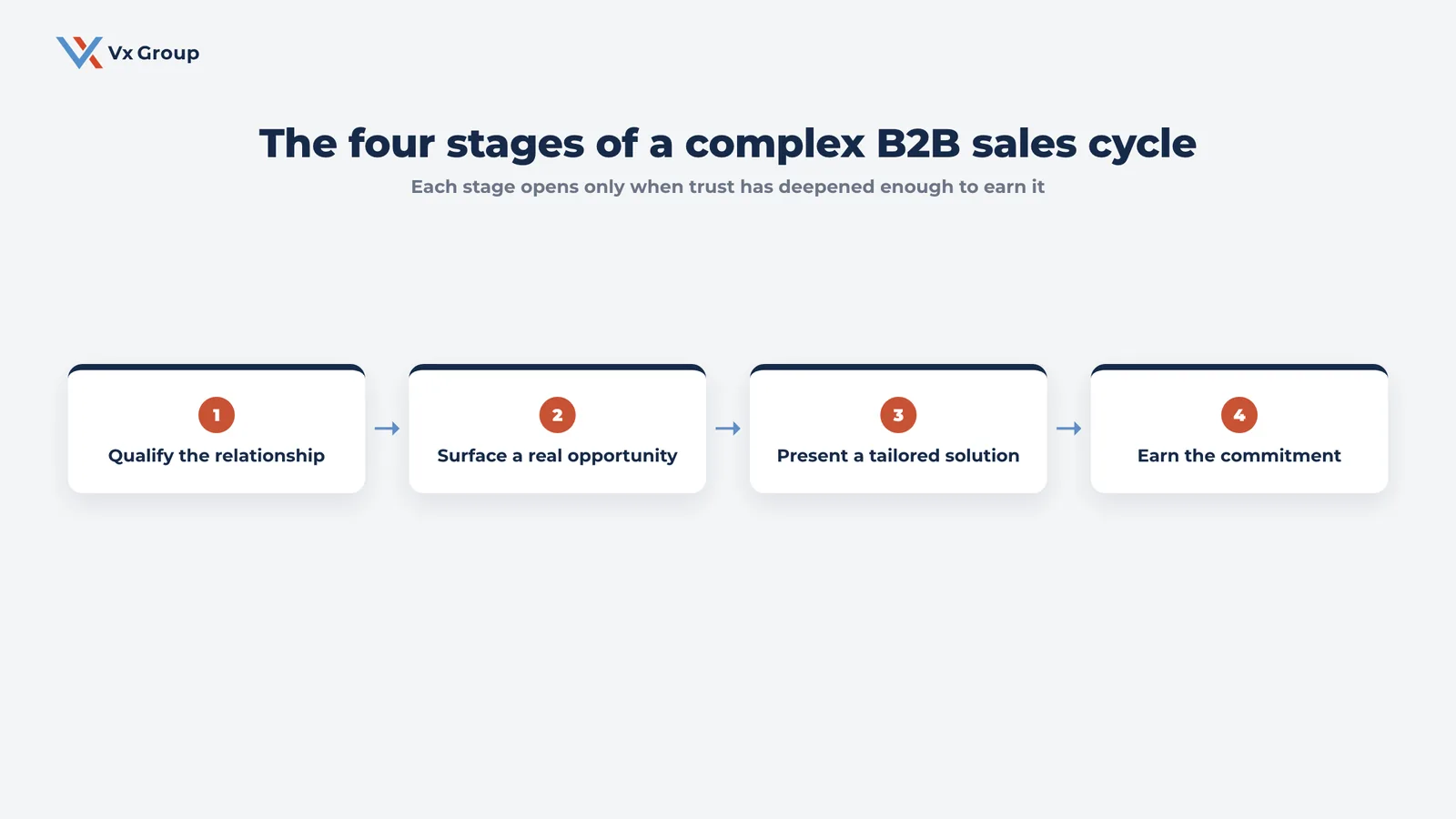
The stages are sequential for a reason. Each one produces the raw material the next one needs, and claiming a stage before you have earned it is what creates a stalled or price-shopped deal later. The rest of this guide is the work inside each stage.
Stage 1: Qualify the relationship
Confirm that you are building a relationship with a real person who fits your ideal customer and has shown genuine interest. This is the foundation of the cycle, and the months you might otherwise waste on a poorly qualified deal are the cost of rushing it.
Confirm fit against written ideal-customer criteria
Before you invest real time, check the prospect against a written list of what a good-fit customer looks like: industry, size, the problem you solve better than anyone, and the kind of relationship you want. Write the criteria down once as a team so qualification is the same judgment every time rather than a gut call that changes by rep. If a prospect misses on the criteria that matter most, name that early and spend your time elsewhere. Sharpening this list is the same work as building a real ideal customer profile.
Run the first meeting on their world rather than your deck
The meeting that fits this stage is a first conversation built to understand their situation rather than to present your company. Open by asking what prompted the conversation, what they are trying to change, and what has gotten in the way so far. Spend the majority of the meeting listening. A company-history slide deck at this stage signals that you are there to talk, and the goal is to prove you are there to understand.
Set the exit criterion before you leave
Do not end the first meeting without a specific reason to have a second one, agreed with the prospect and put on the calendar. The exit criterion for Stage 1 is simple: a real person, a real reason to keep talking, and a scheduled next step. If you cannot get a next step booked, the relationship has not qualified yet, and that is useful information rather than a failure.
Stage 2: Surface a real opportunity
Be useful enough, for long enough, that the customer surfaces a genuine opportunity that fits what you do. The opportunity should come from them because trust has been built, rather than from you manufacturing a reason to send a quote.
Lead with usefulness before there is anything in it for you
The work of this stage is being genuinely helpful before a deal exists: sharing something relevant to their situation, making an introduction, or flagging a risk they had not seen. Each useful act is a deposit of trust, and the customer who has received real value is the one who eventually says what they actually need. Track this the way you would track any pipeline activity so it does not live only in one person’s memory, which is the discipline behind sales pipeline management that does not live in one person’s head.
Ask the three questions that let a need surface
A working session at this stage goes deep on the customer’s situation. Three questions reliably surface a real opportunity:
- “What are you trying to accomplish this year that you are not set up to deliver yet?” This surfaces the gap between goal and capability.
- “Where is the current approach costing you the most time, money, or risk?” This surfaces the pain that funds a decision.
- “If you could fix one thing about how this works today, what would it be?” This surfaces the priority in their words.
Name the opportunity back in their words
When a need surfaces, say it back to the customer in their own language and confirm you have it right before you move toward a solution. “So the real issue is X, and if it were solved you would be able to Y” gives them the chance to correct you and signals that the solution will be built on what they said. Reaching Stage 3 before the customer has surfaced and confirmed a real opportunity produces a polite quote that goes nowhere.
Want a sales cycle you can run on purpose?
See how a relationship-driven cycle would move your most important open deal forward.
Stage 3: Present a tailored solution
Respond to the opportunity the customer surfaced with a specific solution built for what they actually described. A standard pitch deck restarts the sale at square one; a tailored response proves you were listening and moves the relationship forward.
Build the proposal around what they surfaced, point by point
Structure the proposal so each element maps to something the customer told you, and use their language for the problem rather than your internal product names. A simple way to build it: list the needs they surfaced in one column, your specific response to each in the next, and the outcome they told you they wanted in the third. A proposal built this way reads as a plan for their situation and earns evaluation on fit rather than on price alone.
Preview the proposal before you finalize it
The meeting that fits this stage is a proposal preview, where you walk the customer through a draft and invite them to react before anything is final. This one move changes how the proposal lands: it becomes a document you built together rather than a pitch delivered at them, and it surfaces objections while you can still address them. Ask directly, “What would you change about this before I finalize it?”
Tie every element to trust you have already earned
Only include what the relationship has earned the right to propose. If part of the solution depends on trust you have not yet built, hold it for later rather than stretching. A focused proposal that matches the current depth of the relationship closes; an over-reaching one invites doubt and a return to price comparison.
Stage 4: Earn the commitment
Guide the customer to a decision to move forward. By this stage the commitment should read as the natural next step, because every prior stage was crossed with intention rather than skipped.
Resolve risk before you ask for the decision
The work right before a commitment is removing the reasons to hesitate. List the likely objections (budget timing, internal approval, switching cost, implementation risk) and address each one before the decision conversation, so the customer is not weighing unspoken doubts. A decision feels small when the risk around it has already been handled.
Ask for the commitment plainly, once
When the relationship, the opportunity, and the solution are all real, ask for the decision directly and then stop talking: “Are you ready to move forward?” A single clear ask respects the customer and the work that led here. Repeated soft closes signal anxiety and undo the trust the earlier stages built.
Diagnose a stalled close upstream
When a close will not come, the cause is almost always an earlier stage that was claimed before it was earned. Walk back through the cycle: was the relationship truly qualified, did the customer actually surface the opportunity, was the solution built on what they said? Fixing the real stage moves the deal, while a harder closing technique only adds pressure where trust is missing.
| Stage | The seller’s job | The meeting that fits |
|---|---|---|
| 1. Qualify the relationship | Confirm a real person, real interest, and real fit | A first conversation about their world |
| 2. Surface an opportunity | Be useful until the customer names a real need | A deeper working session on their situation |
| 3. Present a solution | Respond with a specific, tailored solution | A proposal preview they can react to |
| 4. Earn the commitment | Guide a decision the relationship has earned | A decision conversation |
How do you know when a deal is ready to advance?
A deal is ready to advance when the current stage’s work is genuinely done, which shows up in the customer’s behavior rather than in your hope. The clearest read is the difference between a deal you are forcing and a deal that is ready to move.
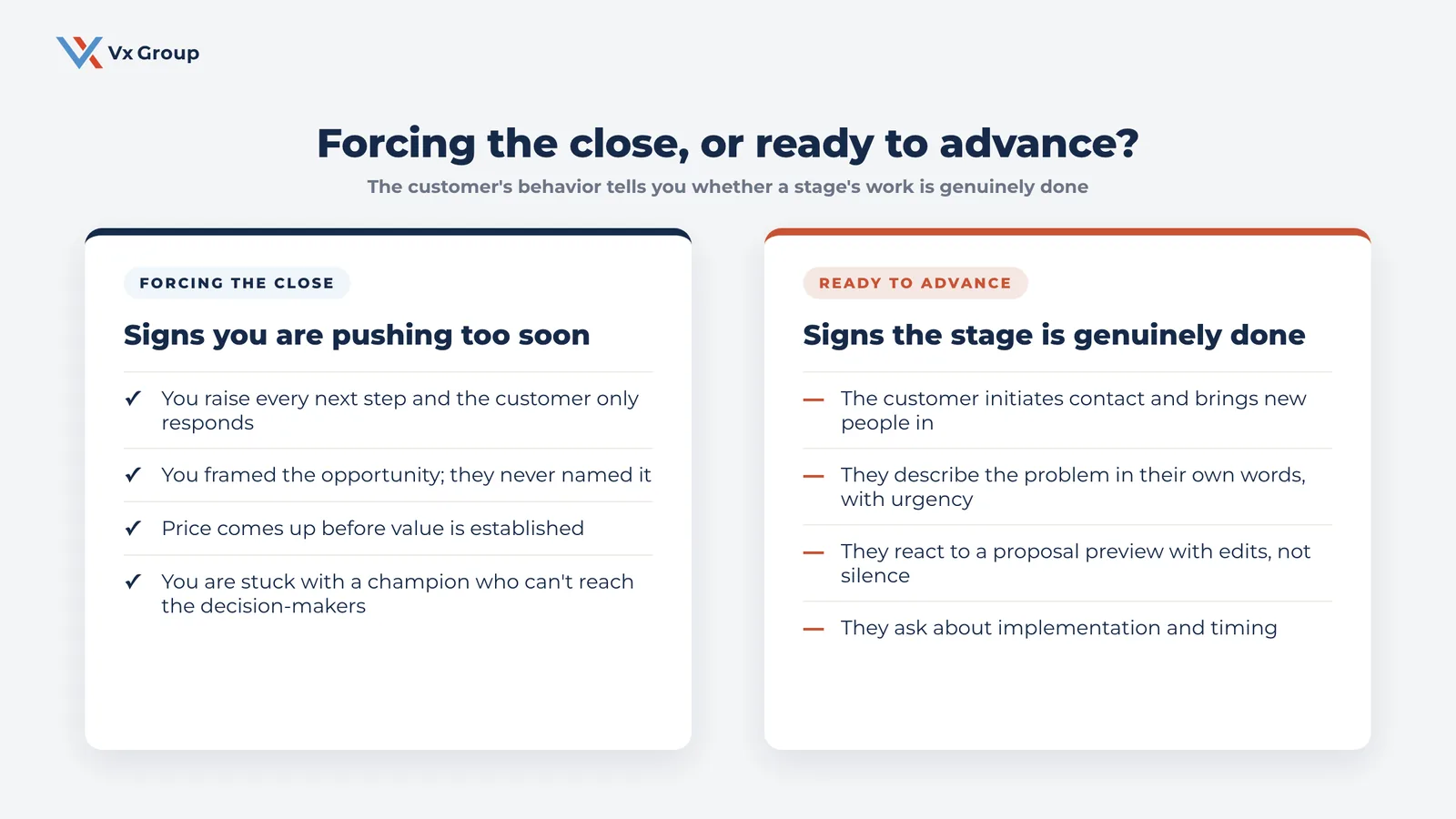
Signs you are forcing the close:
- You are the one raising next steps every time, and the customer only responds.
- The opportunity is one you framed for them rather than one they named.
- Price comes up before value has been established.
- You are managing an internal champion who cannot get you to the actual decision-makers.
Signs the deal is genuinely ready to advance:
- The customer initiates contact and brings new people from their side.
- They describe the problem in their own words and with urgency.
- They react to a proposal preview with edits rather than silence.
- They raise implementation and timing questions, which means they are picturing the decision.
Reading these signals well depends on seeing the whole relationship in one place, which is where a well-run pipeline and a relationship-first prospecting playbook earn their value.
How long should a complex B2B sales cycle take?
A complex B2B sales cycle takes as long as the relationship needs to build real trust, which in legacy and lower-middle-market industries often means several months and sometimes more than a year. The length is set by the size of the decision and the depth of trust required, following the relationship rather than the seller’s timeline.
Compressing the cycle by skipping stages is the fastest way to lose the deal. The companies that win long-cycle sales move through each stage with intention and let the timeline follow the relationship. Once a deal closes, the same relationship discipline is what turns a first contract into years of account expansion.
Ready to grow?
We help relationship-driven B2B teams build a sales cycle where the close is the result of the work.
Conclusion
A complex B2B deal is won or lost long before the close. Qualify the relationship, let a real opportunity surface, present a solution built on what the customer actually said, and the commitment arrives as the natural result of that work. Treat each stage as a threshold of trust to earn rather than a step to rush, match the right meeting to each one, and diagnose any stall upstream instead of closing harder. The teams that move deals this way build a sales cycle they can run on purpose, deal after deal.
FAQs
About the Author: David Tisdale
