

Account Expansion: The Growth Hiding in Your Best Accounts

Account expansion is the practice of growing revenue inside accounts you already serve, by selling more of what they buy, introducing adjacent products or services, and reaching new buyers and departments within the same organization. For most relationship-driven B2B companies, it is the fastest and lowest-risk growth available, because the trust that closes the first deal is already built.
TL;DR
- Account expansion grows revenue within existing customers through deeper penetration, cross-sell, and multi-threading, and it usually closes faster and cheaper than new-logo acquisition.
- The highest-return revenue in most B2B companies sits untouched inside accounts that already trust them, while the sales team chases cold logos.
- You can score every account for expansion room using three inputs: whitespace, relationship depth, and your share of their relevant spend.
- A disciplined quarterly business review surfaces the next opportunity without a hard pitch, and it turns account management into a growth function instead of a service function.
- The signals that an account is ready to expand are different from the signals that an account is at risk, and reading both is the job.
What is account expansion in B2B?
Account expansion is revenue growth that comes from within your current customer base rather than from new customers. It has three mechanics: selling more volume of what an account already buys, cross-selling adjacent products or services they do not yet buy from you, and multi-threading into new buyers, teams, and locations inside the same company. The account is already a customer. Expansion is the work of becoming a bigger part of what they spend.
This matters because the economics are lopsided in your favor. A customer who already knows your quality, your delivery, and your people carries almost none of the risk a cold prospect carries. There is no trust to manufacture from zero, no proof-of-concept to survive, no incumbent to displace. You are the incumbent. The second sale into an account is a fundamentally easier sale than the first, and the fifth is easier than the second.
The villain here is familiar. Most B2B companies pour their sales energy into chasing new logos while the highest-return revenue in the business sits idle inside accounts that already trust them. Account management, where it exists at all, is treated as a service function that reacts when a number slips, instead of a growth function that works expansion on purpose. Vx Group holds that relationships are the most undervalued asset in B2B, and account expansion is where that belief turns into revenue.
Defined Term: Account expansion
Growing revenue inside an existing customer through deeper product penetration, cross-sell of adjacent offerings, and multi-threading into new buyers and business units. Distinct from retention, which keeps the revenue you have, and account management, which is the ongoing role that maintains the relationship.
Why is account expansion the fastest growth for most B2B companies?
Account expansion is the fastest growth lever because the two most expensive parts of any B2B sale, building trust and proving you can deliver, are already paid for. In a relationship-driven business with long cycles and high-value contracts, that head start compounds.
Consider what a new-logo sale actually requires. You have to earn attention, displace an incumbent supplier, survive a procurement process built to slow you down, and prove yourself on a first order before anyone trusts you with a bigger one. Every one of those steps is absent when you expand an existing account. The buyer has your samples, your references, your track record, and often your contract terms already on file.
There is also a retention benefit that runs alongside the revenue. An account that buys three things from you is structurally harder to lose than an account that buys one, because a competitor now has to displace you in three places at once. Expansion deepens the relationship and widens the moat at the same time. This is why expansion and retention are best run as two halves of the same account strategy rather than as separate initiatives. For the retention half of that work, see Customer Retention Strategies for Relationship-Driven B2B Companies.
The catch is that expansion almost never happens by accident. New-logo growth has a natural forcing function, the empty pipeline, that makes salespeople go find it. Expansion has no such alarm. An account can stay flat for years while remaining perfectly happy, and nobody notices the revenue that never showed up. Working expansion on purpose is the entire discipline.
How do you find expansion opportunities in an existing account?
You find expansion opportunities by mapping three things for every account: the whitespace of products they could buy but do not, the depth of relationships you hold across their organization, and your share of their total relevant spend. Each one points to a different kind of growth, and together they tell you where the room actually is.
Most companies skip this step and rely on the account owner’s memory. That is how obvious opportunities sit uncovered for years. The account owner knows the two contacts they talk to and the products those contacts buy, and everything outside that narrow view is invisible. A repeatable map fixes this.
Map the whitespace of products and services they do not buy from you
Build a simple grid: your full product or service line down the rows, the account’s buying units across the columns. Mark every cell where they currently buy, and the empty cells are your whitespace. The point is to make the unbought visible. A customer buying one product line from a company that offers six has five lines of whitespace, and most of it has never been discussed because no one on your side owns the question.
Do this at the buying-unit level rather than at the company level. A manufacturer might buy your core product for their flagship plant and nothing at all for their three other facilities. That is whitespace measured in locations, and it is often the biggest single opportunity in the account.
Rank relationship depth against every buyer who touches the decision
For each account, list the people who influence what gets bought, then rate how strong your relationship is with each one on a simple scale: no relationship, transactional, trusted, advocate. Most at-risk accounts and most stalled accounts share the same tell, which is a single-threaded relationship where your entire footprint depends on one or two people.
The map shows you two things at once. It shows where you are exposed, because a deep relationship with one buyer and nothing beyond them is fragile. And it shows where you can expand, because every buyer you do not yet know is a door into spend you cannot currently see. Multi-threading is both the risk fix and the growth play.
Estimate your share of their relevant spend
For each account, estimate what they spend in total on the category you serve, then estimate your slice of it. You will not get a precise number, and you do not need one. The useful output is a bracket: are you at roughly 10 percent of their relevant spend, 40 percent, or 80 percent? An account where you hold 15 percent of a large budget is a very different opportunity from one where you already hold 75 percent of a small one.
Defined Term: Share of wallet
The percentage of a customer’s total spend in your category that comes to you rather than to competitors. A low share in a large account is the clearest signal of expansion room; a high share means growth has to come from new products or new buying units instead.
This is where you separate accounts that look big from accounts that have room to grow. A large account can be fully penetrated, giving you little expansion room, while a mid-sized account at low share can be the best opportunity in your book. Revenue today tells you who is important. Share of wallet tells you where the growth is.
How do you score and prioritize accounts for expansion?
Score every account on the three inputs above, combine them into a single expansion score, and work the accounts where high opportunity meets high winnability first. The goal is a ranked list your team can act on.
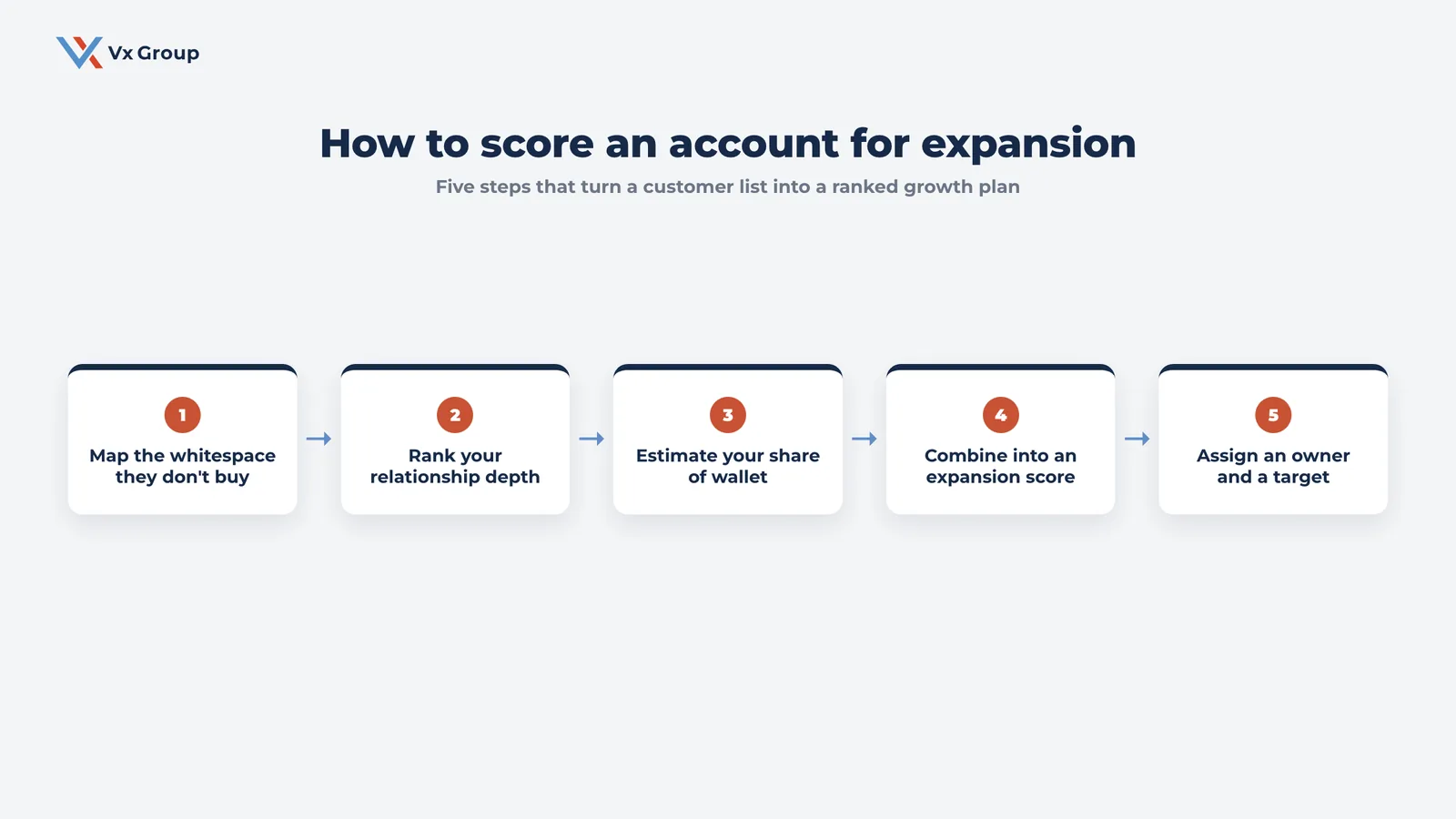
Use a scoring table with a fixed set of columns so every account is judged the same way. Here is the structure to build:
| Column | What it captures | How to score it |
|---|---|---|
| Whitespace | Unbought product lines or locations | Count of open cells in the whitespace grid |
| Relationship depth | Strength and breadth of your contacts | 1 (single-threaded) to 5 (multiple advocates) |
| Share of wallet | Your slice of their category spend | 1 (near-saturated) to 5 (large budget, low share) |
| Fit | How well your growth offerings match their direction | 1 (poor fit) to 5 (strong strategic fit) |
| Expansion score | Priority signal | Sum of the four columns |
The accounts that rise to the top are the ones with real whitespace, room in their budget, and enough relationship to have the conversation. Those are your first calls. Accounts with high opportunity but a thin relationship are a multi-threading project before they are an expansion project. Accounts that are already saturated should move to a retention footing, where the job is protecting revenue rather than growing it.
Set an expansion target and an owner for every priority account
A score with no owner produces nothing. For each account in your top tier, name the person responsible for the expansion plan, write a specific revenue or penetration target, and set the date of the next review. “Grow the Henderson account” is not a plan. “Introduce the coatings line to Henderson’s second plant by Q3, owned by Dana, target 0K” is a plan. The specificity is what makes it real.
This ownership question is where account expansion meets the broader discipline of account management, the ongoing role that holds the relationship and carries the plan between reviews. A future companion piece, What Account Management Actually Means in a Relationship-Driven B2B Company, will go deeper on how to structure that role; for now, the rule is simple: every priority account has one name attached to its growth.
Want help finding the whitespace?
We map the expansion room across your top accounts and hand you a ranked plan to work it on purpose.
How do you run a quarterly business review that surfaces expansion?
Run the quarterly business review as a working session about the customer’s goals, structured so the next opportunity surfaces from their priorities rather than from your pitch. The QBR is the single most reliable expansion mechanism most B2B companies already have available and rarely use well.
The mistake is treating the QBR as a status report where you recap what you delivered and ask if they are happy. That conversation produces a nod and nothing else. A QBR built for expansion is built around where the customer is going, because their direction is where your whitespace becomes relevant.
Open with their business before your numbers
Start the review by asking what has changed on their side: new priorities, new pressures, new projects, new people. Spend the first third of the meeting on their world before any mention of your account. This is how you learn which of your unbought products has suddenly become relevant to a problem they now have, well before you pitch anything.
Walk the whitespace as a fit conversation
Bring the whitespace grid, and walk the unbought lines as a genuine question about fit rather than a sales push: “You are running the coatings process in-house at the second plant. Is that something you would ever want to hand off the way you did here?” You are not pitching. You are testing whether a piece of your whitespace maps to something they actually want. Some will, most will not, and the ones that do are your warmest pipeline anywhere.
Ask the three questions that reveal whitespace
Every expansion-oriented QBR should include three questions, because each one surfaces a different kind of opportunity:
- “What are you trying to accomplish in the next year that we are not currently part of?” This reveals adjacent needs and cross-sell room.
- “Who else in your organization owns problems like the ones we solve for you?” This reveals multi-threading targets and new buying units.
- “Where are you still doing something manually or with a supplier you are not thrilled with?” This reveals displacement opportunities and unmet needs.
Write the answers down in front of them. The questions signal that you are thinking about their growth, and the answers become your expansion plan for the next quarter.
Close by scheduling the next step instead of asking for the order
End the QBR by agreeing on one concrete next action tied to something they raised, and put it on the calendar before you leave. Expansion in long-cycle B2B rarely closes in the room. It advances one committed next step at a time, and the discipline of always leaving with the next step scheduled is what keeps a slow-moving opportunity from going cold.
What signals show an account is ready to expand or at risk?
The signals that an account is ready to expand and the signals that an account is at risk are different sets, and a good account owner reads both at every touch. Confusing the two is how companies push for expansion in an account they should be defending, or defend an account that was ready to buy more.
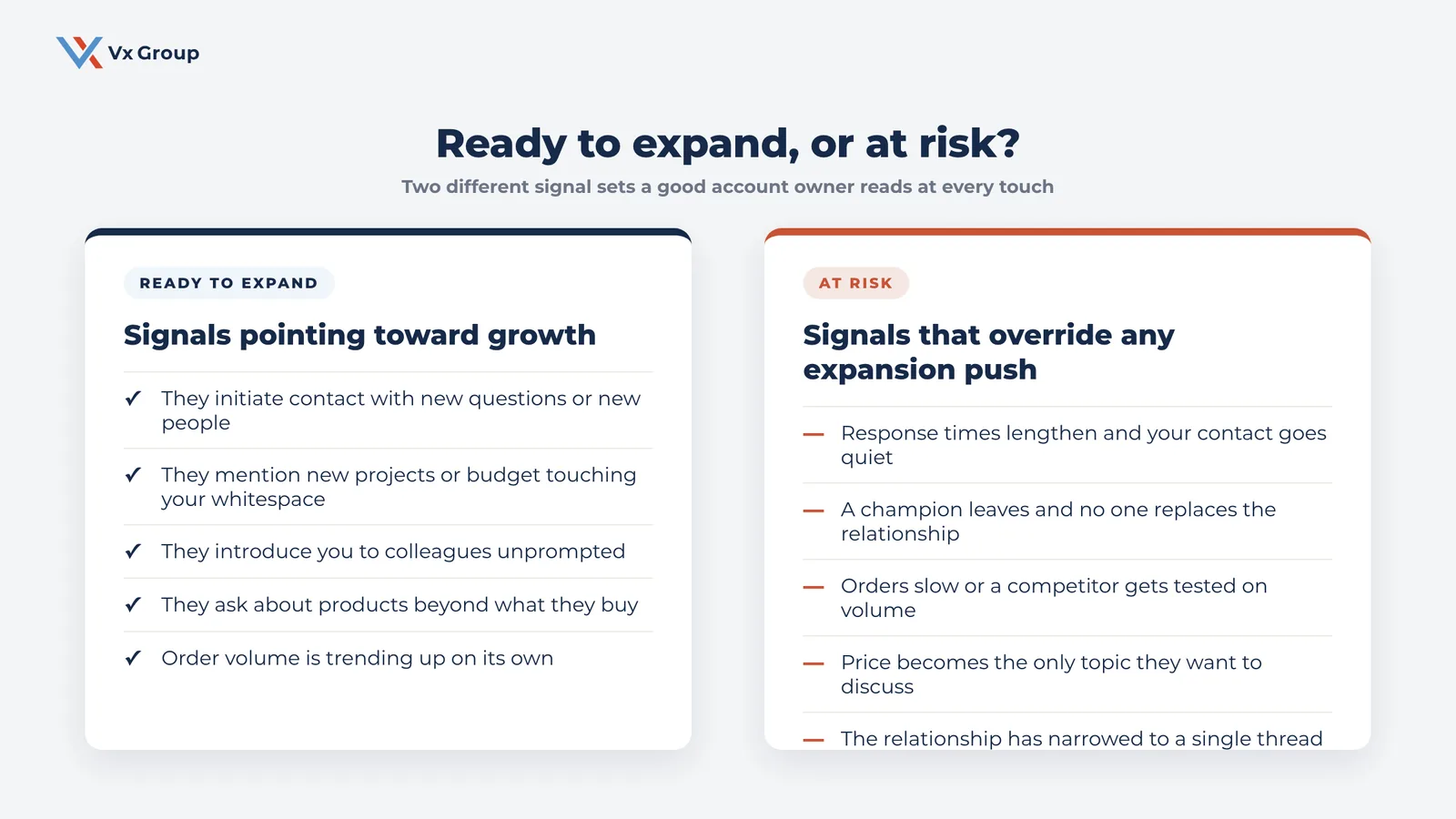
Readiness-to-expand signals point toward growth:
- They initiate contact with new questions or new people from their side.
- They mention new projects, budget, or strategic direction that touches your whitespace.
- They introduce you to colleagues without being asked.
- They ask about products or services beyond what they currently buy.
- Their usage or order volume is trending up on its own.
At-risk signals point toward defense and should override any expansion push until resolved:
- Response times lengthen and your main contact goes quiet.
- A champion leaves or changes roles, and no one has replaced that relationship.
- Orders slow, or they start testing a competitor on part of the volume.
- Pricing suddenly becomes the only topic they want to discuss.
- Your relationship has narrowed to a single thread.
The through-line is that both readiness and risk are visible early to anyone actually watching. Reactive account management waits for the number to move. By the time revenue drops, the champion left two quarters ago. The companion risk to watch here is concentration: expanding an already-large account can quietly push you into dangerous dependency, which is worth managing deliberately. See Customer Concentration Risk: What It Is and How to Reduce It for how to keep expansion from becoming exposure.
Reading these signals well depends on seeing the account’s activity in one place instead of in one person’s head, which is the same discipline that makes a pipeline trustworthy. For the mechanics of that visibility, see Sales Pipeline Management: How to Run a Pipeline That Doesn’t Live in One Person’s Head.
Field Notes: how one supplier grew a mid-tier account into a top-five relationship
Field Notes
A components supplier we worked with had an account that had ordered the same single product line for six years, steady and unremarkable, sitting in the middle of their book. When they built their first expansion map, the account lit up: they held maybe 20 percent of the customer’s relevant spend, had one contact, and had never sold into three of the customer’s four facilities.
They did three things on purpose over three years. They multi-threaded, using a QBR introduction to meet the operations lead at a second facility. They walked the whitespace, discovering that two unbought product lines solved problems the customer was handling with a supplier they disliked. And they set a named owner and a quarterly review rhythm so the account was worked between orders, instead of only when an order came in.
By year three the account had moved from mid-tier to a top-five relationship, buying three product lines across three locations. Nothing about the product changed. What changed was that someone decided to grow the account on purpose instead of waiting for it to grow itself.
None of this was easy for that supplier, but the pattern is worth naming: expansion stays invisible until someone maps it, and unclaimed until someone owns it. The revenue was available the whole time. It took a decision to go get it.
How is account expansion different from retention and account management?
Account expansion grows revenue inside an account, retention protects the revenue already there, and account management is the ongoing role that does both. They are easy to blur, and blurring them is why so many companies do all three badly with the same undifferentiated effort.
| Function | The core question | What success looks like |
|---|---|---|
| Account expansion | How do we sell more into this account? | Revenue and product penetration grow year over year |
| Customer retention | How do we keep this account? | Renewal and repeat revenue hold or improve |
| Account management | Who owns this relationship day to day? | The account is worked on a deliberate rhythm rather than in reaction to problems |
The practical reason to keep them distinct is that they call for different work at different moments. An at-risk account needs retention work, and pushing expansion into it makes things worse. A healthy, under-penetrated account needs expansion work, and treating it as a maintenance relationship leaves money on the table for years. Account management is the role that reads which mode an account is in and applies the right one. Run all three as one deliberate practice, with clear ownership and a regular review rhythm, and the account base itself becomes a growth engine.
Ready to grow?
See how an account expansion strategy would map to your own book of business.
Conclusion
The growth most B2B companies are hunting for is already inside the accounts they serve. It hides because expansion has no empty-pipeline alarm to force the work, and because account management is too often a function that reacts to problems instead of a discipline that pursues growth. Map the whitespace, rank the relationships, estimate the share of wallet, and give every priority account an owner and a quarterly rhythm. The company that works its existing accounts on purpose grows faster, more cheaply, and more durably than the one still chasing the next cold logo.
FAQs
About the Author: Jacob Camhi
