

What Is a Growth Framework (and What Makes One Actually Work)

A growth framework is the decision structure a company uses to direct its growth effort: which customers it is best positioned to win, who owns each part of the work, which markets come first, and how it earns trust over time. A working one connects those decisions into a system a team can run, instead of a list of tactics to try.
TL;DR
- A growth framework is a decision structure, not a campaign calendar or a menu of channels.
- Most “frameworks” are tactic lists wearing a diagram. They tell a team what to do without saying who to do it for or why.
- A real framework answers four questions: who your best-fit customers are, who owns each part of growth, which markets come first, and how trust gets built.
- The practical test is whether the framework helps your team say no to attractive opportunities that do not fit.
- Relationship-driven B2B companies need a framework built around intention, because their long sales cycles and high account values punish scattered effort.
What does “growth framework” actually mean?
A growth framework is the set of decisions that determine where growth effort goes before any tactic is chosen. It sits above the marketing calendar, the sales playbook, and the channel mix. Those things are how you execute. The framework is what tells you which execution is worth doing in the first place.
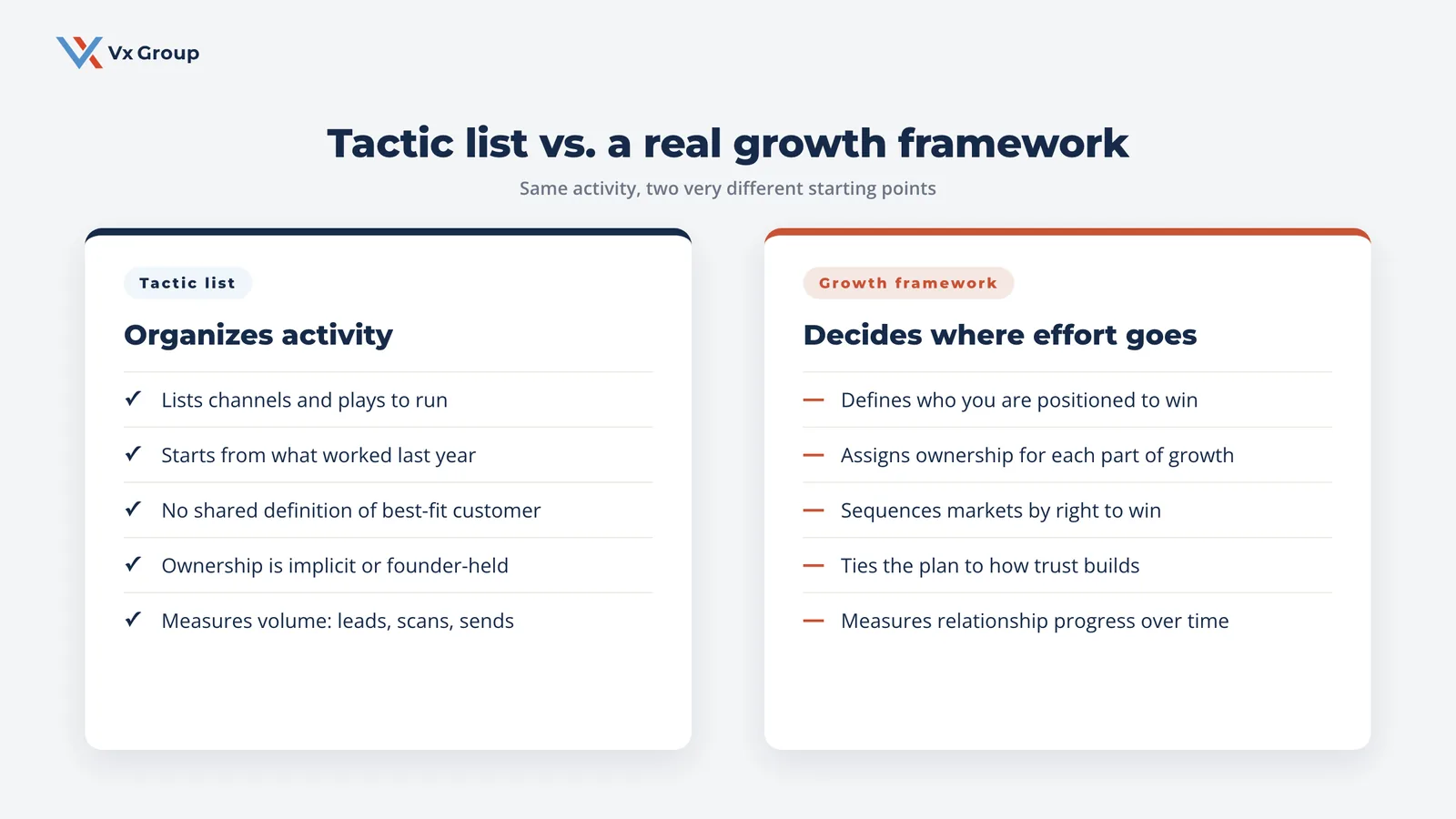
The distinction matters because the word “framework” gets attached to almost anything. A list of seven marketing channels becomes a “growth framework.” A funnel diagram becomes a “growth framework.” A quarterly campaign plan becomes a “growth framework.” None of those decide anything. They organize activity that has already been chosen, usually by instinct or by whatever worked last year.
Defined Term: Growth framework
The structure of decisions that defines who a company is best positioned to win, who owns each part of growth, which markets come first, and how trust is built and measured over the life of a relationship. It governs where effort goes before tactics are selected.
Why do most growth frameworks fail?
Most growth frameworks fail because they are tactic lists wearing a diagram. They describe motion without direction. A team can follow one for a full year, stay busy the entire time, and still have no clear answer to the only question that matters: are we putting effort into the relationships and markets where we actually win?
This is the difference between a framework and a checklist of best practices. A checklist says “run these plays.” A framework says “here is who we are running them for, here is who owns the outcome, and here is how we will know it worked.” When a framework skips the second part, every tactic inside it becomes a coin flip. The company is busy. It is just busy without a thesis.
Relationship-driven B2B companies feel this failure more sharply than most. When a sales cycle runs twelve months and a single account can be worth millions over its life, scattered effort is expensive in a way it never is for high-velocity, low-ticket businesses. A SaaS company can run dozens of small experiments and let volume sort out the winners. A company with fifty deep relationships and a long buying process cannot. It needs to be right about where it points its attention, because it does not get many shots.
What does a real growth framework include?
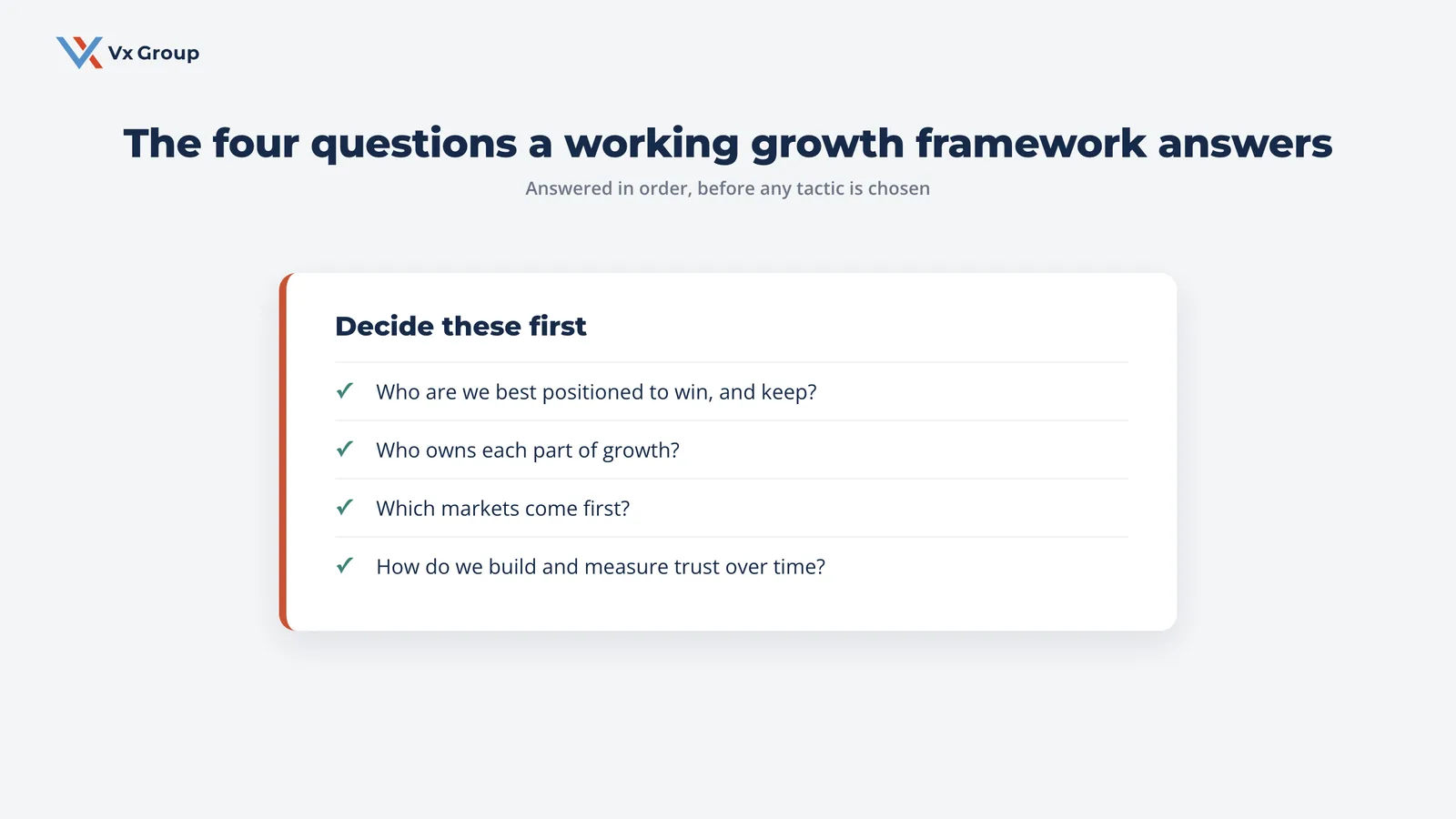
A real growth framework answers four questions before anyone argues about tactics. Each one is a decision, and each one constrains the next.
Defined Term: The four questions a working growth framework answers
Who are we best positioned to win? Who owns each part of growth? Which markets come first? How do we build and measure trust?
1. Clarity on best-fit customers
The first job of a framework is to define who you are genuinely positioned to win, not who you would take a check from. Most companies can describe their average customer. Far fewer can describe the customer they win consistently, keep for years, and grow inside. That second description is the one a framework is built on.
Best-fit clarity is what lets a team disqualify. It turns “we serve mid-market manufacturers” into “we win with second-generation manufacturers who sell through distributors and have outgrown a founder-led sales motion.” The narrower definition feels risky. In practice it is what makes every downstream decision faster, because the team finally shares a picture of who they are aiming at.
2. Defined roles and ownership
A framework that no one owns is a poster. The second component assigns responsibility for each part of growth: who owns demand, who owns the existing relationships, who owns the handoffs between them. In most stalled companies, growth lives in one or two people’s heads, usually the founder’s. That is not a framework. It is a dependency, and it is a risk that grows quietly until one resignation or one retirement exposes it.
Defining roles is how a company makes growth repeatable instead of personal. It is also how systems start to protect the relationships that matter, rather than leaving them to chance. We have written more about why this matters in What Is a Business Growth Operating System?, which covers how ownership and process turn a strategy into something the business can run without its founder in every room.
3. Priority markets
The third component decides where to go first. Every company with more than one viable market faces a sequencing problem, and most solve it by accident: they chase whichever opportunity called most recently. A framework replaces that with a deliberate order, based on where the company has the strongest right to win and the shortest path to trust.
Priority is a forcing function. Naming the first market means naming the markets that wait, and that is exactly the discipline a tactic list never imposes. A company that treats every market as equally urgent spreads itself thin enough that none of them feel a real presence.
4. A plan tied to how trust builds
The fourth component connects growth activity to the way trust actually accumulates in a relationship-driven business. In these companies, revenue follows trust, and trust builds through a sequence of credible interactions over time, not through a single conversion event. A framework that ignores this measures the wrong things: it counts leads and badge scans instead of relationship progress.
A plan tied to trust asks a different question of every interaction: what is this worth over the life of the relationship, not just this quarter? That lens changes what a company prioritizes. One referral, one well-handled service issue, or one early conversation can be the start of a multi-year relationship, and a framework should treat it that way.
How is a framework different from a growth strategy or a growth plan?
A framework, a strategy, and a plan operate at different altitudes, and confusing them is part of why growth stalls. The framework is the structure of decisions. The strategy is the specific bet you make inside that structure. The plan is the sequence of actions that executes the bet.
Defined Term: Strategy vs. framework
A growth strategy is the specific choice a company makes (which segment, which offer, which path to market). A growth framework is the reusable structure that produces and tests those choices. You build the framework once and run many strategies through it.
Put plainly: the framework is the machine, the strategy is what you decide to make with it, and the plan is the work order. A company that has a plan but no framework is executing decisions it never consciously made. That is the most common version of growing by accident, a pattern we unpack in Why Most B2B Companies Grow By Accident. For teams starting from zero, our guide on how to build a B2B growth strategy from scratch walks through making those first decisions in order.
Ready to grow?
Build a growth framework that holds up under real sales cycles, instead of a poster on the wall.
How do you build a growth framework from scratch?
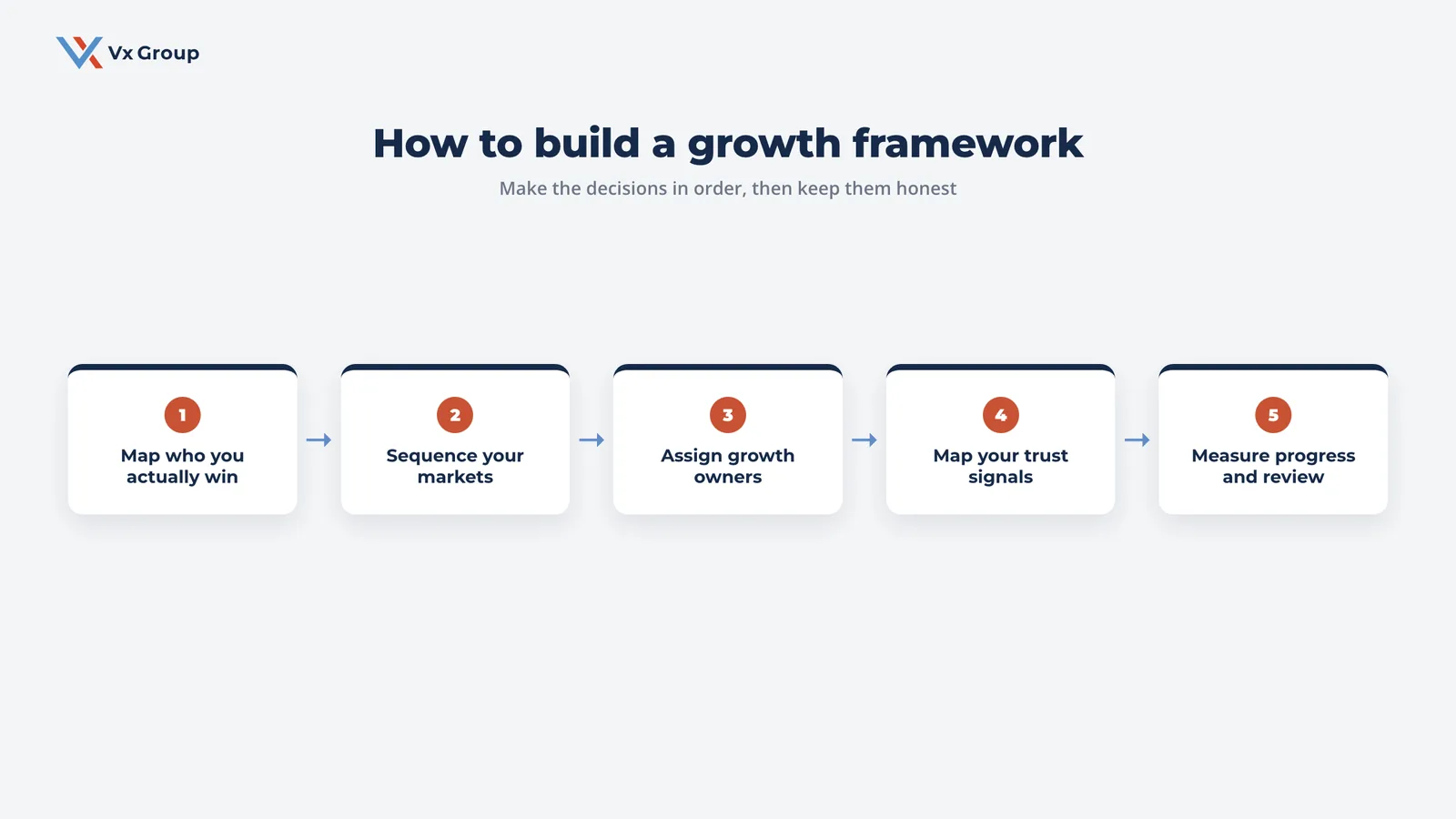
You build a growth framework by making four decisions in a deliberate order, then wrapping them in a review rhythm that keeps them honest. Most teams start with tactics and try to back into the decisions later. The order below works because each step narrows the next, so by the time you reach tactics, the worst options have already been ruled out.
Step 1: Map the customers you actually win
Pull your last two or three years of closed business and sort it by which accounts you won quickly, kept the longest, and grew inside. Look for what those accounts share: industry, size, how they buy, what triggered the first conversation, who championed you internally. The pattern in that list is your best-fit definition. Write it in one or two sentences specific enough that a salesperson could disqualify a prospect with it in under a minute.
Skip the exercise where you describe your imagined ideal customer. The accounts you already win tell the truth about where you have a real right to compete, and the accounts you lost or churned tell you where you do not. Start from the evidence you already have on the books.
Step 2: Choose the one market you will lead with
Rank your viable markets on two factors: where you have the strongest evidence of winning, and where the path to a trusted relationship is shortest. Pick the one that scores highest on both and name it as your lead market for the next two to four quarters. Put the rest in an explicit “next” column so the team can see they are deferred, not abandoned.
Naming one market is the hardest step for most leadership teams, because every market has an internal champion who will argue for urgency. Make the call anyway. A framework that refuses to sequence its markets is a wish list with a logo on it.
Step 3: Assign an owner to every part of growth
List the parts of growth your business actually runs: new demand, existing-relationship expansion, referrals and partnerships, proposals and pursuits, onboarding handoffs. Put a single name next to each one. Where the honest answer is “the founder,” flag it, because that is the dependency the framework exists to reduce.
Ownership does not mean one person does all the work. It means one person is accountable for whether that part of growth moves. Without that line of accountability, the framework describes a system that no one is actually responsible for running.
Step 4: Define what trust looks like at each stage
Map the stages a relationship moves through in your business, from first contact to a multi-year account. For each stage, write down the specific signal that someone has moved forward: a second meeting requested, a problem handed to you to solve, an introduction made, a small first order placed. These signals are how you measure progress, and they are far more honest than lead counts.
This step is what separates a relationship-driven framework from a generic funnel. A funnel measures whether someone advanced toward a purchase. A trust map measures whether the relationship itself got stronger, which in a long-cycle business is the thing that actually predicts revenue.
Step 5: Choose metrics that track relationship progress, not activity
Replace volume metrics with progress metrics wherever you can. Instead of leads generated, track relationships that advanced a stage this quarter. Instead of emails sent, track conversations that produced a real next step. Keep one or two activity metrics if they genuinely predict outcomes, and retire the rest.
The purpose of this step is to stop rewarding motion for its own sake. When a team is measured on activity, it produces activity. When it is measured on relationship progress, it gets selective about where that activity goes, which is the entire reason to have a framework.
Step 6: Set the review rhythm that keeps the framework alive
Schedule a recurring review, monthly or quarterly, where the leadership team looks at the framework and asks three things: Did we stay inside our best-fit definition? Did we hold our market priority, or did we get pulled off it? Did relationships actually advance? A framework without a review rhythm decays into a document, and a document changes no behavior.
The review is also where the framework earns the right to evolve. If your best-fit definition was wrong, you will see it here in the accounts that did not behave as expected, and you update it on purpose rather than drifting away from it by accident.
What growth framework mistakes should you avoid?
Most growth frameworks break in a handful of predictable ways. Knowing them in advance is the cheapest way to keep your framework from quietly turning back into a tactic list.
Treating the framework as a one-time document
A framework built once and filed away stops matching reality within a quarter. Markets shift, accounts change hands, and your best-fit definition sharpens as you learn. The fix is the review rhythm from step six: treat the framework as a living instrument the leadership team revisits, not a deliverable that gets signed off and shelved.
Building the whole thing around the founder
When every part of growth traces back to one person’s relationships and judgment, the framework becomes a single point of failure with a diagram on top. The business feels stable right up until that person is unavailable. Assign real ownership early and document the relationships that currently live only in someone’s head, so the framework protects the company instead of disguising its biggest risk.
Borrowing a playbook built for a different kind of business
Most frameworks that circulate online were built for high-velocity, product-led companies with short cycles and cheap experiments. A relationship-driven B2B company with twelve-month cycles and seven-figure accounts cannot run dozens of low-cost tests and let volume sort out the winners. Borrowing that playbook produces a framework optimized for the wrong physics. Build for your sales cycle and your account values.
Measuring activity instead of trust
A framework that still counts leads, sends, and badge scans has imported the exact habit it was supposed to replace. Activity metrics feel productive and are easy to report, which is why they survive. Swap them for the progress metrics from step five, or the framework will drift back toward a tactic list with better formatting.
What does a growth framework look like in practice?
A common turning point looks like this. A company with strong relationships and flat growth finally maps its closed business and discovers that nearly all of its best accounts came from one industry and one type of buyer, even though the sales team had been chasing four segments at once. It names that segment as its lead market, assigns its strongest relationship manager to own expansion inside existing accounts, and rebuilds its weekly sales review around relationships that advanced rather than calls made.
Within a couple of quarters the pipeline looks smaller on paper and stronger in practice, because the team stopped pouring effort into markets where it had no real right to win. What changed was the decision structure that told the team where to point the tactics they already had, so the same plays finally ran where the company had a real right to win.
How do you know if your growth framework is actually working?
The clearest test is whether the framework helps your team say no. A framework that only ever validates what you were already going to do is decoration. A working one regularly tells you to pass on an attractive opportunity because it falls outside your best-fit definition, your priority markets, or your capacity to build trust well.
A second test is whether the framework survives a change in personnel. If the person who holds the relationships leaves and the framework still tells the team who to focus on and how to move forward, it is real. If growth walks out the door with them, what you had was a person, not a framework.
The last test is consistency of language. In companies with a working framework, the sales leader, the marketing lead, and the founder describe the growth priorities the same way without rehearsing. When those three answers diverge, the framework exists on a slide, not in the business.
Conclusion
A growth framework earns its name when it changes what a company chooses to do, not just how the company describes what it was already doing. The four decisions (best-fit customers, ownership, priority markets, and a plan tied to trust) are what separate a structure a team can run from a tactic list that keeps everyone busy. If your current framework has never once told you to walk away from a good-looking deal, it is not yet doing its job.
—
Ready to grow?
See how relationship-driven B2B companies build a framework that survives real sales cycles.
FAQs
About the Author: Jacob Camhi
