

Industrial B2B Marketing: How Manufacturers Win New Business

Industrial B2B marketing is the practice of winning new business for manufacturers and distributors through relationships, reputation, and trust rather than high-volume digital funnels. It works on long sales cycles, technical buyers, and referrals. The companies that grow treat marketing as a system for building relationships at scale.
TL;DR
- Industrial buyers are skeptical of marketing and buy from companies they already trust, so relationship-building beats lead-volume tactics.
- The SaaS growth playbook fails in industrial markets because sales cycles run 6 to 18 months and switching costs are high.
- The channels that actually win industrial business are trade shows, referrals, channel partners, and credible technical thought leadership.
- Most industrial companies are “best kept secrets” whose digital presence makes them look smaller than they are.
- Marketing’s real job in an industrial company is to create and protect relationships, then make them repeatable with systems.
- Measure relationship quality and pipeline movement instead of badge scans and impressions.
Most manufacturers who say “marketing doesn’t work for us” are right about the marketing they tried. They hired an agency, ran some ads, posted on LinkedIn, paid for a new website, and waited for leads that never came. The real villain is random acts of marketing: a scattered, tactic-first approach borrowed from industries that look nothing like theirs. Their product and their market are usually fine.
Industrial companies sell complex products to technical buyers across sales cycles measured in quarters rather than clicks. A spray-and-pray campaign aimed at filling a funnel ignores how these deals are actually won. This guide lays out what industrial B2B marketing really is, why it follows different rules, and where to put your time and budget so it produces new business.
What is industrial B2B marketing?
Industrial B2B marketing is how manufacturers, distributors, and industrial suppliers attract, earn, and expand business relationships with other businesses. It centers on trust, technical credibility, and long-term relationships instead of transactional lead generation.
The defining feature is the buyer. An industrial buyer is rarely a single person clicking “buy now.” It is a buying group: an engineer who specifies the part, a purchasing manager who negotiates the terms, an operations leader who lives with the consequences, and often an owner or executive who signs off on anything strategic. Each has different questions, different fears, and a different definition of risk.
Defined term: Industrial B2B marketing
Generating and growing revenue for industrial companies (manufacturers, distributors, fabricators, and suppliers) by building credibility and relationships with technical, multi-person buying groups over long sales cycles. Its unit of measure is relationship value over time rather than lead volume.
That buying group does not respond to urgency tactics or clever copy. They respond to evidence that you understand their problem, that you have solved it before for companies like theirs, and that you will still be answering the phone in three years when something goes wrong.
Why is industrial marketing different from other B2B marketing?
Industrial marketing is different because the sales cycle is long, the buyers are technical and risk-averse, and the relationships outlast the products. The playbooks built for software or professional services break down when applied to a company selling precision components or industrial equipment.
Borrowing the wrong playbook is a common and expensive mistake. The tactics that drive high-velocity software growth (free trials, self-serve signups, aggressive retargeting, monthly campaign experiments) assume a fast cycle and a low cost of switching. Industrial buying assumes the opposite.
Here is how the two models actually compare.
| Factor | SaaS / high-velocity marketing | Industrial B2B marketing |
|---|---|---|
| Typical sales cycle | Days to weeks | 6 to 18 months |
| Primary buyer | Individual or small team | Multi-person buying group |
| Decision driver | Features, speed, price | Trust, risk reduction, proven fit |
| Cost of switching vendors | Low | High, often years of integration |
| What marketing produces | Volume of inbound leads | Qualified relationships and warm introductions |
| Relationship lifespan | Months to a few years | 10 to 20+ years |
| Best channel | Paid digital, content funnels | Trade shows, referrals, channel partners |
| Right metric | Conversion rate, CAC | Relationship quality, pipeline movement |
A manufacturer who measures success the way a software company does will optimize for the wrong thing every quarter. Growth in industrial markets comes from clarity about where you already win and intention about deepening those relationships, rather than from simply doing more.
What actually wins new business for manufacturers?
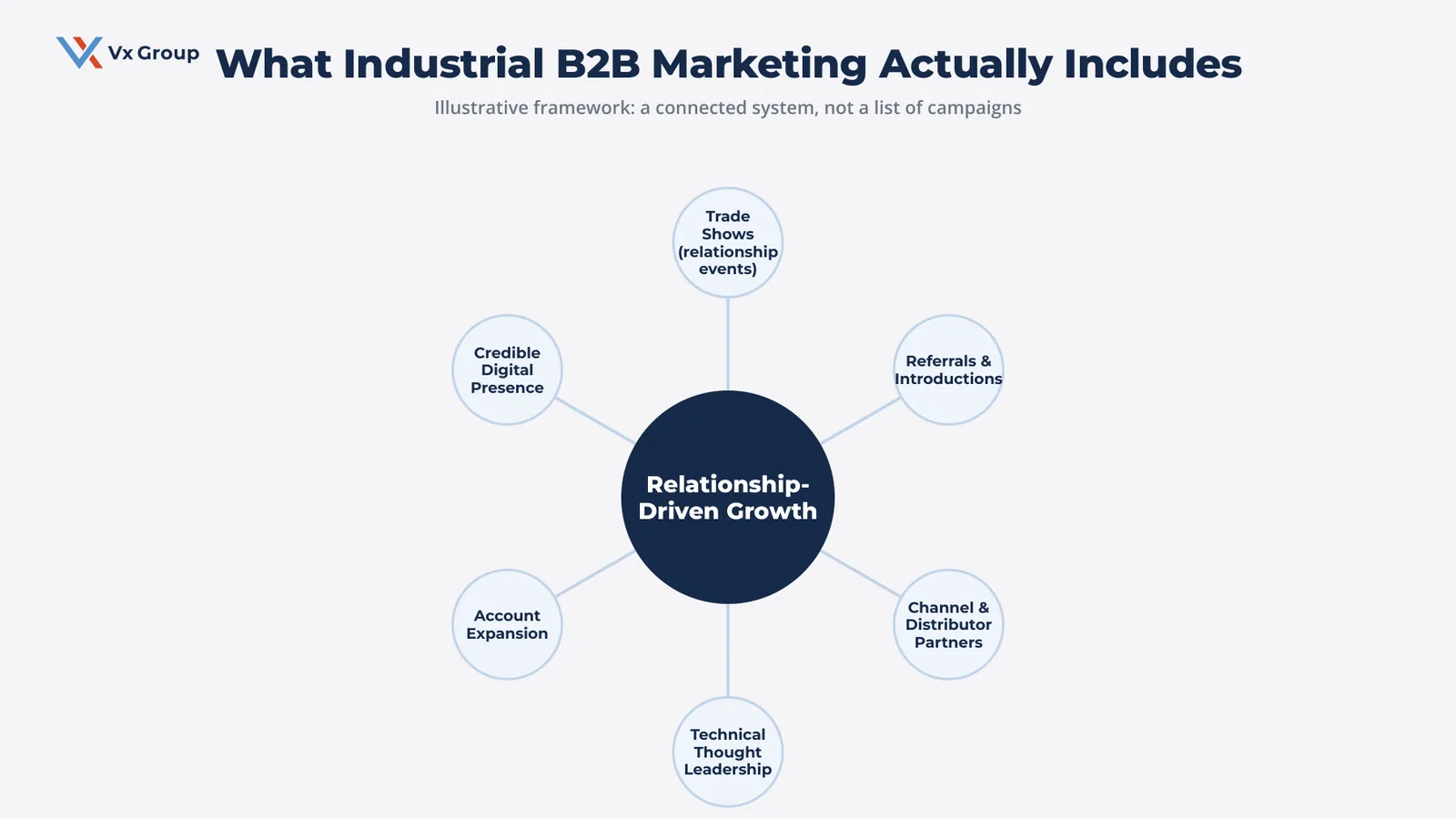
The channels that win industrial business are the ones that build trust before a buyer ever needs you: trade shows, referrals and introductions, channel and distributor relationships, and technical thought leadership that proves you know the work. Digital presence supports all four, but it rarely closes the deal on its own.
Think of industrial marketing as a connected system rather than a list of campaigns. Each channel feeds the others, and trust compounds across them.
Treat trade shows as relationship events, and stop counting badges
Trade shows are the single most underused asset in industrial marketing, and the most commonly misused. Companies that badge-scan every passerby and count leads are measuring how busy the booth was rather than whether they advanced any relationship worth pursuing.
The companies that win at trade shows arrive with a plan: a list of existing customers and target accounts they intend to see, specific conversations they want to have, and a follow-up sequence ready before they leave. A show is the rare moment when a year’s worth of relationship-building can happen in three days, face to face, with people who already know your industry.
Referrals and introductions carry more weight than any ad
A warm introduction from a trusted peer outperforms every paid channel in industrial markets, because it transfers existing trust. When a plant manager recommends a supplier to another plant manager, the credibility problem is solved before the first call.
The danger is depending on referrals without a system to generate them. A company stuck at the referral ceiling grows only as fast as word of mouth happens to spread, with no way to influence it.
Defined term: The referral ceiling
The growth plateau a company hits when new business depends entirely on unprompted word of mouth. Revenue grows only as fast as referrals happen on their own, with no system to ask for, earn, or direct them. Breaking through requires making referral generation intentional and repeatable.
Channel partners extend reach without diluting trust
Distributors, reps, and channel partners let an industrial company reach buyers it could never call on directly, as long as the partner relationships are managed rather than assumed. A strong channel multiplies your sales force; a neglected one quietly recommends your competitor.
Treating channel partners as an extension of your own team (with shared materials, training, and clear economics) turns them into advocates. For a deeper treatment, see our guides to channel partner programs and dealer network strategy.
Technical thought leadership proves you know the work
Content earns industrial buyers’ trust when it demonstrates real expertise rather than when it chases keywords. An application note, a teardown of a common failure mode, or a clear explanation of a specification decision tells a skeptical engineer that you have actually done the work.
This is where most industrial content fails. Generic blog posts written for an algorithm signal the opposite of expertise. One genuinely useful technical resource will earn more credibility than fifty thin articles.
Ready to grow?
Turn the channels that win industrial business into a system that runs without depending on one person.
Why do so many good manufacturers stay invisible?
Many excellent manufacturers stay invisible because they have underinvested in how they show up. Their work is exceptional, their reputation among existing customers is strong, and yet a prospect researching them online finds a dated website that makes a respected company look like a minor player.
This is the best-kept-secret problem, and it is self-inflicted. The gap that costs them deals sits between the reality of the business and the impression it creates before anyone talks to a human.
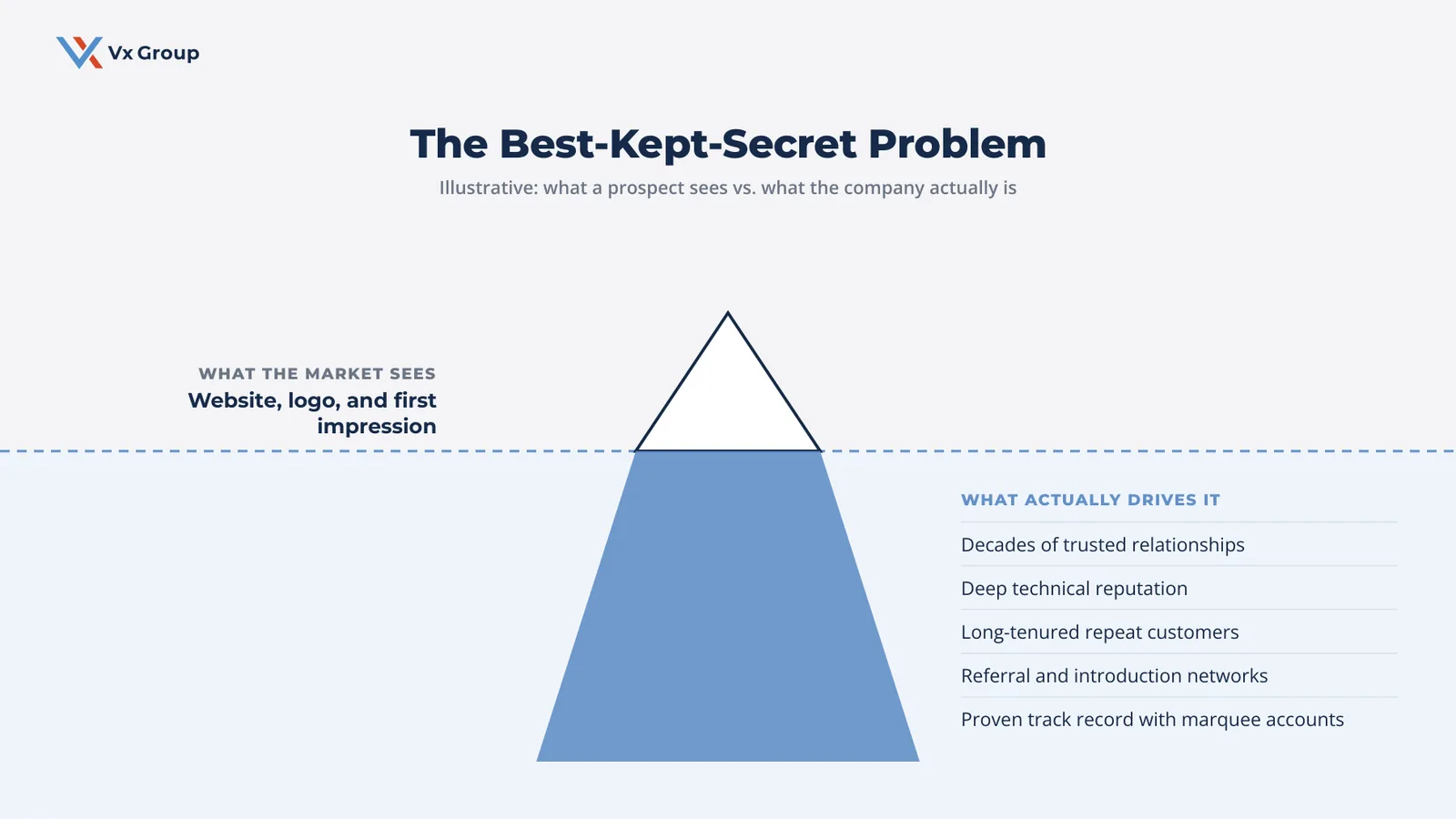
What a buyer can see (your website, your proposals, your trade show booth, your first email) is a small fraction of what your company actually is. Below the surface sits decades of relationships, technical depth, and earned reputation that no prospect can perceive yet. When the visible surface looks smaller than the company, you lose deals you should have won, and you never know it happened.
Brand is the first trust deposit. For an industrial company, brand has little to do with a clever logo or a campaign. It means every touchpoint a prospect encounters before the relationship begins signals competence, stability, and fit. A modern, credible digital presence earns the meeting where a relationship can start; it never replaces the relationship itself.
Field Notes
A precision components manufacturer with a 40-year reputation and several marquee customers kept losing new opportunities to a smaller, newer competitor. The product was not the problem. When their prospects researched both companies, the competitor’s polished site and clear technical content made it look like the established player, while the manufacturer’s outdated presence made a respected company look like a risky unknown. Closing that perception gap (clear positioning, credible proof, technical content that showed depth) recovered deals that were being lost in the first ten minutes of research, before sales ever got involved.
How should an industrial company actually structure its marketing?
An industrial company should structure marketing as a system that creates relationships and then protects them, rather than a series of disconnected campaigns. The goal is repeatable, intentional relationship-building that does not live or die with one salesperson.
Most industrial growth runs through a handful of deeply trusted individuals. That works until it does not. A retirement, a resignation, or a vacation can put millions in relationship value at risk overnight, because the knowledge lives in someone’s head instead of in the business.
Systems protect the human side of growth. When you document who your best relationships are, why they buy, how they were won, and what keeps them loyal, you make excellent behavior repeatable regardless of who is in the seat. That is the difference between a company that grows through one rainmaker and one that grows on purpose.
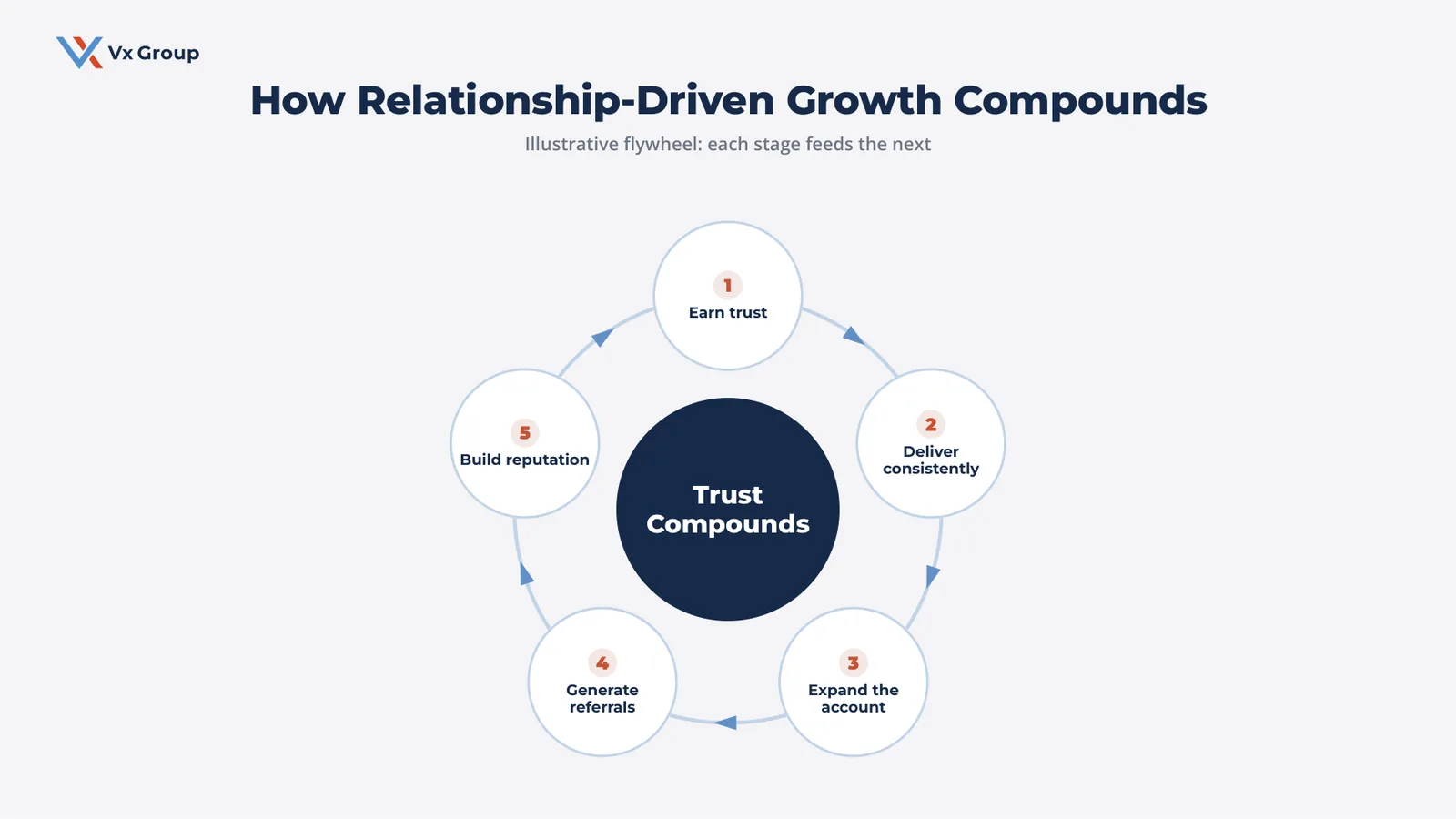
A relationship-driven system tends to compound. Each strong relationship produces referrals, references, and expansion, which build reputation, which makes the next relationship easier to start.
The starting point is clarity before activity. Before spending another dollar on growth, an industrial company should be able to name its best-fit customers, the pattern its strongest accounts share, and the markets where it has the right to win. That clarity is what makes every downstream marketing decision sharper. If you have not defined that profile yet, start with What Is an Ideal Customer Profile, then connect it to How the B2B Growth Engine Works in a Manufacturing Company.
Defined term: Best-fit customer
The type of customer where your company wins more often, delivers more value, keeps the relationship longer, and earns better margins. Best-fit is defined by the shared pattern across your strongest existing accounts rather than by who is willing to buy. Targeting best-fit customers raises win rates and lowers the cost of every marketing channel.
How do you measure industrial B2B marketing?
Measure industrial marketing by the quality and movement of relationships rather than by activity metrics like impressions, clicks, or badge scans. The right questions are whether you are reaching your best-fit accounts, whether relationships are advancing, and whether pipeline is moving toward revenue.
Activity metrics feel productive and mislead constantly. A booth can scan five hundred badges and produce nothing. A campaign can generate a thousand impressions and reach no one who matters. Counting effort tells you the team was busy, which is not the same as growing.
A more useful set of measures for an industrial company includes: how many target accounts you are in active conversation with, whether each key relationship moved forward or stalled this quarter, where deals are getting stuck in the cycle, and how much revenue is concentrated in relationships that have no succession plan. Those numbers tell you what to do next. Activity metrics only confirm that the team stayed busy.
What is the first move for a manufacturer starting from scratch?
The first move is to get clear on where you already win before you add any new activity. Rank your existing accounts by relationship quality and value, find the pattern your best customers share, and use that pattern to define who you should be pursuing.
This sounds simple and almost no one does it. Most companies react to whatever opportunity shows up rather than designing growth around their strongest accounts. Starting with clarity means your trade show targets, your referral asks, your content, and your channel strategy all point in the same direction, toward more of the customers you are built to serve.
From there, the sequence is straightforward: fix the first impression so your digital presence matches the quality of your company, make referral generation intentional instead of accidental, treat your next trade show as a relationship campaign with a plan, and put the whole thing on a system so it survives any one person leaving. None of it requires doing more. It requires doing the right things with intention.
Win the business you should already be winning
Industrial B2B marketing rewards the companies that understand how trust is actually built in their market and design around it. The manufacturers that grow are not the ones running the most campaigns. They are the ones who get clear about where they win, fix how they show up, and turn relationship-building into a system that does not depend on any single person.
If your growth has flattened, or it all runs through one or two people, the path forward is clarity before activity. Vx Group helps relationship-driven industrial Companies Build that system.
Ready to grow?
Grow your industrial B2B company by winning the business you should already be winning.
—
FAQs
About the Author: Jacob Camhi
