

What Is ABM Marketing? A Practical Guide for B2B Companies

Account-based marketing (ABM) is a B2B growth approach that concentrates sales and marketing effort on a defined set of high-value accounts, treating each one as a market of its own. Rather than chasing volume, you build deep, coordinated relationships inside the accounts most likely to grow. Relationship-driven companies have done a version of this for decades.
TL;DR
- ABM focuses your time, money, and attention on a short list of accounts that can actually move your revenue, instead of casting a wide net.
- It works because most B2B revenue is concentrated in a handful of relationships, so depth beats reach.
- The technology and acronyms are new. The behavior, picking your best-fit accounts and investing in the people inside them, is what good operators have always done.
- You do not need expensive software to start. You need a clear target list, a relationship plan per account, and sales and marketing rowing in the same direction.
- Success is measured by relationship depth and account growth, not by how many leads you collected.
- ABM fits companies with high-value, long-cycle, relationship-based sales. It is a poor fit for low-price, high-volume transactions.
Most B2B Companies spread their growth budget thin. A little paid search here, a trade show booth there, a newsletter no one opens, a list of 4,000 cold contacts that produces three conversations. The activity feels like progress, though the pipeline rarely reflects it.
This is the cost of random acts of marketing: motion without direction. For companies whose revenue depends on a small number of significant relationships, that scattered approach does more than waste budget. It starves the accounts that matter most of the attention they need to grow.
Account-based marketing is the correction. This guide explains what ABM is, how it differs from traditional demand generation, why it fits relationship-driven B2B companies better than almost anyone selling ABM software will tell you, and how to run a program without buying a single new tool.
What is ABM marketing?
ABM marketing is a strategy that targets a specific list of named accounts and coordinates every sales and marketing touch around winning and growing those accounts. The account is the unit of focus, so the work centers on whole organizations rather than individual leads. A company decides which organizations are worth pursuing, learns who matters inside each one, and builds a deliberate plan to earn and expand the relationship.
Traditional demand generation works in the opposite direction. It attracts a large pool of unknown prospects, captures their contact information, and filters them down toward a sale. ABM begins with the accounts you already know are valuable and works to get deeper inside them.
Defined term: Account-Based Marketing (ABM)
A B2B go-to-market strategy that selects a finite list of high-value target accounts and aligns sales and marketing to pursue each account with personalized, coordinated outreach. The goal is depth of relationship within chosen accounts, measured by account engagement and revenue, rather than total lead volume.
The phrase you will also see is simply “what is ABM,” and the Answer is the same. ABM and account-based marketing are the same thing. Some teams extend the idea to “account-based experience” or “account-based everything” to signal that the whole company, including service and delivery, organizes around target accounts. The core principle does not change: pick the accounts that matter, then concentrate.
How is ABM different from traditional B2B marketing?
ABM differs from traditional B2B marketing in direction, focus, and how success gets measured. Demand generation pulls in many prospects and narrows them down, optimizing for reach. ABM identifies a small set of accounts and goes deep, optimizing for relationship quality inside a defined target list.
Here is how the two approaches compare across the decisions that matter most.
| Dimension | Traditional demand generation | Account-based marketing |
|---|---|---|
| Starting point | A wide audience of unknown prospects | A defined list of named target accounts |
| Primary metric | Lead volume and cost per lead | Account engagement and account revenue |
| Sales and marketing | Often work in sequence (marketing hands leads to sales) | Work together on the same accounts from day one |
| Messaging | Broad, built for a segment | Personalized to the account and the people in it |
| Sales cycle fit | Shorter, higher-volume cycles | Longer, complex, high-value cycles |
| Budget logic | Spend to fill the top of the funnel | Spend to win and expand specific relationships |
| Best for | Products with large addressable markets | Companies where a few accounts drive most revenue |
Neither approach is wrong on its own. The mistake is running demand generation tactics against a market that rewards relationships. A company with twelve-month sales cycles and customers who stay for twenty years does not grow faster by collecting more cold leads. It grows by getting deeper inside the right accounts.
If you want the full breakdown of when to use each, see our guide on ABM vs. demand generation and the B2B demand generation guide.
Why does ABM work so well for relationship-driven companies?
ABM works for relationship-driven companies because it matches how their revenue is actually built: through a small number of deep, trusted relationships rather than a large number of shallow transactions. For these businesses, ABM simply names a discipline they already practice, the discipline of investing in the accounts most likely to grow.
Look at where revenue sits in most lower-middle-market B2B companies. A handful of accounts produce the majority of profit. Those relationships took years to build. They survive on trust, responsiveness, and a track record of delivery. The companies that own them rarely grew by buying lead lists. They grew by being the kind of partner a customer wants to keep.
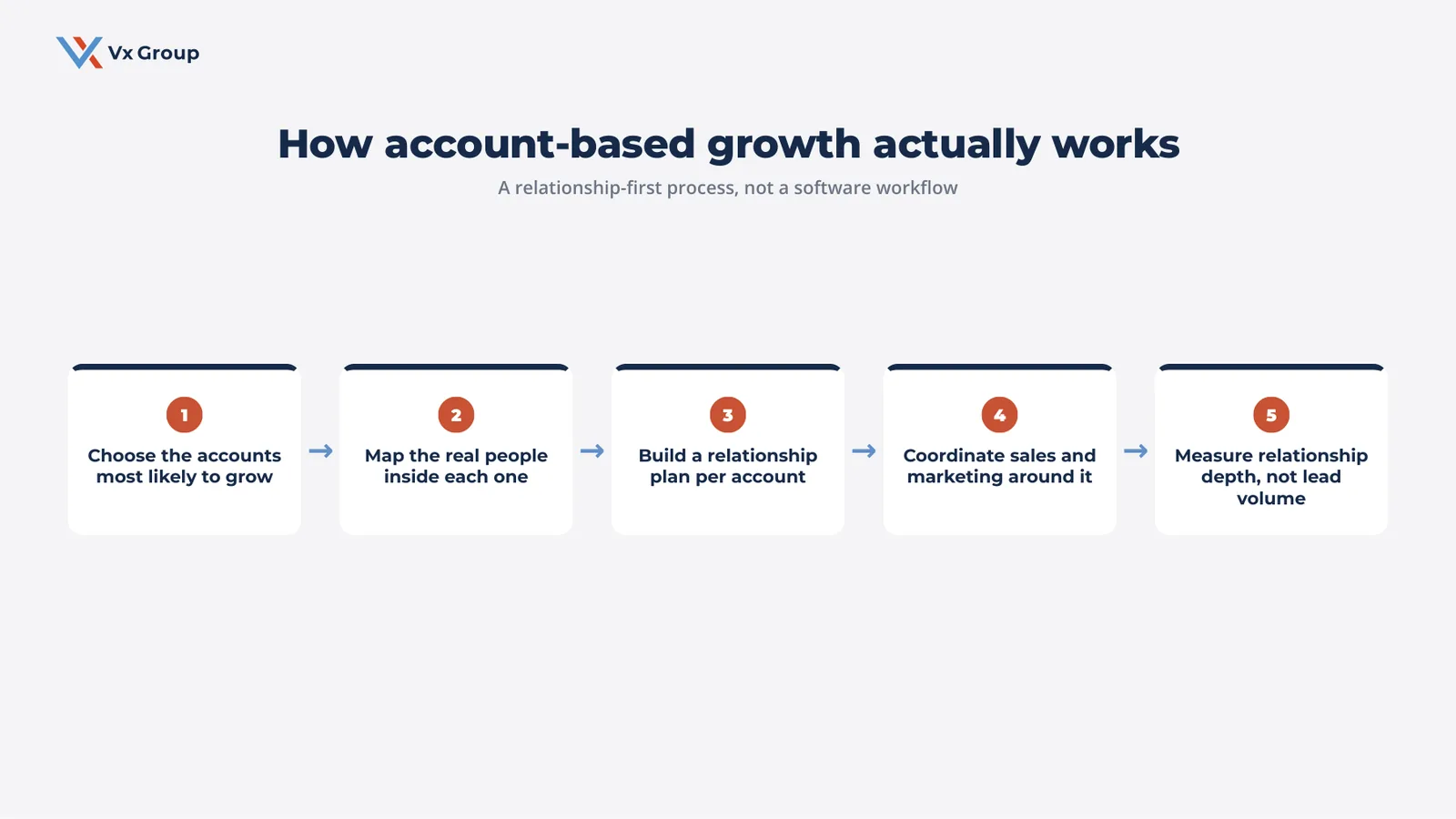
ABM gives that instinct a structure. It turns “we take care of our best customers” into a repeatable process: choose the accounts, map the people, plan the relationship, coordinate the team, and measure what is actually deepening.
There is a second reason ABM fits these companies. Their growth is often locked inside one or two people. The founder knows everyone at the top three accounts. A veteran sales rep carries the relationships that took fifteen years to earn. When that knowledge lives only in someone’s head, a single resignation can put millions in revenue at risk. An account-based approach forces the relationships, the contacts, and the plan into a system the company owns. That protects the human side of growth instead of replacing it.
Which accounts should you target with ABM?
You should target the accounts where relationship depth and growth potential are both high, and stop spending on accounts where neither is true. The hardest part of ABM is the discipline of choosing a short list and saying no to everything else, long before any outreach begins.
Start with your own book of business. The accounts that already trust you and still have room to grow are usually your best targets, because the relationship cost is already paid. Then look outward to prospects that resemble your best customers in industry, size, and the way they buy. That profile is your ideal customer profile, and getting it right is the foundation of any account-based program.
Defined term: Ideal Customer Profile (ICP)
A precise description of the type of company most likely to become a high-value, long-term customer, based on attributes like industry, revenue, ownership structure, and buying behavior. The ICP defines who belongs on a target account list and, just as importantly, who does not.
A simple way to sort candidate accounts is to weigh two factors against each other: how deep the relationship already is, and how much the account could realistically grow. The four combinations point to four very different plays.
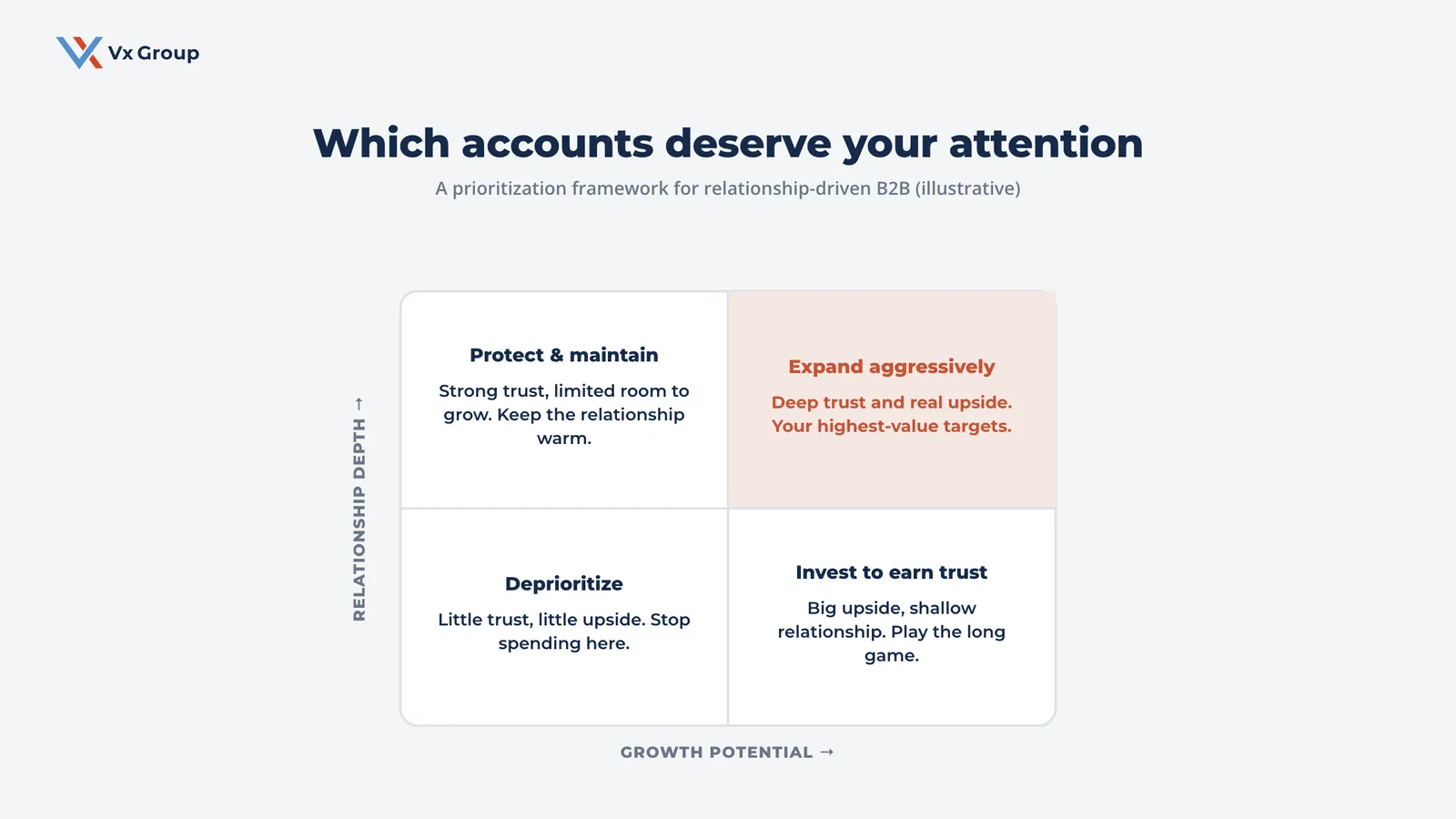
The accounts with deep trust and real upside deserve the most coordinated effort. Accounts with upside but a shallow relationship are worth a patient, long-game investment to earn trust. Accounts you already serve well with little room to grow need maintenance, not heavy spend. And accounts with neither trust nor upside should come off the list entirely, no matter how impressive the logo looks.
For a deeper method on defining who belongs on the list, read what is an ideal customer profile.
What are the main types of ABM?
There are three common types of ABM, and they differ by how many accounts you pursue and how personalized each engagement is. Most companies run a mix, matching the level of investment to the value of the account.
One-to-one ABM
One-to-one ABM is reserved for a small number of your highest-value accounts, often fewer than ten. Everything is tailored to the specific company: custom proposals, executive relationships, account-specific content, and a dedicated plan. The effort per account is high because the potential return is high.
One-to-few ABM
One-to-few ABM groups a slightly larger set of accounts, perhaps fifteen to fifty, that share a common situation or industry. Messaging is personalized to the cluster rather than the individual company. This is the primary tier for most relationship-driven businesses, because it balances personalization with reach.
One-to-many ABM
One-to-many ABM applies account-based principles to a broader list, often using data and light personalization to address hundreds of accounts that fit the profile. It is closer to targeted demand generation, but the target list is still defined by named accounts rather than anonymous traffic.
The right blend depends on how concentrated your revenue is. The more value sits in a few relationships, the more your effort should tilt toward one-to-one and one-to-few.
Ready to grow?
Turn your top accounts into a real account-based growth plan, instead of marketing to everyone and hoping.
How do you actually run an account-based program?
You run an account-based program by selecting target accounts, mapping the buying group, building a per-account plan, coordinating sales and marketing on every touch, and measuring relationship progress over time. The sequence matters more than any single tactic.
The first move is to build the target list using your ideal customer profile and the prioritization logic above. Keep it short enough that each account gets real attention. A list of 500 “targets” is just a contact database with a new name.
Next, map the people. In a complex B2B sale, no one signs alone. There is an owner or executive sponsor, a financial gatekeeper, an operational champion, and often a skeptic who can stall the whole thing. Knowing who they are, what each one cares about, and how they relate to one another is the real work of account-based selling.
Then build the relationship plan. For each account, decide what trust looks like, what the next meaningful interaction should be, and who on your team owns it. This is where marketing earns its keep, by creating the materials, introductions, and reasons to connect that move a relationship forward.
Coordination is the step most companies skip. Sales and marketing have to work the same accounts with the same message at the same time. When marketing is filling a funnel while sales is working a different list, the account-based advantage disappears.
Field Notes
A precision parts manufacturer we know was generating leads through trade shows and a generic email program, then wondering why pipeline stayed flat. Their actual revenue came from eight accounts, six of which they had never made a deliberate plan to grow. When they shifted to an account-based approach, they stopped measuring booth badge scans and started mapping the decision-makers inside those eight accounts. Within two quarters, two dormant accounts had expanded their orders, not because of a clever campaign, but because someone finally owned the relationship and had a plan to deepen it. The lesson holds across industries: the growth was already sitting inside the accounts they had. It just needed attention and a system.
The final step is the rhythm. A useful account plan gets reviewed regularly, updated as relationships move, and held accountable to progress. Companies that treat it as a living system compound their advantage. Companies that file it away are back to random acts of marketing within a quarter.
How do you measure ABM success?
You measure ABM success by how relationships deepen and accounts grow, not by how many leads you collected. The metrics that matter track movement inside your target accounts: engagement from the right people, progress through the buying group, expansion of existing accounts, and revenue per relationship over time.
Useful account-based measures include the number of target accounts actively engaged, the breadth of contacts reached inside each account, pipeline created within the target list, win rate on targeted accounts versus non-targeted deals, and net revenue growth in existing accounts. Each of these tells you something about relationship quality, which is the thing ABM is built to improve.
Lead volume and cost per lead, the staples of traditional reporting, say almost nothing in an account-based program. A campaign that produces 300 leads and zero movement inside your top ten accounts has failed, even though the lead report looks healthy. This is why finance and operations leaders, who tend to be skeptical of marketing, often warm to ABM faster than anyone. It ties spend directly to named accounts and measurable revenue, which makes the return far easier to see.
Is ABM right for your company?
ABM is right for your company if a small number of accounts drive most of your revenue, your sales cycles are long and involve multiple decision-makers, and your average deal is large enough to justify personalized effort. If those three things are true, you are likely already doing a rough version of ABM and would benefit from making it deliberate.
ABM is a poor fit if you sell a low-price product to a very large market with short, simple buying decisions. In that case, the math favors reach, and traditional demand generation will serve you better.
Most lower-middle-market industrial, manufacturing, construction, and B2B service companies sit squarely in ABM territory and do not realize it. They have the concentration, the long cycles, and the high deal values that make account focus pay off. What they usually lack is the system: a documented target list, a relationship plan per account, and the alignment between sales and marketing to execute it.
That gap is exactly where account-based growth strategy turns instinct into a repeatable advantage. If your growth has flattened and it depends on a few key relationships, the fix is rarely more activity. It is more intention, aimed at the right accounts. For the broader context on building that system, see our B2B growth strategy guide and what is B2B growth consulting.
Conclusion
ABM describes the disciplined version of something relationship-driven B2B companies have always done well: invest in the accounts most likely to grow, build real relationships with the people inside them, and protect those relationships in a system the company owns. The acronym is recent, but the behavior behind it has been proven for decades.
If most of your revenue lives in a handful of relationships, an account-based approach is the most direct path to growing it. The companies that win are the ones that stop spreading themselves thin and start concentrating on what matters.
Ready to grow?
See how an account-based program could compound growth across your most valuable accounts.
FAQs
About the Author: Jacob Camhi
