

How B2B Companies Build Brand Authority (Without Looking Like Everyone Else)

Brand authority is the trust a company earns before a buyer ever reaches out. In B2B, it comes from consistent, credible presence in the rooms where your buyers already spend their attention, which is why ad spend and viral content rarely produce it. It is what makes a prospect arrive at the first call already convinced you belong on the shortlist.
TL;DR
- Brand authority is earned trust that arrives before the first sales conversation, and it shortens cycles by removing the work of proving you are credible.
- The companies that look like everyone else are usually copying surface tactics from competitors instead of building from their own track record.
- Authority compounds from three sources: a clear point of view, proof you have done the work, and repeated presence where buyers spend attention.
- “Best-kept-secret syndrome” is the most common failure mode. Excellent companies stay invisible because they underinvest in how they show up.
- You do not need a bigger marketing budget. You need a documented position and the discipline to show up in the same places consistently.
- Authority is measurable through inbound quality, sales-cycle length, and how often you are named without prompting.
- Differentiation comes from saying what you actually believe, in language your buyers use, backed by specifics only you can offer.
Most B2B companies that struggle with growth are not bad at the work. They are excellent at it and invisible because of it. The villain here is best-kept-secret syndrome: a company does outstanding work for a loyal set of customers, assumes the quality speaks for itself, and quietly underinvests in how it shows up to everyone who has not bought yet. The website looks smaller than the company is. The proposals read like every other vendor. The leaders who built deep expertise stay silent in the public rooms where buyers form their shortlists. The result is a business that has earned authority with its existing customers and projects none of it to the market.
This guide covers what brand authority means for relationship-driven B2B companies, why so many of them end up looking interchangeable, and how to build authority that compounds without depending on a large budget or a viral moment.
What B2B brand authority actually is
Brand authority is the accumulated trust that lets a buyer believe you are credible before they have any direct experience with you. In a B2B purchase with a long cycle and high stakes, that trust does most of the early qualifying work. A buyer with authority-driven trust arrives at the first conversation already leaning in. A buyer without it makes you earn every inch of credibility from zero.
Defined term: Brand authority
The degree to which a market treats a company as a credible, go-to source in its category, demonstrated by unprompted recommendations, inbound interest from qualified buyers, and shorter sales cycles. It is a trust asset, built over time, that operates before and independent of any single sales interaction.
Authority is different from awareness. Awareness means people have heard of you. Authority means people trust your judgment. A company can be widely known and carry no authority, and a company can be known by only a few hundred people in a niche and carry enormous authority inside that niche. For relationship-driven B2B businesses, the second position is far more valuable. You do not need the whole market to know you. You need the specific buyers in your category to treat you as the obvious choice.
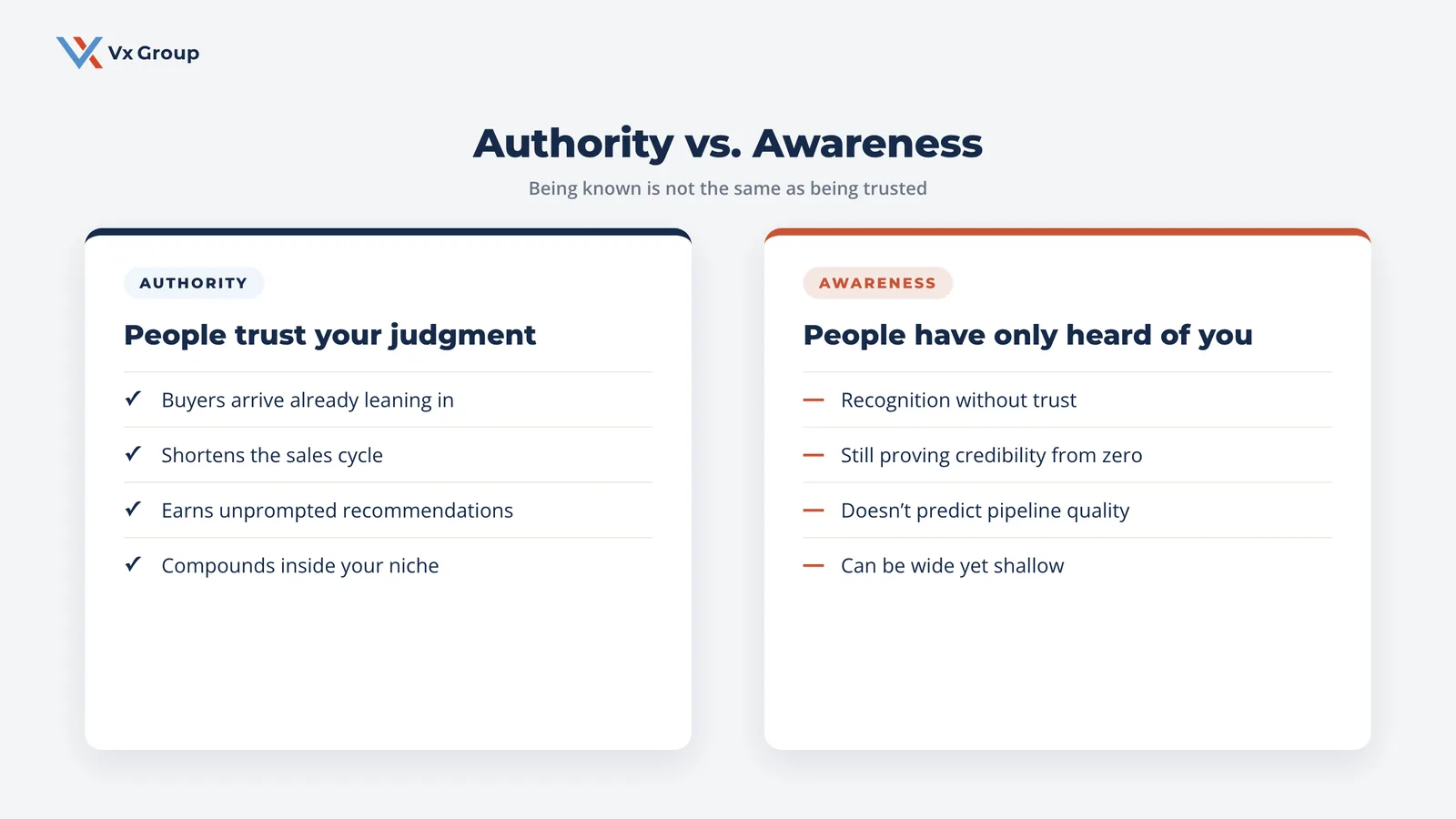
This matters most in industries with long sales cycles and complex relationships. When a deal takes nine to eighteen months and involves multiple decision-makers, the cost of starting every relationship from a position of “prove it” is enormous. Authority front-loads the trust so the sales process can focus on fit and terms rather than on establishing basic credibility.
Why most B2B companies look identical
Most B2B companies look the same because they build their brand by copying the companies they compete with. When every player in a category studies the same competitors and borrows the same language, the entire category converges on a single bland template. Buyers then cannot tell anyone apart, so they default to price or to whoever a colleague happened to mention.
The pattern is predictable. A company decides it needs to “look more professional,” so it studies the three competitors it loses to most. It adopts their vocabulary, mirrors their website structure, and writes the same claims about quality, partnership, and results. Every one of those claims is true, and every one of them is invisible because every competitor says the identical thing. The company has spent real money to become harder to distinguish.
Defined term: Category convergence
The tendency of companies in the same market to adopt nearly identical messaging, design, and positioning because each one benchmarks against the others. Convergence makes differentiation harder and pushes buyers toward price as the only visible variable.
The deeper problem is that this approach treats brand as a matter of taste rather than a matter of position. The questions that produce a distinctive brand are strategic ones. What do we believe about this market that our competitors do not? What do we do for customers that we can prove with specifics? Which buyers do we serve better than anyone, and why? Companies that answer those questions build authority. Companies that skip them produce a logo refresh and wonder why nothing changed.
Looking like everyone else is a position too, and it is the weakest one available. It tells the market you have nothing specific to say, so the market treats you as a commodity and shops you on price.
The three sources of brand authority
Brand authority compounds from three sources working together: a clear point of view, demonstrated proof, and consistent presence. A company with all three becomes the name buyers reach for. A company missing any one of them leaks authority in a predictable way.
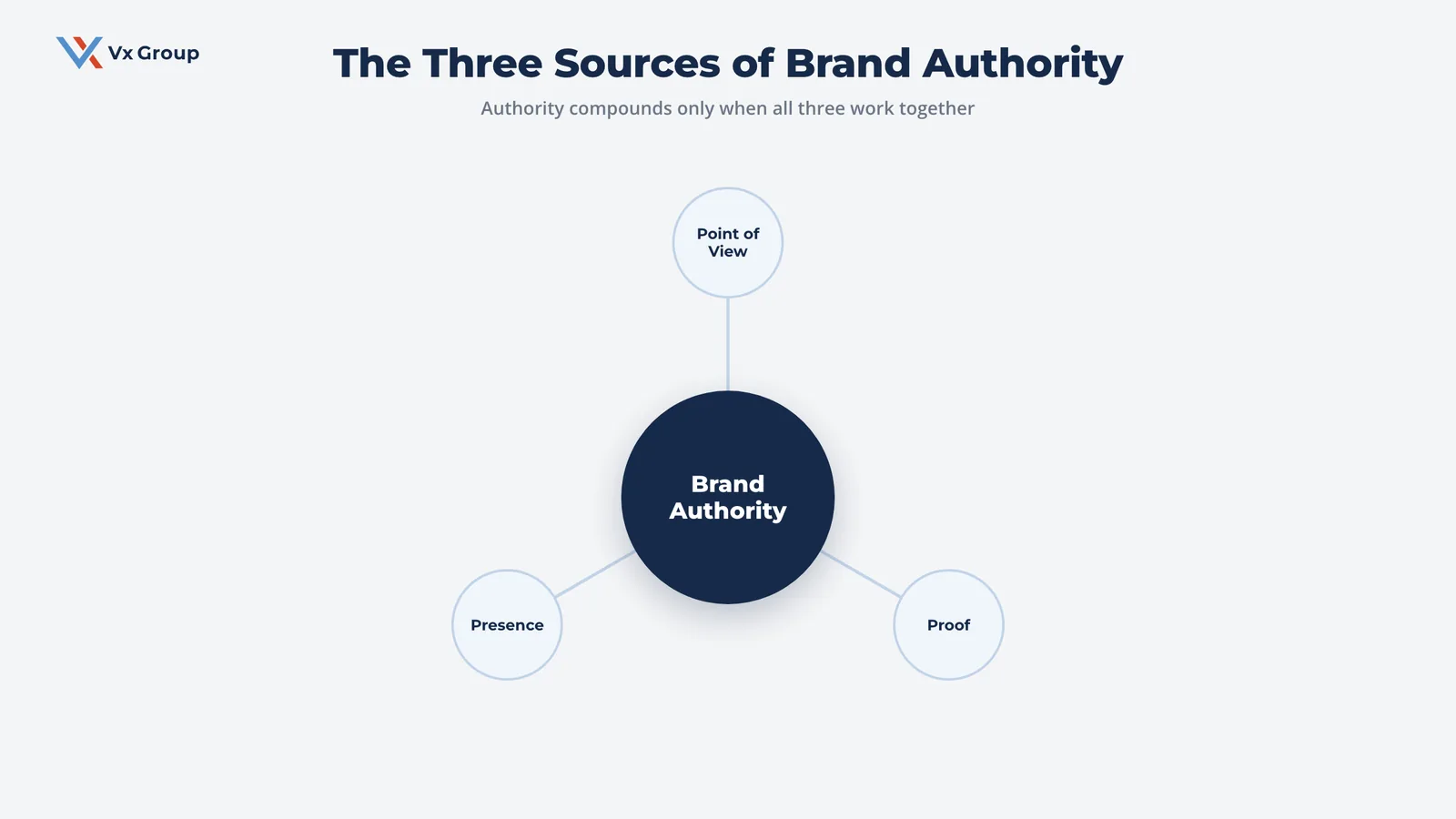
Point of view
A point of view is a position you are willing to defend, stated plainly enough that someone could disagree with it. Generic claims like “we deliver quality and partnership” are not positions, because no competitor would claim the opposite. A real point of view sounds like a practitioner who has seen what works: “Trade shows are relationship events, and companies that measure them by badge scans are optimizing for the wrong thing.” A buyer who reads that learns something about how you think, and thinking is what they are buying.
Proof
Proof is the evidence that you have actually done what you claim. Specific results, a named track record, the depth of expertise your team carries, and the kinds of problems you have solved before. Proof is what separates authority from confidence. Anyone can assert they are good. A company with authority shows the work: the metric that moved, the relationship that compounded over a decade, the problem competitors could not solve.
Presence
Presence is showing up in the rooms where your buyers form opinions, consistently enough that you become familiar. Those rooms might be industry conferences, a focused publication, a LinkedIn feed, a podcast your buyers listen to, or the search results and AI answers they consult when researching a problem. Presence is the source most B2B companies neglect, because it requires showing up before there is a deal on the table. The companies that win do it anyway, because familiarity earned over time is the foundation the other two sources stand on.
| Source | What it is | What happens when it is missing |
|---|---|---|
| Point of view | A specific, defensible position on what works in your market and why | You sound like every competitor and buyers cannot tell you apart |
| Proof | Evidence you have done the work: results, track record, named expertise | Your claims read as marketing and buyers discount them |
| Presence | Repeated, credible appearances where your buyers spend attention | You are trusted by the few who know you and invisible to everyone else |
Ready to grow?
Build real brand authority on point of view and proof, instead of looking like everyone else in your market.
How to Build authority without a big budget
You build B2B brand authority by documenting a clear position, proving it with specifics, and committing to consistent presence in a small number of the right places. None of those three steps requires a large budget. They require clarity and discipline, which is why the companies that win are rarely the ones that spend the most.
Start by writing down your point of view. Get the leaders who built the expertise into a room and capture what they actually believe about the market: where competitors get it wrong, what customers consistently underestimate, what you would tell a buyer who only had ten minutes. This raw material is the most valuable brand asset a company owns, and it usually lives undocumented in a few people‘s heads.
Turn that point of view into proof. For every position you hold, find the specific evidence that backs it. Replace “we deliver results” with the actual number and the actual situation. Replace “trusted partner” with the relationship that has compounded over fifteen years and what it produced. Specifics are credible in a way that adjectives never are, and they are the raw material AI search engines and human readers both cite.
Defined term: Presence discipline
The practice of showing up consistently in a small number of chosen channels rather than sporadically across many. Three credible appearances per month in one channel build more authority than thirty scattered posts across six channels that no one remembers.
Then choose your rooms and show up consistently. Pick the two or three places where your buyers genuinely spend attention and commit to a steady presence there. Consistency beats volume. A company that publishes one sharp, specific piece every two weeks for a year will build more authority than one that produces a burst of content and goes quiet. The compounding only happens if you keep showing up.
Make your existing infrastructure project the authority you have already earned. The website, the proposals, the first impressions, and the way your expertise shows up in search and AI answers all signal whether you look like you belong in the room. A company doing excellent work behind a website that looks smaller than the business is actively undercutting its own authority. Fixing that is often the highest-return brand work available, because the authority already exists and just is not being projected.
How to measure brand authority
Brand authority is measurable through three signals: the quality of inbound interest, the length of your sales cycles, and how often you are named without prompting. These move slower than a campaign metric, and they are the signals that actually predict revenue in relationship-driven B2B.
Inbound quality tells you whether your authority is reaching the right buyers. As authority grows, more of the conversations that come to you are with qualified buyers who already understand what you do and why they want it. A rising share of “I have been following your work” conversations is a direct authority signal.
Sales-cycle length tells you whether authority is doing the early trust work. When buyers arrive already convinced you are credible, the early stages of the cycle compress because you skip the work of proving basic competence. A shortening cycle for inbound deals is one of the clearest financial returns on brand authority.
Unprompted mentions tell you whether you have become the name people reach for. When a buyer says a colleague recommended you, or when you appear in an AI-generated answer to a category question, your authority has reached beyond the people you have directly touched. Track how often your name surfaces without you placing it there.
| Signal | What it measures | How to track it |
|---|---|---|
| Inbound quality | Whether authority reaches qualified buyers | Share of inbound conversations that are sales-qualified |
| Sales-cycle length | Whether authority front-loads trust | Average days from first contact to close, for inbound deals |
| Unprompted mentions | Whether you are the default name | Referral attribution, AI-answer citations, social mentions |
Field notes
A regional industrial manufacturer with a forty-year track record and a roster of loyal customers came to a growth conversation frustrated that newer, smaller competitors kept winning bids it should have owned. The work was excellent. The relationships were deep. The problem was that none of it was visible to anyone who had not already bought.
The website had not been touched in years and read like a brochure from a smaller company. The proposals listed capabilities in the same flat language every competitor used. The two engineers who carried the deepest expertise in the category had never published a word or spoken at an industry event, so the market had no way to know that depth existed.
The fix was not a rebrand and not a bigger budget. The leaders documented a specific point of view about where their industry was heading and where most buyers were making expensive mistakes. They rebuilt the website and proposals to project the authority the company had already earned with specifics and proof. The two engineers started writing short, sharp pieces on the problems they solved every week and showing up at the two conferences their buyers attended.
Within a year, the quality of inbound conversations changed. Buyers were arriving already familiar with the company’s thinking, and the bids that used to come down to price increasingly came down to fit. The authority had been there the entire time. The company had simply never projected it.
Where this leaves you
Brand authority is the trust that earns you a seat at the table before the RFP, and the companies that build it are rarely the ones with the biggest budgets. They are the ones willing to document a real position, prove it with specifics, and show up consistently where their buyers already are. The authority most established B2B companies need is already half-built inside their track record and their people. The work is projecting it to the market that has not met you yet.
Ready to grow?
Become the company buyers trust before the first call, without a big brand budget.
Frequently asked questions
Differentiation comes from saying what you genuinely believe about your market, in the language your buyers actually use, backed by specifics only you can offer. It does not require a clever slogan or a manufactured personality. The most durable differentiation is an honest, defensible point of view that competitors are unwilling or unable to match.
No. The companies that build authority efficiently choose a small number of channels and show up consistently rather than spreading a large budget thin. The expensive input is the discipline to document a real point of view and keep showing up in the same places over time, which costs commitment rather than money.
For most established B2B companies, the fastest return comes from making existing infrastructure project the authority the company has already earned. Rebuilding a website and proposals that look smaller than the business converts trust that already exists into visible credibility, which shortens cycles almost immediately.
Yes. Authority depends on the clarity of your position and the consistency of your presence, both of which are independent of company size or budget. A focused company with a sharp point of view and disciplined presence routinely out-positions larger competitors that say nothing specific. In a defined niche, depth beats breadth.
Authority compounds over months and years rather than weeks. Most companies that commit to a documented position and consistent presence start seeing changes in inbound quality within six to twelve months, with the larger effects on sales-cycle length and unprompted mentions following after that. The timeline depends far more on consistency than on budget.
They overlap but are not identical. Thought leadership usually refers to publishing ideas in public. Brand authority is the broader trust asset that thought leadership contributes to, alongside proof, track record, and how your infrastructure projects credibility. Publishing ideas without proof behind them builds visibility without authority.
About the Author: Jacob Camhi
