

What an Account Management Strategy Looks Like in a Relationship-Driven Business

An account management strategy is a written plan for which customer relationships get your company’s time, who owns each one by name, how often each gets real contact, what triggers an escalation, and what gets recorded after every conversation. In a relationship-driven B2B company, it’s how you protect the revenue your top accounts already carry.
TL;DR
- An account management strategy decides which customer relationships get senior attention and how that attention is kept up, written down where the whole leadership team can see it.
- In most manufacturers and distributors with 50 to 500 people, the top ten accounts carry most of the revenue, and nearly everything the company knows about them lives in two or three people’s heads.
- A working strategy has five parts: account tiers, a named owner for every important relationship, a contact schedule by tier, escalation triggers, and a short record after every conversation.
- Three tiers is enough for most companies. Tier 1 gets a named senior owner, monthly contact with more than one person at the customer, and a quarterly review.
- Writing it down is what keeps that relationship value inside the company when a long-tenured salesperson retires or resigns.
Try this at your next leadership meeting. Ask who owns your fifth-largest account, by name, and what was said on the last real call with them.
In most of the manufacturers and distributors we work with, one of two things happens. Everyone turns to look at the same person (usually a salesperson who’s been there twenty years and knows the plant manager’s kids by name), or three people give three different answers.
Either way, the account may be perfectly fine today. What the answer tells you is that the company’s account management strategy lives in somebody’s head, and it’ll leave when they do.
We see this constantly. A company does $40 million or $80 million a year, a handful of customers carry most of it, and the plan for keeping those customers is some version of “Dave handles them.” Dave is great at it, and Dave is also 61.
Most of what you’ll find when you search “account management strategy” was written for software companies, with customer success teams, renewal dates, login data, and health scores. That’s useful if you sell subscriptions. A company that sells pumps, packaging, fasteners, or contract manufacturing runs on purchase orders, plant visits, and relationships that last decades, so the playbook looks different.
If you run sales or operations at that kind of company, what follows is the version built for you: how to tier accounts, who should own them, how often each tier hears from you, what should set off an alarm, and what to write down after every conversation.
What is an account management strategy?
An account management strategy is the set of company-wide rules for how you protect and grow existing customer relationships: which accounts get the most attention, who is responsible for each, how often they hear from you, and how what you learn gets shared. It sits above any single account plan and covers your whole book of business.
Defined Term: Account management strategy.
A written set of rules for how a company manages its existing customer relationships, covering how accounts are tiered, who owns each relationship by name, how often each tier gets contact, what triggers an escalation, and what gets recorded after every conversation.
People use a handful of terms interchangeably here, and it helps to pull them apart:
- Account management strategy: the company-wide rules. One document, owned by leadership, reviewed once a year.
- Account plan: one document per important account, covering your goals for that customer, the people involved, open opportunities, risks, and next steps.
- Key account management: how you run your top tier day to day. It’s one part of the strategy, aimed at the handful of customers that matter most.
- Customer account management: the everyday work of serving an account, such as orders, quotes, service issues, and follow-up.
The strategy is the part most companies skip. They have account plans for a few big customers (usually built for a sales meeting and never opened again) and a lot of customer account management happening every day. What’s missing is the layer that decides, in writing, how the whole book of business gets covered.
That layer is also where growth inside existing customers gets decided. If you’ve read our pieces on share of wallet and account expansion, this is the structure that makes either one possible. Nobody grows an account they aren’t paying attention to.
Why does a relationship-driven B2B company need its account strategy written down?
A relationship-driven B2B company needs its account management strategy written down because most of its revenue sits with a small number of long relationships, and most of what keeps those relationships healthy is known by only a few people. When one of those people leaves, the knowledge goes with them.
Run the math once and the case gets pretty obvious. Take an illustrative $60 million distributor whose top ten accounts buy $33 million a year, about 55% of revenue. Those relationships have lasted an average of fourteen years. If they hold for another eight at today’s volume, they’re worth roughly $264 million.
The same company’s sales team is working an open new-business pipeline of $9 million. At a 30% close rate, about $2.7 million of that turns into revenue from new customers.
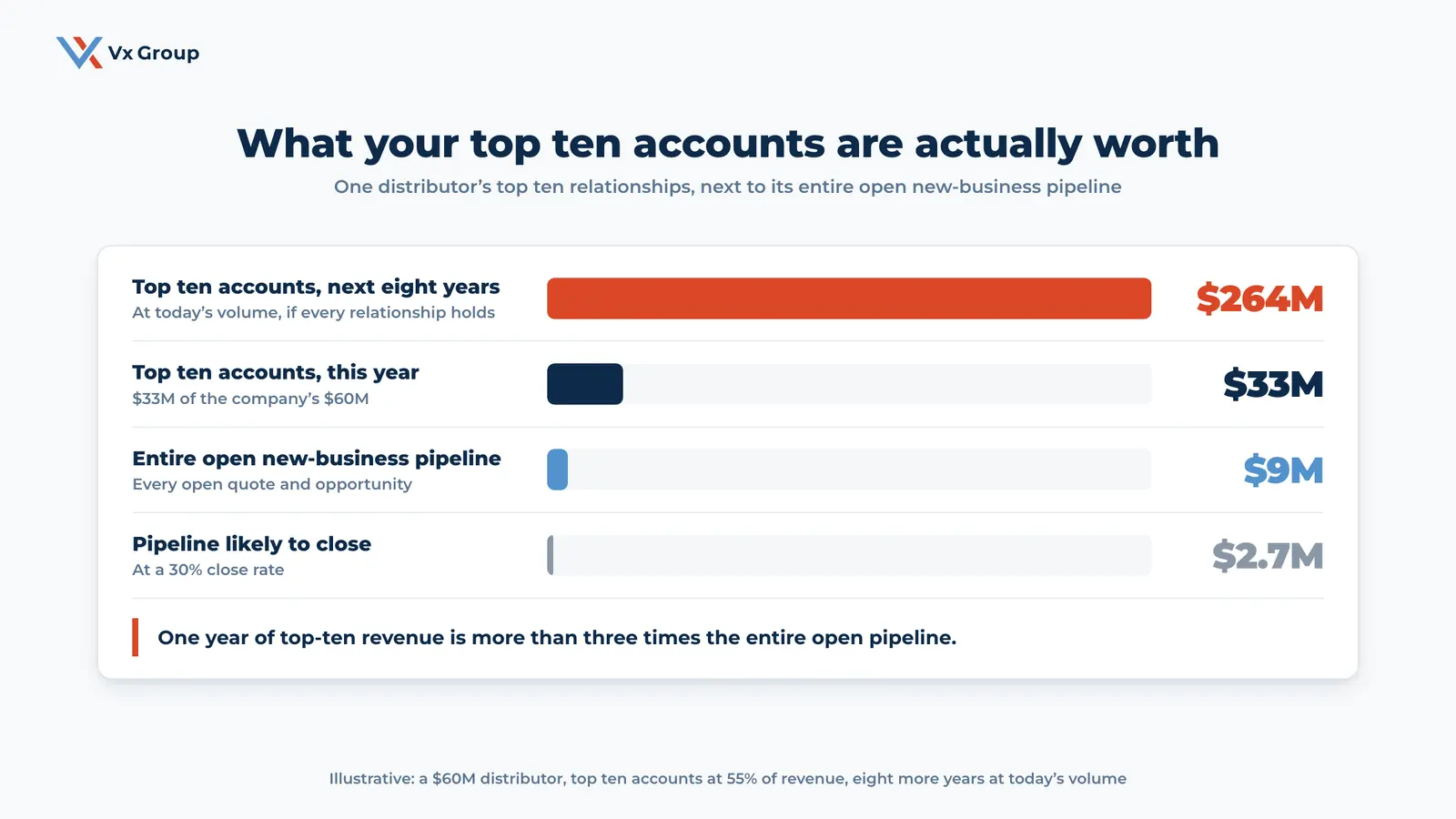
One year of revenue from the top ten is more than three times the entire open pipeline. That’s the Vx Group position in plain numbers: the lifetime value sitting in a company’s top ten relationships routinely exceeds everything in its new-business pipeline. And yet in most companies, the pipeline has a weekly meeting, a CRM report, and a sales manager, while the top ten have Dave.
When a long-tenured salesperson leaves, the company usually loses things nobody thought to write down:
- Who actually makes the buying decision (often a different person than the one who signs the PO)
- Which plant manager hates surprises and which one wants a call before every price change
- The pricing history, including the “one-time” discount from 2019 that’s still on every invoice
- The promises made about lead times, stocking, and service response
- Which competitor has been quoting against you, and what the customer said about them
None of that lives in the ERP. Most of it isn’t in the CRM either (assuming you have one people actually use). We wrote about the broader version of this risk in founder-dependent sales, and the same thing happens one level down. A company can depend completely on its top salespeople’s memories without anyone noticing, right up until one of them turns in their notice.
It’s also why customer concentration risk gets worse when nobody manages it. Revenue piles up with a few customers, and the knowledge about those customers piles up with a few employees.
Field Notes:
The pattern we hear most often after a long-tenured salesperson leaves goes like this. For a few months, nothing seems wrong. Orders keep coming because the customer’s purchasing system still has your part numbers loaded. Then a buyer changes, a competitor gets a trial order, or a quote goes out to three suppliers for something you’ve supplied for years, and nobody on the team knows who to call or what was promised. By the time the drop shows up in a monthly report, the relationship has already moved.
What goes into an account management strategy?
An account management strategy has five parts. Each one answers a question your leadership team should be able to answer without looking around the table at each other:
- Account tiers. Which customers get the most time from your most senior people, and why.
- Named ownership. Who owns each relationship, by name, plus a backup.
- A contact schedule by tier. How often each tier gets a real conversation, and with how many people at the customer.
- Escalation triggers. Which signals mean an account needs attention this week, and who gets told.
- A conversation record. What gets written down after every conversation, and where it lives.
You don’t need new software for any of this. Most companies build the first version in a spreadsheet and a shared folder, then move it into the CRM once the habits stick.
How should you tier your accounts?
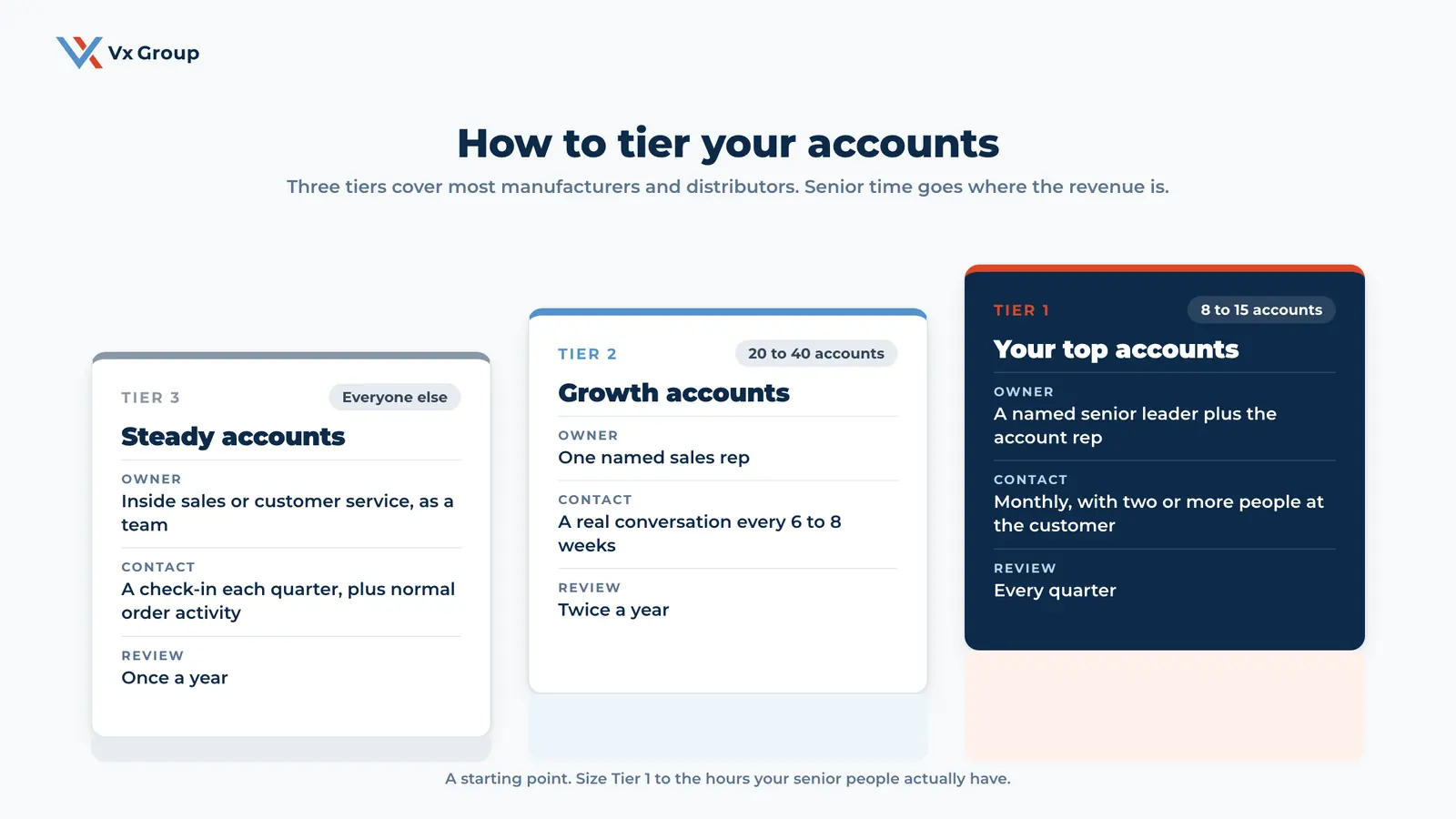
Tier your accounts by combining what each customer buys today with what the relationship could realistically be worth in three years, then cap your top tier at the number of accounts your senior people can actually cover. For most manufacturers and distributors, three tiers is enough.
| Tier | How many | Who belongs here | Owner | Contact floor | Account review |
|---|---|---|---|---|---|
| Tier 1: Top accounts | 8 to 15 | Your largest customers today, plus the few with the biggest realistic growth | A named senior leader paired with the account rep | Monthly, with two or more people at the customer | Every quarter |
| Tier 2: Growth accounts | 20 to 40 | Solid revenue today with room to grow, or a close match to your best customers | One named sales rep | A real conversation every 6 to 8 weeks | Twice a year |
| Tier 3: Steady accounts | Everyone else | Smaller or occasional buyers who mostly order on their own | Inside sales or customer service, as a team | A check-in each quarter, plus normal order activity | Once a year |
Rank accounts by two numbers
Pull last year’s revenue by customer from your ERP and sort it. Then add a second column: what each account could reasonably buy from you in three years if the relationship went well. That second number is a judgment call, and that’s fine. Your sales team already makes it in their heads. This just puts it on paper where everyone can argue about it. Our share of wallet guide walks through how to estimate it.
An account belongs in Tier 1 if it’s in your top ten by current revenue or your top ten by realistic three-year potential. Some accounts land on both lists. A few will surprise you.
Add one filter for what it would cost to lose them
Some accounts matter beyond their invoices. A customer whose name opens doors across an industry, one that sends you referrals, or one whose specs you helped write can earn a Tier 1 spot on a smaller number. Keep this exception list short (two or three accounts at most), or Tier 1 turns into a list of everyone’s favorite customers.
Cap Tier 1 at what your senior people can actually cover
Count the hours. If a Tier 1 account gets a monthly conversation, a quarterly review, and a couple of visits a year, that’s roughly 30 to 40 hours of senior time per account per year. Three senior people with 300 spare hours each can cover about 25 accounts. Most companies can cover fewer than they think.
If your Tier 1 list has 40 accounts on it, the senior team can’t keep up, and your largest customers end up getting the same attention as everyone else.
Re-tier once a year, at budget time
Revisit tiers once a year, ideally when you set the sales budget. Moving accounts between tiers every quarter confuses customers and owners alike. The one exception is an escalation: an account that’s slipping can get Tier 1 attention any time, without waiting for the annual review.
Ready to grow?
We help relationship-driven B2B companies tier their accounts, name owners, and put a written plan around the customers that carry most of their revenue.
Who should own each account relationship?
Every important account should have one named owner, written down, with a backup. For Tier 1 accounts, the owner is a senior leader (the owner, president, or head of sales) paired with the rep who handles the day-to-day, so the relationship never depends on a single person.
Defined Term: Account owner.
The one person accountable for the health of a customer relationship, including its contact schedule, its conversation record, and raising an escalation when something changes. Other people can talk to the customer. The owner is the one who answers for it.
“Accountable” is the important word there. A lot of companies say an account is “owned” by sales, or by “the team.” When we ask who owns an account and hear a department back, that’s usually the account that surprises everyone a year later.
Write one name next to every Tier 1 and Tier 2 account
Put one person’s name in a column on your account list. A department or a pair of names doesn’t count, because when two people share an account, each one assumes the other made the call.
Pair a senior leader with the rep on every Tier 1 account
The rep handles orders, quotes, and day-to-day questions. The senior leader owns the relationship one level up: the plant manager, the VP of operations, the owner of the customer’s business. The pairing does two jobs. It gives the customer a second relationship with your company, and it means one resignation leaves the account with half its relationships intact.
Name a backup for every Tier 1 account
The backup is whoever would take over tomorrow. They should meet the customer in person at least once a year, and they should be able to read the conversation record and pick up where things left off.
Give owners the authority to pull in help
An owner who can’t bring in an engineer, a customer service lead, or the president when an account needs it will eventually stop raising problems. Write down what an owner can ask for without approval. A site visit with an applications engineer, a call from the president, and an expedited sample are good starting examples.
How often should each account tier get contact?
Each tier gets a contact floor: the minimum number of real conversations it should get, written down so everyone can see when an account falls behind. For most relationship-driven B2B companies, Tier 1 gets a conversation every month with two or more people at the customer, Tier 2 gets one every six to eight weeks, and Tier 3 gets a quarterly check-in.
Count only real conversations toward the floor
A conversation is a phone call, a video call, a visit, or a meeting at a trade show where you learned something about the customer’s business. Order confirmations, quote emails, and newsletter sends keep things moving, and they stay off the tally. (We know. Everyone’s CRM is full of “touches.” Very few of them tell you anything new.)
Talk to more than one person at every top account
Tier 1 accounts should have at least three people at the customer who know someone at your company by name: the buyer, someone who uses what you sell (a plant manager, engineer, or maintenance lead), and someone senior. A relationship that runs through one buyer is at risk the day that buyer retires. When we look back at accounts that left quietly, most of them ran through one person on each side.
Set the floor, then let owners go above it
The floor is a minimum. Good owners will talk to their Tier 1 customers far more often than once a month. Writing it down means everyone can see when an account goes 60 days without a real conversation, and somebody asks why.
Hold a quarterly review with every Tier 1 customer
Once a quarter, sit down with each Tier 1 customer for an honest look at how things are going: what’s working, what’s been frustrating, and what’s coming up for them next year. Our guide to running a quarterly business review customers want to attend covers the format, and it’s one of the best ways to meet the second and third people at an account.
What should trigger an account escalation?
An escalation trigger is a specific signal that an account needs attention this week, written down along with who gets told and how fast they act. The most useful triggers in a relationship-driven business are changes in ordering, changes in people, and changes in how the customer buys.
Defined Term: Escalation trigger.
A written, observable signal that a customer relationship may be at risk or about to change, paired with the person who must be told and the number of days they have to act.
Most companies already notice these signals. The trouble is that one person notices them, in passing, and nothing happens until the quarterly numbers make it obvious. A written trigger list turns “huh, they’ve been quiet lately” into a phone call that same week.
| Trigger | What it looks like | Who gets told | Act within |
|---|---|---|---|
| Order volume drops | A Tier 1 account’s orders for the trailing quarter are down 15% or more from the same quarter last year | Account owner and head of sales | 5 business days |
| A key contact leaves | Your main buyer, plant manager, or longtime contact retires, resigns, or changes roles | Account owner and backup | 2 business days |
| Purchasing changes | A new purchasing lead, a supplier consolidation project, or a move to centralized buying | Account owner and head of sales | 5 business days |
| Work goes out to bid | The customer sends an RFQ to several suppliers for something you’ve supplied for years | Account owner, plus the president for Tier 1 | 2 business days |
| A complaint reaches someone senior | A late shipment, quality problem, or warranty claim that got the attention of a senior person at the customer | Account owner and operations lead | 1 business day |
| The customer changes hands | The customer is acquired, merges, or brings in new owners | Account owner and president | 5 business days |
Pick a threshold for order changes and write it down
Start with a threshold for order drops, such as 15% on a trailing quarter compared with the same quarter last year, and adjust it after a year once you see how many false alarms it produces. Comparing against the same quarter last year keeps seasonal customers from setting it off every winter. Our piece on net revenue retention shows how to run the same numbers across your whole customer base.
Track people changes as closely as order changes
Buyer turnover is the trigger companies miss most often. A new purchasing lead often arrives with a mandate to review suppliers, and the incumbent who hears about it first has the best shot at keeping the business. Ask about personnel changes in every Tier 1 conversation, and log what you hear.
Send every escalation to a person, with a date
Every escalation needs a named person and a deadline. “Let’s keep an eye on it” is how an account slips for another quarter. The person who raises the trigger writes it in the account record, tags the owner, and the owner reports back at the next weekly sales meeting with what they learned.
What should you record after every account conversation?
After every conversation with a Tier 1 or Tier 2 account, the owner writes five lines: who they talked to, what the customer told them, what changed, what your company promised, and the next step with a date. It takes about five minutes, and it’s the part of an account management strategy that keeps relationship knowledge inside the company.
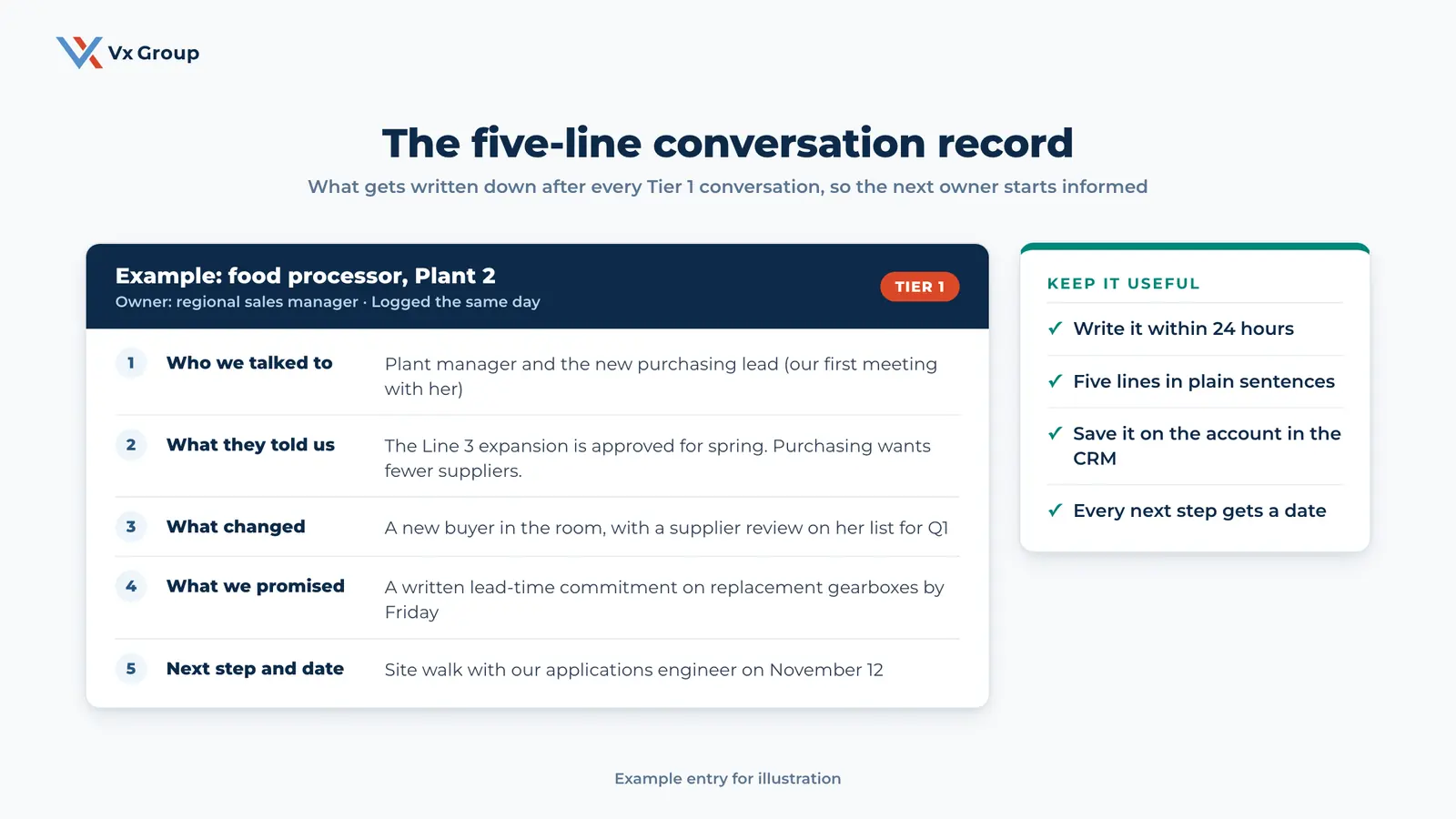
Write it the same day
Notes written a week later lose the details that matter: the name of the new engineer, the month they mentioned for the expansion, the competitor they brought up. Set the rule at 24 hours.
Keep it to five lines
Long call reports don’t get written, and when they do, nobody reads them. Five short lines in plain sentences give the next owner enough to pick up the relationship without starting over.
Save it where the next owner will look
The record belongs on the account in your CRM, where anyone who picks up that account can see the full history. A notebook, a personal email folder, or someone’s phone works fine right up until the day that person leaves. If your team doesn’t really use the CRM, our CRM adoption guide covers why that happens and how to fix it.
Read the records before every account review
The records are worth something only if somebody reads them. Before each quarterly Tier 1 review, the owner and the head of sales read the last three months of records together. Most of the questions for the review come straight out of them.
How do you review and update the strategy?
Review the accounts on a schedule by tier (Tier 1 every quarter, Tier 2 twice a year, Tier 3 once a year) and review the strategy itself once a year. The account review is an internal working session for your own team. The customer-facing quarterly business review is a separate meeting with the customer in the room.
A Tier 1 account review takes about 30 minutes per account and covers six questions:
- What did the customer buy this quarter compared with the same quarter last year?
- Who did we talk to, and who did we miss?
- Did any escalation triggers fire, and what happened?
- What did we promise, and did we deliver it?
- What’s the next growth opportunity in this account, and who’s working it?
- Does this account still belong in its tier?
If you write account plans for Tier 1 customers, the review is the natural time to update them. Keep the plan short enough that the owner opens it before every visit.
The annual review of the strategy is where you re-tier, check whether owners have the time they need, and look at which triggers fired (and which ones should have but didn’t). Plan on adjusting one or two rules a year. Our guide on how to improve customer retention covers the retention side of this in more depth.
How long does it take to put an account management strategy in place?
Most companies can put a working first version in place in about 90 days, without new software, if one senior person gives it a few hours a week.
| Timeframe | Work | What you should have |
|---|---|---|
| Weeks 1 to 2 | Pull revenue by customer, estimate three-year potential, draft the tiers | A tiered account list the leadership team agrees on |
| Weeks 3 to 4 | Name an owner and a backup for every Tier 1 and Tier 2 account | One name next to every account that matters |
| Weeks 5 to 8 | Write the contact floors, the trigger list, and the five-line record, and set them up in the CRM | Every Tier 1 conversation logged within 24 hours |
| Weeks 9 to 13 | Run the first round of Tier 1 account reviews | A review on the calendar for every Tier 1 account |
The revenue results take longer. In a long-cycle business, account management shows up in the numbers on the same delay as everything else. The early signs show up in behavior first: fewer accounts going 60 days without a real conversation, more people known by name at each Tier 1 customer, and escalations raised while there’s still time to do something about them.
What are the most common account management strategy mistakes?
The most common mistakes come from leaving account management to the sales team alone. Deciding where senior time goes is a leadership call, and the mistakes below usually trace back to nobody making it.
- Putting too many accounts in Tier 1. When everything is a priority, the senior team spreads itself so thin that the largest customers get the same attention as everyone else.
- Assigning accounts to a team or a department. Shared ownership means each person assumes someone else made the call.
- Counting emails as relationship contact. Order confirmations and newsletters keep the account informed, and they tell you almost nothing about what’s changing inside the customer.
- Building it in software first. A new CRM module or account tool will move an undefined process faster. Write the tiers, owners, and triggers first, then set up the tool to follow them.
- Skipping the conversation record. Without it, the strategy still runs on what people remember, and that knowledge goes with them when they leave.
- Reviewing accounts only when revenue drops. By the time a drop shows up in the monthly numbers, the decision on the customer’s side was often made months earlier.
Where to start this week
Start with the question from the top of this article. Pull your top 15 customers by revenue, put them in a list, and write one name next to each: the person who owns that relationship. Then add a second column with the date of the last real conversation anyone at your company had with that customer.
That list usually takes less than an hour, and it tells you more about your account management strategy than most planning sessions. The blank cells and the names that show up five times are where to start.
Ready to grow?
If most of your revenue sits with a handful of customers and the plan for keeping them lives in a few people’s heads, let’s talk about protecting and growing those relationships.
FAQs
About the Author: Jacob Camhi
