

Outsourced Sales Team vs Hiring In-House: Which Fits a Long-Cycle B2B Company?

An outsourced sales team is the better call for opening a new market, generating top-of-funnel volume, or testing a product line before you commit headcount. An in-house team is the better call once the relationship itself is what keeps deals renewing. Most relationship-driven manufacturers land on a hybrid: outsourcing opens the door, an employee carries the relationship.
TL;DR
- Need pipeline volume fast, or testing a brand-new market? An outsourced sales team gets you dialing within weeks.
- Deals close on trust built over years, and the buyer is loyal to a person? Hire in-house.
- Average deal size under $25,000 with a short, transactional cycle: outsourced usually wins on cost.
- Average deal size in six or seven figures with a cycle over six months: in-house usually wins on retention.
- Manufacturers and other relationship-heavy B2B sellers get the best of both from a hybrid model, where outsourced reps open doors and employees carry the account forward.
- Vx Group sells growth services and has a stake in this question, so weigh the recommendation below against your own numbers.
- The riskiest move is treating an outsourced sales team as a permanent substitute for a named account owner.
How do outsourced sales teams and in-house sales teams compare?
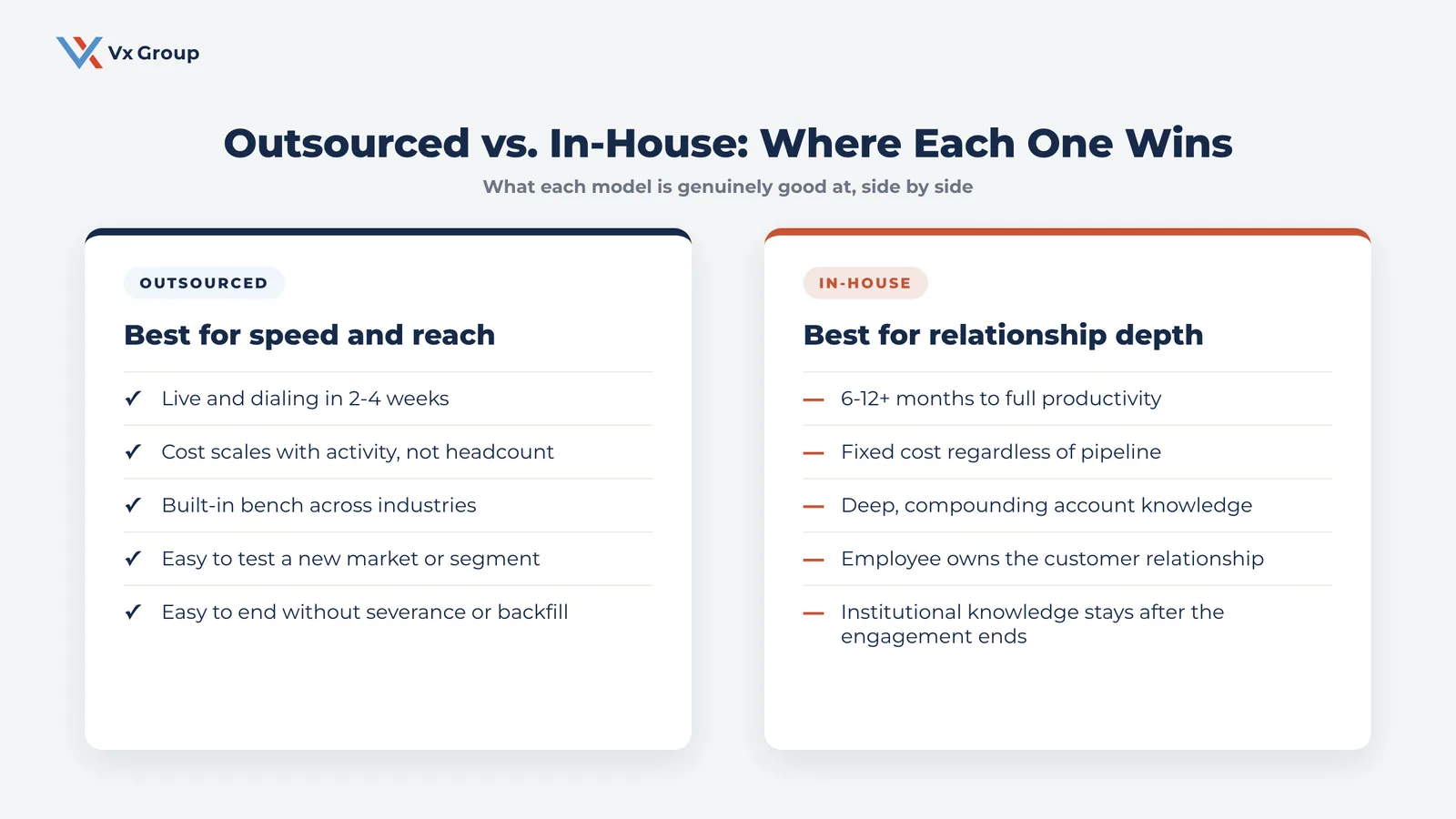
Six factors separate the two models: how fast each one produces revenue, how the cost behaves, who ends up owning the customer relationship, how deep the industry knowledge runs, how much control you have over the method, and what you’re left with when the engagement or the employment ends.
| Outsourced sales team | In-house sales team | |
|---|---|---|
| Speed to productive | Live and making calls in two to four weeks | Six to twelve months or more to reach full quota productivity in a complex sale |
| Cost shape | Variable: a monthly retainer or per-activity fee that scales with volume | Fixed: salary, benefits, commission, and management overhead, whether or not the pipeline is full |
| Who owns the customer relationship | The vendor and its reps; you’re renting access to a relationship you can lose if you switch providers | The employee, and through them, your company; the relationship survives even if that person changes roles internally |
| Industry knowledge depth | Broad sales skill across many industries, shallow on your specific product and buyers at the start | Deep and compounding, built from years of handling your specific objections, buyers, and edge cases |
| Control over method | Limited; you’re buying a playbook that’s hard to fully customize to your process | Full; you set the CRM discipline, the cadence, and the standard for what a qualified conversation looks like |
| What happens when it ends | The relationships, the call notes, and the market knowledge usually leave with the vendor | The account history, the relationships, and the institutional knowledge stay inside your company |
None of these six factors settles the question by itself. A company with a short cycle and a small deal size can still need in-house coverage if the buyer base is small and every relationship counts. A company with a long cycle can still lean outsourced if the product itself carries the renewal, with the individual rep mattering very little to that decision. The two sections below go into where each model earns its keep, followed by the decision rule that weighs all six factors against your specific numbers.
What is an outsourced sales team genuinely good at?
An outsourced sales team is the fastest way to put trained reps in front of a market without the months of hiring, training, and ramp that an internal hire requires. It works best as a pressure test: a way to find out whether a market, a message, or a price point holds up before a full-time salary is riding on the answer.
Use it to test a new market before you commit headcount
A manufacturer entering a new geography or a new vertical does not know yet which messaging lands, which titles respond, or what the real objections will be. An outsourced team can run that experiment for a few months at a fraction of the cost of a full-time hire, and the company gets a real answer before making a permanent bet. If the market proves out, the company then knows exactly what kind of person to hire in-house and what that person needs to know on day one.
Use it to build top-of-funnel volume while your team focuses on existing accounts
Most long-cycle B2B companies have a small number of people who are good at both prospecting and account management, and prospecting usually loses when the two compete for the same hours. An outsourced sales development function can carry the cold outreach and qualification load so the in-house team spends its time where the relationship actually needs a familiar face: renewals, expansions, and the accounts already worth protecting. This only works if the two functions are coordinated; done well, it looks close to what we cover in Sales Prospecting, where the goal is qualified conversations that a closer can actually work. A full pipeline of unqualified leads rarely solves a growth problem on its own; we go deeper on why in Why More Leads Is Almost Never the Answer in B2B Sales.
Use it when the sale is transactional and does not depend on a long relationship
Some B2B purchases are closer to a retail decision than a partnership: a defined spec, a competitive price, a short evaluation window. When the product does most of the selling and the buyer has no reason to need continuity from a specific rep, an outsourced team can run the whole motion end to end, indefinitely, without the company losing much by not owning that relationship directly.
Use it to buy speed during a leadership gap or a sudden growth mandate
A vacant sales leadership seat, a new investor with a quarterly growth target, or a product launch on a fixed deadline all create the same problem: the company needs activity now and does not have months to hire and ramp someone. An outsourced team can fill that gap immediately while the company makes a more deliberate hiring decision behind it. This works especially well after a leadership change, when the pipeline has gone quiet and the board wants to see movement before the new hire has even finished onboarding.
Defined Term: Ramp time
The number of weeks or months a new salesperson needs before they are closing deals at a normal, sustainable rate. Outsourced teams are built to compress this; in-house hires in complex sales rarely avoid it.
The honest limit on all four of these use cases is duration. An outsourced sales team earns its cost back quickly when it is solving a defined, time-bound problem. The companies that get burned are the ones that keep renewing the contract year after year for a relationship-driven account base, because the market knowledge the vendor built never transfers back to the company that paid for it.
What does an in-house sales team do better?
An in-house sales team is the better structure once the relationship with the buyer is doing real work in closing and renewing the sale. That shows up most in long-cycle, high-consideration purchases where the buyer needs to trust the specific person across a multi-month or multi-year evaluation.
Use it when the relationship is the product
In a lot of manufacturing, industrial, and professional-services selling, the buyer is choosing whether to trust a person who understands their plant, their compliance requirements, and their history with past vendors. That trust takes time to build, it is worth protecting once it exists, and protecting it is difficult to do through a vendor whose reps rotate between client accounts.
Use it to build account knowledge that compounds over years
An employee who has worked the same accounts for three years knows things that never make it into a CRM field: who actually signs, who blocks, what happened the last time a competitor tried to get in, and what the buyer’s real budget cycle looks like versus the official one. That knowledge compounds every year the employee stays on the account, and it disappears the moment the relationship sits with a rotating outside team instead.
Use it when your buyer expects continuity across a multi-year contract
A buyer signing a three-year supply agreement or a multi-phase project wants to know who they are calling in year two. An in-house employee can commit to that continuity personally, because staying on the account is part of the job. An outsourced relationship depends on a contract between two companies staying in place, which is a different and less personal kind of commitment.
Use it when the sale requires deep technical or regulatory knowledge
Some B2B sales require the seller to genuinely understand the buyer’s engineering constraints, certifications, or compliance environment well enough to have a credible technical conversation. Building that depth takes time inside the business, and it rarely survives a handoff to a vendor whose reps are managing several client accounts in different industries at once.
Defined Term: Relationship equity
The trust, history, and access a salesperson has built with a specific buyer, the kind that survives a bad quarter and shortens the next negotiation. It is the asset an in-house structure is built to protect.
The tradeoff is speed and flexibility. A new in-house hire in a complex sale needs months to reach full productivity, the salary keeps running whether the pipeline is full or thin that quarter, and scaling down means a layoff instead of a contract non-renewal. Companies that build their whole go-to-market around one founder’s personal relationships run into a related problem when that person becomes the bottleneck; we cover that pattern in Founder-Dependent Sales. The fix in both cases is the same: build the structure and the knowledge transfer so the relationship survives past any one person, whether that person is the founder or the rep.
Getting this balance right is as much a sales team structure question as it is a hiring question, and building the internal capability to hold relationships long after the initial sale is closer to what we describe in How to Build an Infinite Team.
Ready to grow?
We help relationship-driven B2B companies figure out where the line between outsourced reach and in-house ownership should sit for their specific pipeline.
What does the hybrid model look like, and how do you structure the handoff?
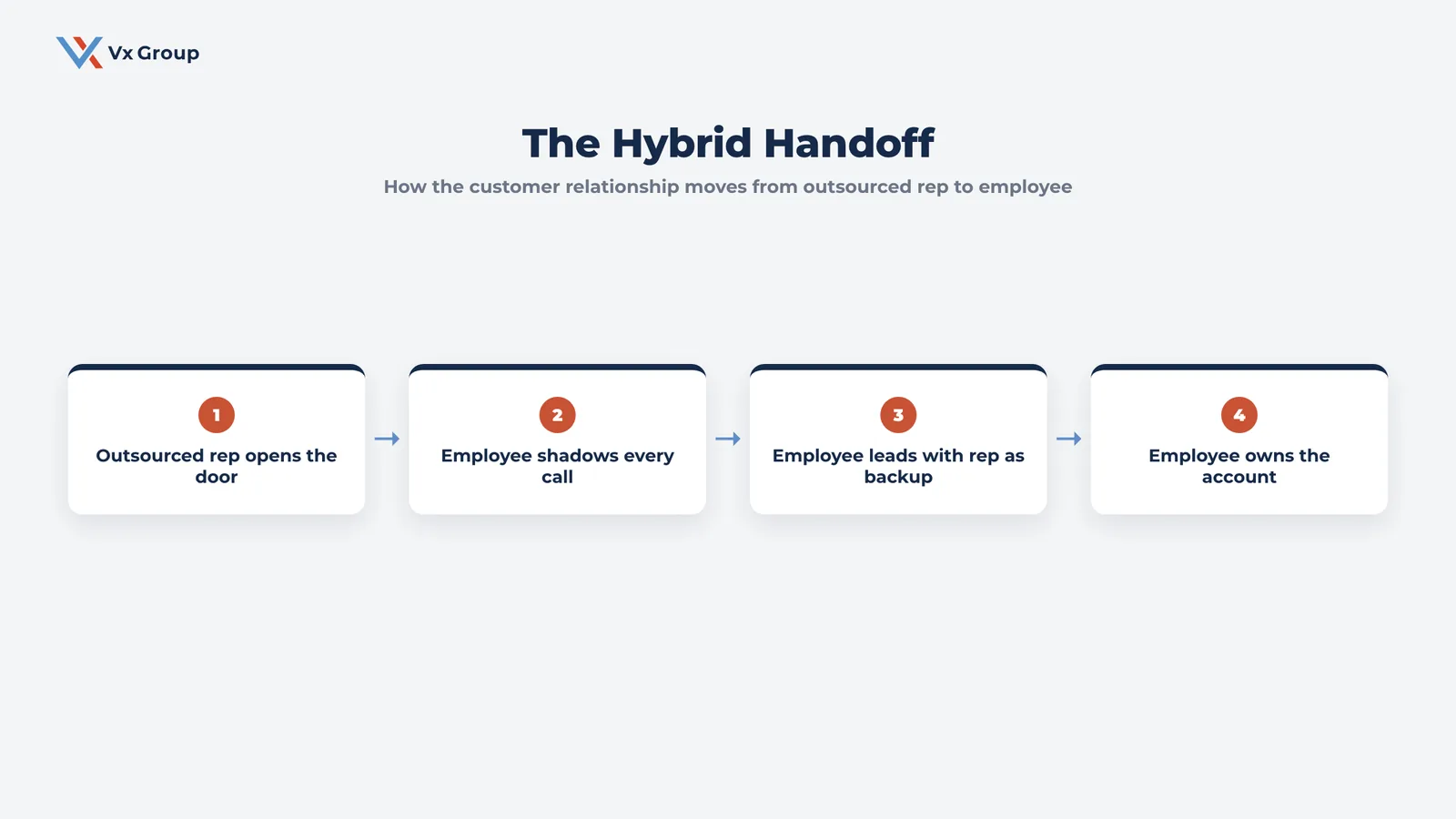
The hybrid model uses an outsourced team to generate and qualify pipeline, then moves the account to an employee before the relationship becomes the reason the deal closes or renews. It solves the speed problem of hiring in-house and the ownership problem of permanent outsourcing, as long as the handoff is planned before the engagement starts, with a set trigger everyone agrees to up front.
Set the handoff date before the engagement starts
Decide, in the outsourcing contract itself, at what point an account moves to an employee: after the first meeting, after a signed contract, after a defined revenue threshold, or after a fixed number of months. Without a set trigger, handoffs happen late, inconsistently, or not at all, because the outsourced team has no incentive to give up an account it is still getting paid to manage.
Split first-touch and account-ownership roles from day one
Assign the outsourced team to prospecting, qualification, and the first one or two meetings. Assign a named employee as the account owner from the moment a lead becomes a real opportunity, even if that employee is not doing most of the talking yet. The buyer should hear the employee’s name and see the employee on calls well before the handoff is complete.
Give the employee shadow time on every call before they take the lead
Have the employee sit in on calls as a silent or lightly-speaking participant for the first stretch of the relationship. This gives the buyer time to get familiar with a second face and gives the employee the account history and buyer context they will need once they are running the relationship alone.
Move to full employee ownership at a defined milestone
Pick one clear signal, a signed contract, a completed onboarding, a third meeting, and treat it as the hard line where the employee takes the lead and the outsourced rep steps back to an introduction role only. A milestone tied to a specific, dated event is easy to audit: anyone can check the calendar and confirm it happened on schedule.
Track the handoff with a single shared metric
Measure the percentage of active accounts that have moved to full employee ownership on schedule. This is the number that tells you whether the hybrid model is actually transferring relationships, and it exposes a hybrid that has quietly turned into permanent outsourcing well before the annual contract renewal does.
For most relationship-driven manufacturers and industrial sellers, this hybrid structure outperforms either pure model. It also happens to be the structure that requires the most discipline to run well, since it depends on a company actually enforcing the handoff instead of letting the outsourced arrangement become the default forever.
A note on where Vx Group sits in this comparison:
Vx Group sells growth and sales services, including help with sales team structure and hiring decisions, so there is an obvious interest in how this question gets answered. That is worth knowing before reading the recommendation below. The comparison above and the decision rule below are built to hold up regardless of what a reader decides, and for a meaningful share of the companies we talk to, the honest answer is a hybrid that does not require hiring an outside firm to run indefinitely.
Which is right for you?
The decision comes down to three inputs: how long the sales cycle runs, how large the average deal is, and whether the relationship or the product is doing the work of closing and renewing the sale. Pull your own numbers before reading the rules below: average days from first touch to signed contract, average contract value over the last four quarters, and how many of your renewals depend on the same rep still being on the account.
Average sales cycle under 60 days and deal value under $25,000: lean outsourced. Speed and cost efficiency matter more than relationship depth at this deal size, and the transactional nature of the sale means a rotating rep rarely costs you much.
Average sales cycle of six to eighteen months and deal value in the six or seven figures: lean in-house. The relationship is carrying too much of the sale and too much of the renewal risk to hand to a vendor whose reps may not be there in eighteen months.
Relationship-driven business (manufacturing, industrial, professional services) that also needs faster top-of-funnel volume: lean hybrid, and write the handoff plan before the first outsourced call gets made.
Product sells on spec sheet or price, with little need for buyer trust in a specific person: outsourced can run the relationship indefinitely, because there is not much relationship equity to protect in the first place.
Testing a brand-new market or vertical, regardless of your default model elsewhere: start outsourced to get a fast, low-commitment read on the market, then transition the accounts worth keeping to an in-house owner once the market proves out.
Cycle length and deal value tend to move together, but the third input, who the buyer is actually loyal to, is the one companies skip and regret skipping. A company can have a long cycle and a large deal size and still be a reasonable outsourcing candidate if the buyer’s loyalty sits mainly with the product and the brand, more than with any individual rep. The relationship test is the one that should carry the most weight when the other two are close.
This is also a sales leadership responsibility: whoever owns this call needs the authority to hold the outsourced vendor and the in-house team to the same handoff standard, or the hybrid model drifts back into permanent outsourcing by default.
The decision comes down to what you're protecting
An outsourced sales team buys speed, reach, and a low-commitment way to test a market. An in-house team protects a relationship that compounds in value the longer it lasts. Most relationship-driven B2B companies end up choosing which parts of the sale need a rotating vendor and which parts need a named employee who will still be there in three years.
Run your own numbers against the decision rule above before assuming your current setup is the right one. A lot of companies are running the sales structure they happened to build when they made their first hire, years before anyone measured cycle length, deal value, or how much of the sale actually rides on the relationship.
Ready to grow?
Bring us your cycle length, average deal value, and current team structure, and we will map out the hybrid that fits your numbers.
FAQs
About the Author: Jacob Camhi
