

Industrial Content Marketing: A Practical Guide for Manufacturers

Industrial content marketing is the work of creating technical, sales-supporting content for companies with long, complex buying cycles. For a manufacturer, that means writing for the three people who decide anything: the engineer who specifies your product, the buyer who justifies the cost, and the owner who has to trust you before the first order.
TL;DR – Most industrial content is built to please a search algorithm, so it never reaches the people who actually sign off on a machine, a contract, or a first order. – A manufacturing sale runs through three readers: the engineer who specifies, the buyer who justifies the cost, and the owner who decides whether to trust you. Good content answers all three. – Build a small library of deep technical assets you can produce once and reuse across the blog, email, LinkedIn, spec sheets, sales calls, and live events. – Live events and webinars are your richest source material. Record them, cut them up, and feed the pieces into every other channel for months. – The content that wins your biggest accounts is written for one company by name. Customer-specific content is the differentiator most competitors will not bother to build.
What is industrial content marketing?
Industrial content marketing is the practice of producing technical and trust-building content for companies with long, multi-person buying cycles: manufacturers, distributors, and industrial suppliers. The goal is to give a buying committee what it needs to specify your product, justify the cost internally, and trust your company enough to place a first order. Blog traffic is a byproduct of doing that well, and a weak goal on its own.
Most manufacturers already produce content. Spec sheets, a few case studies, a blog nobody updates, a PDF behind a form.
Volume is rarely the shortfall. Almost none of what they already publish is built for how an industrial purchase actually happens.
Defined Term: Industrial content marketing
Creating technical and trust-building content that helps a multi-person buying committee move a long, high-value industrial purchase forward, from first research through the first order and the reorders after it.
An industrial content program is one piece of a larger industrial marketing strategy. It works best sitting alongside a clear channel plan and a defined view of your best-fit accounts, which is where channel marketing for manufacturers and distributors comes in.
Why does most industrial content marketing fail?
Most industrial content fails because it is built for a search algorithm instead of the buying committee. Someone runs a keyword tool, finds “industrial [something],” and writes a 900-word post aimed at ranking.
The engineer who lands on it needs a torque spec, a material tolerance, or an integration detail, and finds none. The buyer needs numbers to build a business case, and finds adjectives.
The owner is looking for a reason to trust you, and finds a page that looks like every other supplier’s.
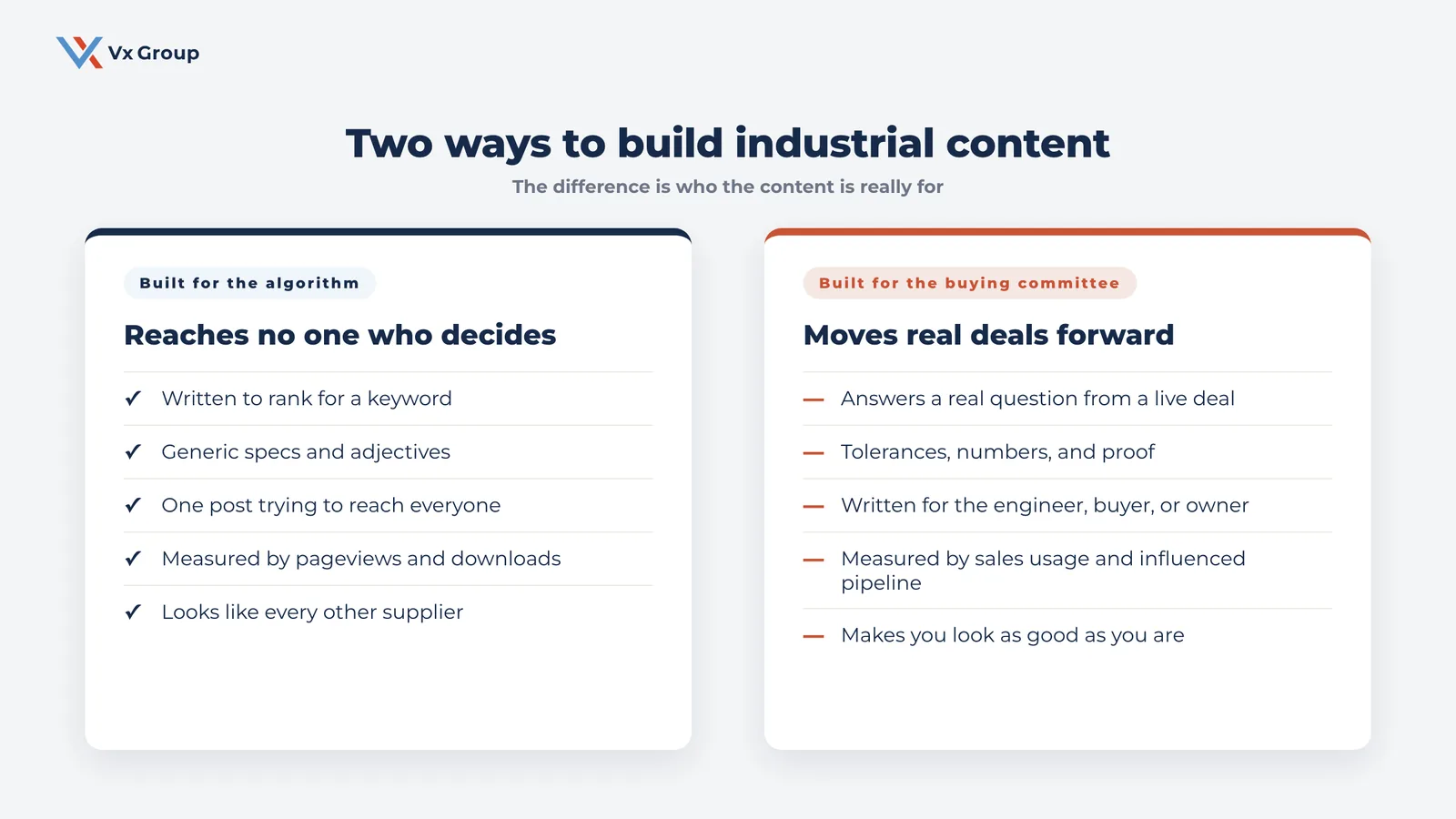
This is the best-kept-secret problem in a specific form. A manufacturer can be excellent at the actual work and still lose deals because its content makes the company look smaller, or more generic, than it really is.
Random acts of content have the same failure mode as random acts of marketing: activity without a plan for who reads it or what it moves.
Who are you actually creating content for in a manufacturing sale?
You are creating content for a buying committee. In a typical manufacturing purchase, three roles have to say yes, and each one reads for a completely different reason.
Defined Term: Buying committee
The group of people inside a company who together decide on a high-value industrial purchase. In manufacturing it usually includes a technical specifier (the engineer), an economic buyer (procurement or finance), and an executive sponsor (the owner or plant leader).
The engineer specifies. This reader wants depth: tolerances, materials, integration notes, failure modes, and proof that your product performs under real conditions.
The buyer justifies. This reader builds the internal business case and wants total cost, lead times, warranty terms, and the numbers that make the purchase defensible to a boss.
The owner or plant leader decides on trust. This reader is asking a quieter question: will these people still be here, and still be good, in five years when I need a part or a fix?
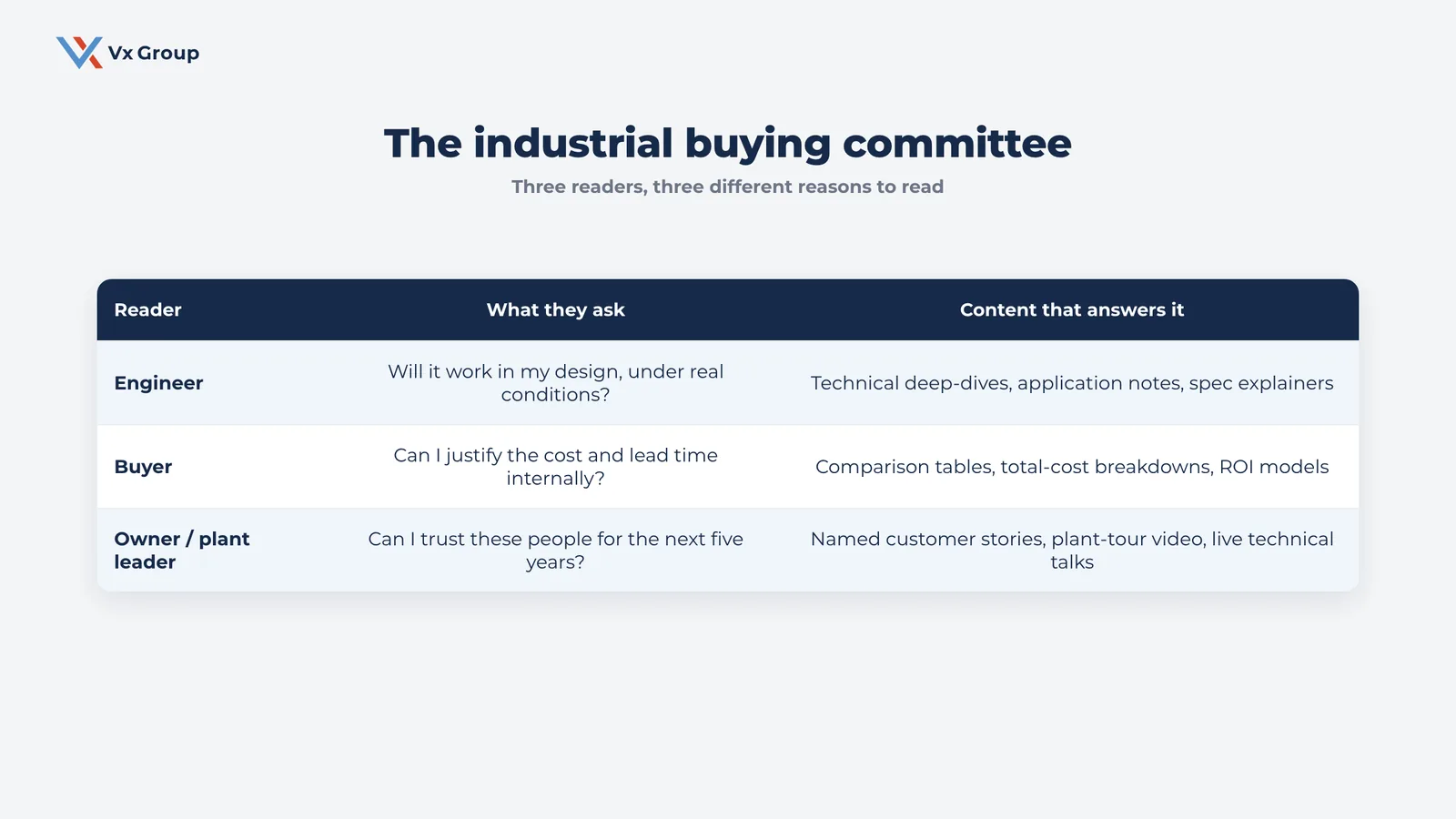
When one piece of content tries to speak to all three at once, it usually reaches none of them. The fix is to write for each role on purpose, then connect the pieces into one path through the sale.
How do you build an industrial content plan that supports the sale?
Build the plan backward from the sale. Start with the questions your buying committee asks at each stage, then create the specific asset that answers each one, and let your keyword research serve those questions.
Map the committee’s real questions to content
List every question the engineer, buyer, and owner ask across a full deal, from first research to signed order. Interview your best salespeople and pull the actual questions they field, and you will usually land on 20 to 40 recurring ones.
Each recurring question becomes a content asset. A question your team answers ten times a week on the phone is a piece of content you should have written once.
Rank the topics by their impact on real deals
Score each question by how often it shows up in real deals and how much it moves a decision, then rank the list. A topic with 30 searches a month that unblocks a six-figure order beats a topic with 3,000 searches that never touches a buyer.
Write the high-impact, low-volume technical answers first. Those are the pages that get quoted inside a customer’s building, in a meeting you are not in.
Assign each asset to one reader
Label every planned asset with its primary reader: engineer, buyer, or owner. This keeps you honest about depth, because an engineer asset with no numbers is not finished, and an owner asset buried in specs will not build any trust.
Aim for a library balanced across all three readers, weighted toward the technical depth engineers need, since that is where most manufacturers are thinnest.
Match the format to the question
Deliver a spec question as a detailed article, a cost argument as a comparison table or calculator, and a trust question as a named customer story or a plant-tour video. This is the same discipline behind consultative selling: meet the buyer where the real question is.
Do not default everything to a blog post. The format you choose is part of the answer.
What content formats actually work for a long, technical, multi-person sale?
The formats that work are the ones that match how technical buyers research and how committees decide. A long industrial sale rewards depth, proof, and repeat exposure over months, so the format library looks different from a fast software sale.
Here are the formats that earn their place, and who each one serves:
- Technical deep-dives and application notes, for the engineer. The specifications, tolerances, and integration detail that let someone design you in.
- Comparison tables and total-cost breakdowns, for the buyer. The numbers that build an internal business case.
- Named customer stories from a real plant or application, for the owner. Proof that a company like theirs trusted you and it worked.
- Live webinars and technical talks, for all three at once, in real time. Your single richest content event.
- Short videos, for the engineer and the owner. Plant tours, product walkthroughs, and a two-minute answer to a common spec question.
- Spec sheets and one-pagers your sales team can hand over, for the buyer, inside the room.
- An email sequence that delivers the right asset at the right stage, for whoever raised the question.
Most of these formats can come from the same underlying work, produced once and reused many times.
How do you make one piece of content work across every channel?
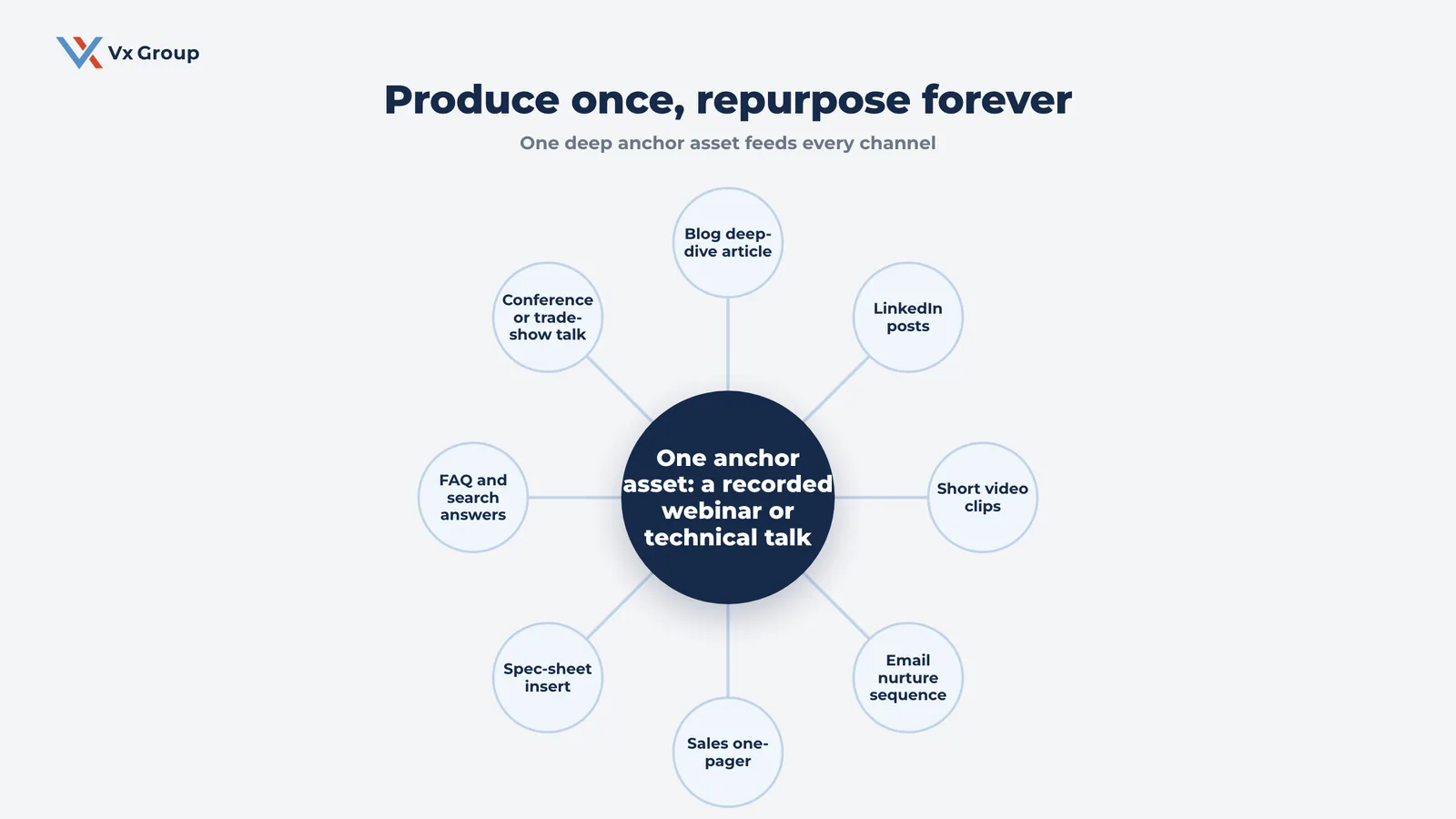
Produce once, repurpose forever. Create one deep anchor asset, then cut it into a dozen smaller pieces that live on the blog, in email, on LinkedIn, in sales calls, and on spec sheets.
Defined Term: Anchor asset
A single deep piece of content, usually a recorded live webinar or a thorough technical talk, rich enough to be broken into many smaller assets for every other channel.
Most manufacturers have the opposite habit. They start a blog post from scratch on Monday, a LinkedIn post from scratch on Tuesday, and a webinar from scratch next month, then burn out by spring.
Produce one anchor asset per topic
Pick a high-impact topic and produce one thorough anchor, ideally a recorded live webinar or a filmed technical talk with a real expert. Record everything, because the video, the transcript, and the slides are your raw material for months.
One good 45-minute technical webinar can carry a channel for a full quarter.
Cut the anchor into channel-sized pieces
Break the recording into its natural parts: each question becomes a short video, each key point becomes a LinkedIn post, the full transcript becomes a blog article, and the best data becomes a graphic. Give every piece one job and one reader.
Publishing consistently from one anchor is also how you build real thought leadership as a B2B growth strategy instead of a scattered feed.
Route each piece to the right channel and stage
Place each piece where its reader already is: technical depth on the blog and in search, quick proof on LinkedIn, and the sales-ready one-pager in your team’s hands. Feed the sequence through email so a prospect who raised a question gets the exact asset that answers it.
Send the raw clips to your sales team so they can forward the two-minute answer to a live objection.
Re-cut the anchor after the first run
Come back in 90 days and re-cut the same anchor for a new angle or a new audience. Update the numbers, swap the example, and the asset is fresh again.
This is where it compounds, because the tenth use of an anchor costs almost nothing and still moves deals.
Ready to grow?
See how a repurposing system could work for your team and your sales cycle.
How do you turn a live event or webinar into a content engine?
Treat every live event as a production shoot. A trade show booth, a lunch-and-learn, a customer training session, or a webinar is hours of expert content most manufacturers let evaporate.
Plan the event as content before you plan it as an event
Decide the three questions the session will answer, and who each answer serves, before you book the room or the platform. Line up the camera, the screen recording, and someone to capture the questions the audience asks.
Those live questions are next quarter’s content calendar, handed to you for free.
Capture everything in a usable form
Record video and audio, save the slides, and get a clean transcript. Ask a colleague to note the moments the room leaned in, because those are your hooks.
Turn the recording into a stack of assets within a week
While the event is fresh, cut the blog article, three to five short clips, a handful of LinkedIn posts, and one email to everyone who could not attend. A recording repurposed within a week keeps its energy, while one that sits for three months rarely gets touched.
The same recording can also seed the next live session, including the kind of AI-assisted production covered in AI for manufacturing.
Fold the live audience back into the sale
Follow up with attendees individually, each with the specific asset tied to what they asked. A trade show is a relationship event, and your content is the reason to reconnect after the floor closes.
How does customer-specific content set you apart with your biggest accounts?
Customer-specific content is content built for one account by name, and it is the fastest way to separate yourself from every competitor sending the same generic PDF. For your ten most valuable relationships, generic content is not enough.
Defined Term: Customer-specific content
Content created for a single named account: their application, their line, their numbers, their people. Examples include a tailored cost model, an application note written around their exact use case, or a private technical briefing for their engineering team.
Your biggest accounts already justify the effort. The lifetime value concentrated in a manufacturer’s top ten relationships usually dwarfs the pipeline of new prospects, so content built to protect and grow those accounts pays back quickly.
Field Notes
A metal-fabrication client kept losing reorder share at its three largest accounts to a cheaper competitor. Instead of a price cut, the team built a one-page cost-of-downtime analysis for each plant, using that plant’s own line data. Two of the three accounts expanded their orders within a quarter, because for the first time a supplier had done the math in their language.
Build one tailored asset for each top-ten account
Pick your ten most valuable accounts and create one tailored asset per account: a custom cost model, an application note for their line, or a technical review of their current setup. Use their real numbers and their real constraints, because generic benchmarks do not build trust the way a company’s own data does.
Deliver it in a live working session
Walk each account through its asset in a live session so the content becomes a conversation. That conversation is often where account expansion actually happens, since the content gives you a reason to be in the room.
Systematize it so it does not live in one rep’s head
Store each account asset, and the knowledge behind it, in a shared place your whole team can reach. When a key salesperson leaves, the relationship and its content should stay with the company.
Systems protect the relationships that matter most.
How do you measure whether industrial content is actually working?
Measure content by its effect on real deals. A 12-month industrial sale will not show up in this month’s pageviews, so leading indicators matter far more than traffic or download counts.
Track these instead:
- Sales usage: how often your team sends a specific asset in live deals. Assets that get forwarded are working.
- Committee engagement: whether several people from one account are reading. When more than one contact engages, you are watching a real buying process.
- Question reduction: whether the questions reps used to answer by phone now get answered before the call. That shortens cycles.
- Influenced pipeline: which deals touched a piece of content on their way to a quote or an order.
- Account expansion: for your top accounts, whether account-specific content lines up with larger or more frequent orders.
Traffic and rankings still matter as an early signal that people can find you. Treat them as where measurement starts, then watch the deal-level indicators above to see whether the content is working.
Where to start
Pick one high-impact question your sales team answers every week and build the single best answer to it that exists in your industry. Produce it as an anchor you can film or record, then cut it into the blog post, the LinkedIn posts, the email, and the sales one-pager from that one effort.
Do that four times over a quarter and you will have a content core that supports the engineer, the buyer, and the owner across every channel, plus a repurposing habit that compounds instead of burning your team out.
Ready to grow?
See how a content program can support your specific industrial sales cycle and your biggest accounts.
Subscribe to Insights → Practical growth playbooks for manufacturers and relationship-driven B2B, sent to your inbox.
About Vx Group
Vx Group helps manufacturers, distributors, and relationship-driven B2B companies grow through intentional strategy and systems rather than random acts of marketing. The Vx Group team works inside long-cycle, high-value businesses to build the content, brand, and sales infrastructure that supports how these companies actually win.
FAQs
About the Author: Jacob Camhi
