

What Is B2B Customer Experience (and Why It’s Different From B2C)?

B2B customer experience is the total impression a business customer builds across every interaction with your company, from the first conversation through years of working together. For relationship-driven companies it is shaped far more by the consistency of human follow-through than by a portal, an app, or the score on a satisfaction survey.
Defined term: B2B customer experience
The total impression a business customer forms across every interaction with a company over the life of the relationship. In B2B it is driven far more by how reliably people deliver and follow through than by digital interfaces or one-time touchpoints.
TL;DR
- B2B customer experience covers the whole relationship over time, well beyond any single transaction, portal, or NPS score.
- The consumer playbook does not transfer. B2B relationships run for years, carry high stakes, and involve several people on the customer side.
- Every interaction is a trust deposit or a withdrawal. Nothing lands as neutral.
- Consistency outweighs occasional brilliance. One dropped ball can erase the goodwill a great quarter built.
- A consistently good experience is the most direct path to retention and expansion, because in a long relationship the experience is what the customer is paying for.
- Systems keep the experience reliable by making good follow-through repeatable no matter who is in the seat.
How is B2B customer experience different from B2C?
B2B customer experience is different because the relationship is long, the stakes are high, and the buying decision is made by several people who keep evaluating you long after the deal closes. A consumer might judge a brand on one purchase and a return policy. A business customer judges you across years of orders, problems, renewals, and quiet moments when you either followed through or you did not.
The consumer experience toolkit was built for transactions: a fast checkout, a clean app, a five-star prompt after the sale. Those tools measure single moments. B2B relationships are built out of patterns that form over months and years, so the same tools miss most of what matters.
Here is how the two compare on the dimensions that decide whether a customer stays:
| Dimension | B2C customer experience | B2B customer experience |
|---|---|---|
| Time horizon | A single purchase or short cycle | A multi-year relationship |
| Who decides | One buyer | A buying group and the people they answer to |
| What it turns on | Convenience and the transaction | Trust and consistent follow-through |
| How it is judged | Individual moments | Patterns across the whole relationship |
| Cost of a bad experience | Switch brands next time | Reputations and budgets on the line |
| What usually measures it | NPS, CSAT, checkout speed | Whether you did what you said, every time |
A business customer cannot test you cheaply and walk away. They are committing to a partner for a long cycle, often years, and they read every interaction for evidence that the commitment is safe.
Drop the consumer-CX habits that backfire in B2B
Start by retiring the habits that work in consumer markets and quietly hurt you in a long relationship. Cut the reflex to chase a higher survey score, because a satisfied number on a quarterly form tells you almost nothing about whether a multi-year account feels secure. Stop pushing important conversations into self-service deflection, where a consumer values the speed and a business customer reads it as being handled by a machine. Keep the genuinely useful parts, like fast portals for routine tasks and clear status updates, and move your real attention to the human follow-through around the moments that carry weight.
Defined term: The relationship lifecycle
The full arc of a B2B relationship: first conversation, onboarding, delivery, problem-solving, expansion, and renewal. Experience forms across the entire arc, so a strong start counts for little if the middle goes quiet.
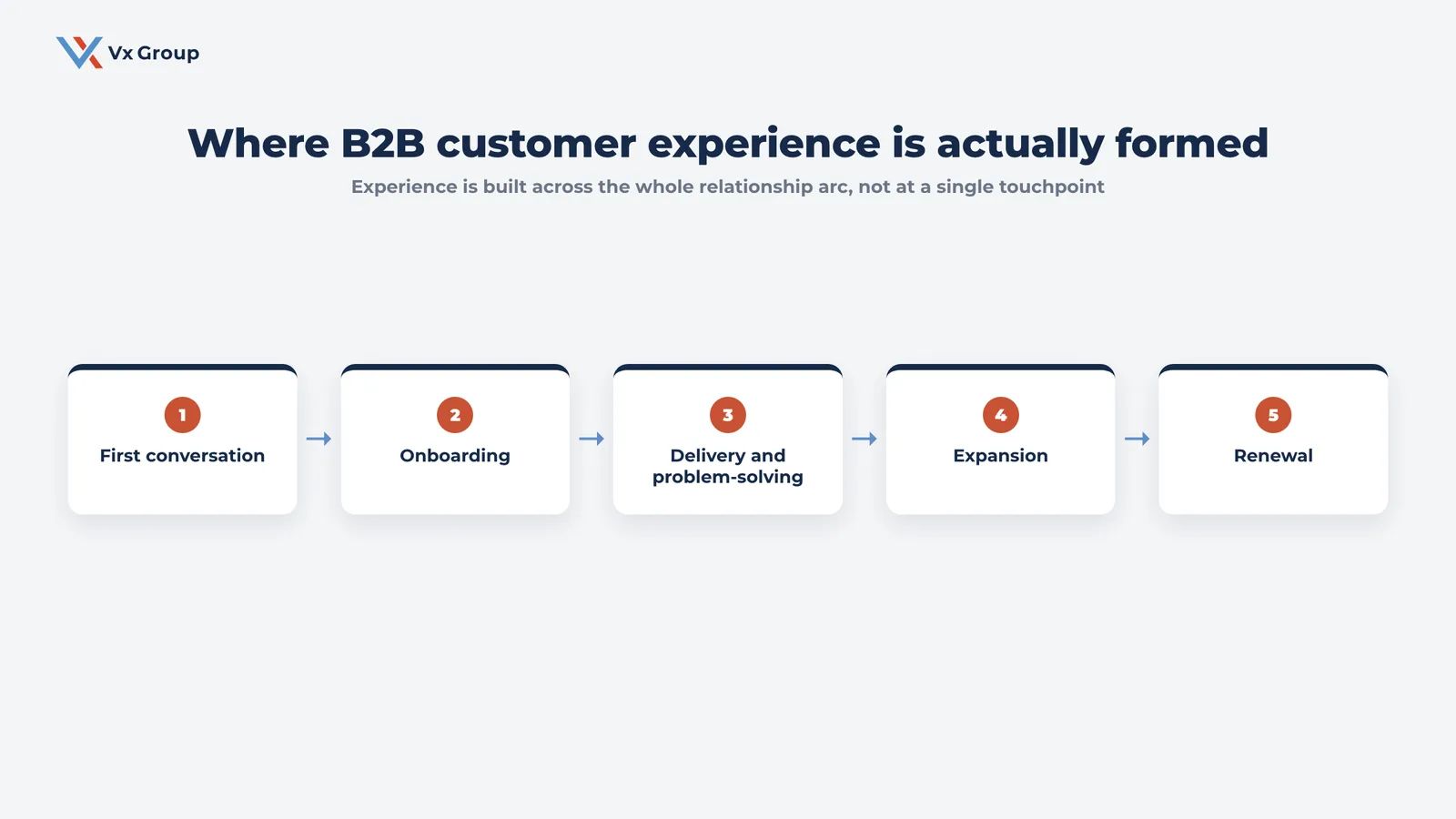
What actually shapes B2B customer experience?
What shapes B2B experience most is consistency of follow-through, meaning you do what you said, when you said, every time. That reliability is the foundation of trust, and trust is what a business customer is really buying when the relationship is meant to last.
Treat every interaction as a deposit into or a withdrawal from a trust account:
- Deposits: a proposal delivered on the date you promised, a problem handled without drama, a check-in with no agenda except being useful, an invoice that matches the quote.
- Withdrawals: a missed deadline, a detail that slipped, a question that took three follow-ups to answer, a familiar contact who went quiet right when the customer needed them.
Defined term: Trust deposit
Any interaction that strengthens a customer’s confidence in your company. Trust deposits accumulate quietly and compound, which is why steady, unremarkable reliability builds a more durable relationship than the occasional grand gesture.
This is why consistency outweighs brilliance. A spectacular quarter followed by a dropped ball costs more than the spectacular quarter earned, because the customer remembers the pattern rather than the peak. Winning on experience comes down to reliability: the customer never has to wonder whether the next interaction will go well, because it always has, and that certainty is worth more than any single impressive moment.
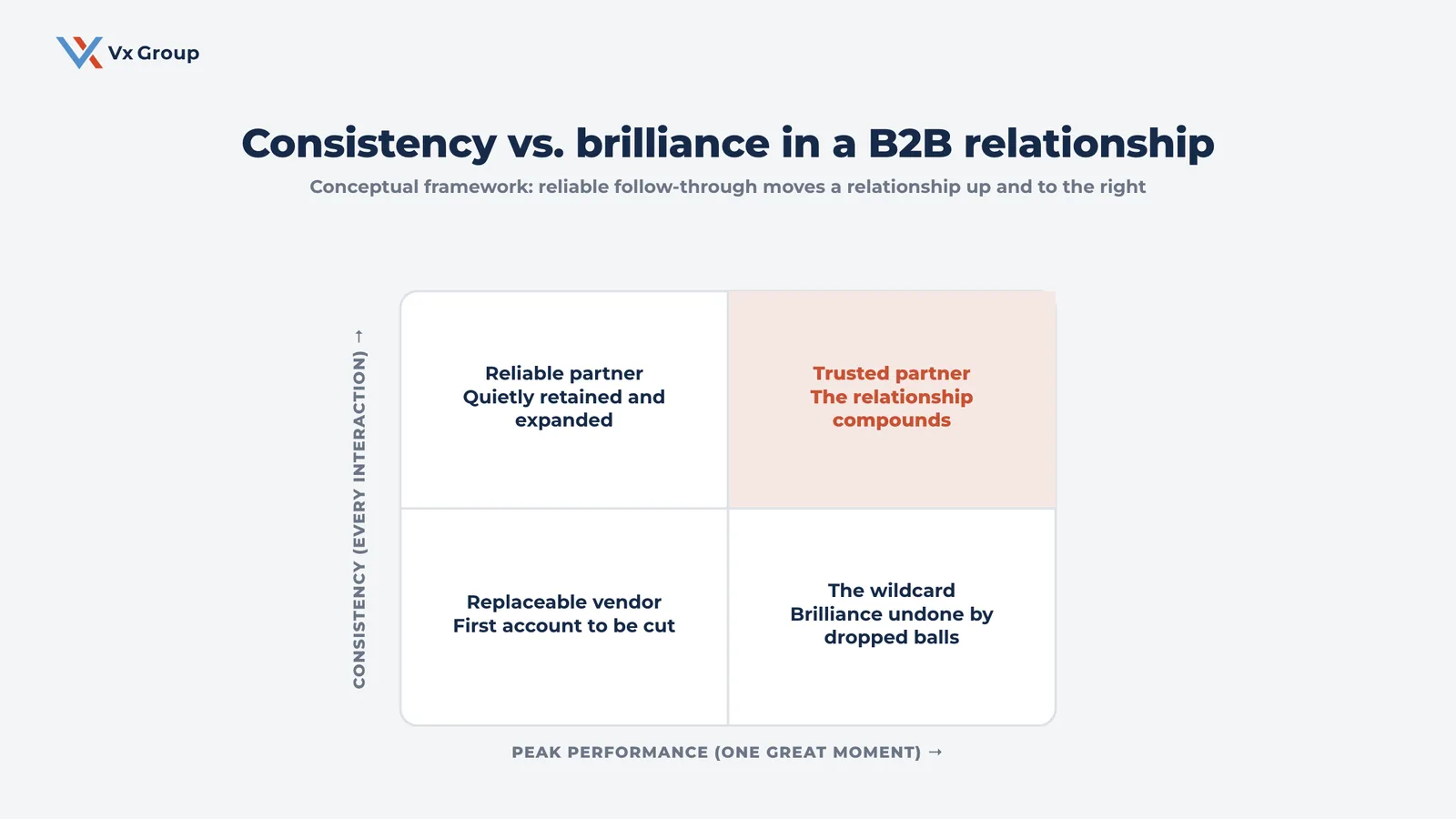
Audit your last five interactions with a top account
Pick one important account and list the last five times your team touched it: a proposal, a support reply, an invoice, a check-in, a delivery. Mark each one as a deposit or a withdrawal using the test above. The pattern usually shows up fast. If three of the five were withdrawals, the account is quietly at risk even if no one has complained, and closing the small gaps that keep recurring will do more for it than any grand gesture. Run the same audit across your top ten relationships once a quarter and you have a working read on experience that no survey will give you.
Protect the three moments that carry the most trust
Three moments shape how an account remembers you: onboarding, the first real problem, and the run-up to renewal. Onboarding sets the expectation for what working with you feels like, so a slow or confusing start is expensive to undo later. The first real problem is where trust is either earned or spent, because the customer learns how you behave when something goes wrong. The renewal window is when all of it gets priced in, consciously or not. Put a documented standard on each of these three, assign an owner, and you have protected the moments that move retention the most.
Why does B2B customer experience drive retention and growth?
B2B customer experience drives retention and growth because in a long relationship the experience is the product. What the customer pays for over years is the confidence that working with you will keep being reliable, easy, and worth it next quarter and next year.
When the experience is consistently good, the customer has no reason to shop around and every reason to expand what they do with you. When it wobbles, even strong work gets discounted, because the customer starts holding back and protecting themselves against the next disappointment. That is the direct line from experience to revenue. A reliable experience keeps and grows the accounts you already have, which is almost always the fastest growth available to a relationship-driven company.
It also decides which accounts grow. Customers expand with the partners they trust to handle more, and they quietly cap the ones they have to double-check. Experience settles that judgment long before a renewal conversation ever starts.
Track the behavioral signals that predict churn
Watch what customers do, because behavior predicts retention earlier than any satisfaction score. A handful of signals tend to move before an account leaves:
- Response latency: the time your team takes to reply is creeping up.
- Reopened issues: the same problem comes back more than once.
- Contact changes: your main relationship on the customer side has left or gone quiet.
- Initiation flips: you are always the one reaching out, and they have stopped reaching back.
- Order rhythm: the steady pattern of orders or usage starts to thin.
When two or more of these show up on the same account, treat it as an early warning and step in well ahead of the renewal conversation. By the time a customer raises the issue themselves, the trust account is already overdrawn.
How do you make a great B2B customer experience repeatable?
You make the experience repeatable by building systems so that follow-through never depends on one person remembering to do it. When the experience lives only in a star employee’s habits and head, it walks out the door the day they do, and a single resignation can put years of relationship value at risk.
The worry that systematizing the relationship makes it feel less personal has it backward. Systems do the opposite. They make sure every customer gets the reliable follow-through your best person delivers, even when that person is on vacation or has moved on. A few practices make it real:
- Write down what matters about each account. Decisions, preferences, history, and the people involved should live somewhere other than one inbox.
- Define the moments that cannot slip. Onboarding, the response to a problem, and the run-up to renewal carry the most weight, so give each one a standard.
- Make handoffs clean. When an account changes hands, nothing the customer told you a year ago should have to be repeated.
- Keep the relationship visible. Disciplined account management and a sales pipeline that does not live in one person’s head let a leader see which relationships are healthy and which are drifting before a customer feels it.
Done consistently, this turns reliability from a personality trait into a company capability. The three practices below are where most teams start.
Give every account a record the whole team can use
Put the important context about each account somewhere everyone can reach: decisions, preferences, the history of past issues, and who matters on the customer side. When that context lives in one person’s inbox, every handoff loses a little, and the customer feels it as having to explain themselves again. A shared account record turns individual memory into something the company owns, so a new rep can pick up a ten-year relationship without dropping the thread.
Set a standard for the moments that cannot slip
Write down what good looks like for the moments you protected earlier. Define how fast a problem gets a first response, what onboarding covers in the first thirty days, and what a renewal check-in always includes. A standard does not make the relationship feel scripted. It makes sure the customer gets your best version of follow-through even during a busy week when attention is short and three other accounts are on fire.
Run a short relationship review every month
Set a recurring time to look at your most important accounts as living relationships rather than as revenue lines. Walk the behavioral signals, confirm the standards held, and give an owner to anything that is drifting. A thirty-minute monthly review on your top accounts catches erosion while it is still cheap to fix, and it keeps the experience from sliding back onto one person’s shoulders where it started.
Field Notes
Good companies usually lose a long-standing customer to a slow accumulation of small withdrawals rather than to a price war or a flashy competitor: a late reply here, a dropped detail there, a familiar contact who left and took the context with them. None of it is dramatic enough to trigger a complaint. The customer simply stops feeling certain, starts taking other calls, and is gone at the next renewal. Consistency is what prevents that quiet erosion, and it is almost always a systems problem before it is a people problem.
Ready to grow?
See what building that consistency looks like inside your business.
Consistency is the experience
Treat customer experience as the discipline of being reliable on purpose. The companies that compound relationships spend less energy chasing a higher survey score and more on removing the small, recurring ways a customer gets let down, then building the systems that keep good behavior in place when the team changes. Start with the one account you can least afford to lose, and ask a harder question than whether they are satisfied. Ask whether they ever have to wonder if the next thing will go well. The honest answer is your real experience score.
Subscribe to Insights → for more on building B2B relationships that compound.
FAQs
About the Author: Beth Barbaglia
