

Account-Based Selling vs. Volume Selling: Which Wins in Relationship-Driven B2B?

For relationship-driven B2B companies with long sales cycles and high-value accounts, account-based selling wins. Concentrating effort on a defined set of best-fit accounts beats high-volume outreach because the economics of these businesses reward depth over reach. One deep relationship can outweigh fifty shallow ones, and volume tactics rarely build the trust these sales require.
Defined Term: Account-based selling
A sales approach that concentrates effort on a defined set of high-fit target accounts, treating each as a market of one, instead of casting a wide net and chasing whoever responds. It prioritizes depth of relationship over volume of outreach.
TL;DR
- Account-based selling concentrates effort on a defined set of best-fit accounts.
- Volume selling casts a wide net and pursues whoever responds.
- For long-cycle, high-value B2B, account-based selling wins clearly.
- The economics favor depth: one deep relationship can beat fifty shallow ones.
- Volume tactics generate activity and noise, and little of the trust these sales need.
- The exception is genuinely transactional, low-value, short-cycle sales, which most legacy B2B companies do not run.
What is the difference between account-based selling and volume selling?
The difference is focus. Account-based selling picks a small number of high-fit accounts and goes deep on each one. Volume selling casts the widest possible net and works whoever responds. One optimizes for relationship depth, the other for activity and reach.
The villain here is spray-and-pray: high-volume, low-quality outreach that treats every possible contact as equally worth pursuing. It generates motion and a full activity dashboard, and for a relationship-driven business it produces very little real revenue.
Volume selling assumes that more contacts at the top means more deals at the bottom. That holds in transactional markets with short cycles. It breaks in markets where a single sale requires months of trust-building with several people, because spreading effort thin means no relationship ever gets deep enough to close.
Defined Term: Spray-and-pray
A high-volume outreach approach that contacts as many prospects as possible with minimal targeting, hoping a small percentage respond. It optimizes for activity rather than relationship quality and rarely produces results in long-cycle, high-trust B2B sales.
When does account-based selling win?
Account-based selling wins whenever the sale is high-value, the cycle is long, and the decision rests on trust built across several people. That describes almost every relationship-driven B2B company, which is why focus beats volume for this audience.
The economics are the core of the argument. When a single account can be worth millions over the life of the relationship, the rational move is to concentrate effort on the accounts most likely to become those relationships. One relationship can change the trajectory of the business, which is not a claim volume selling can make.
Ready to grow?
Trying to decide whether to go deep or go wide? Get a clear read on which approach fits how your company actually sells.
Account-based selling also fits how trust actually forms in these markets. Going deep on a defined set of accounts means every interaction compounds, instead of starting over with a new cold contact each time. Depth is what the long cycle requires, and it is what a wide, shallow net can never produce.
When does volume selling make sense?
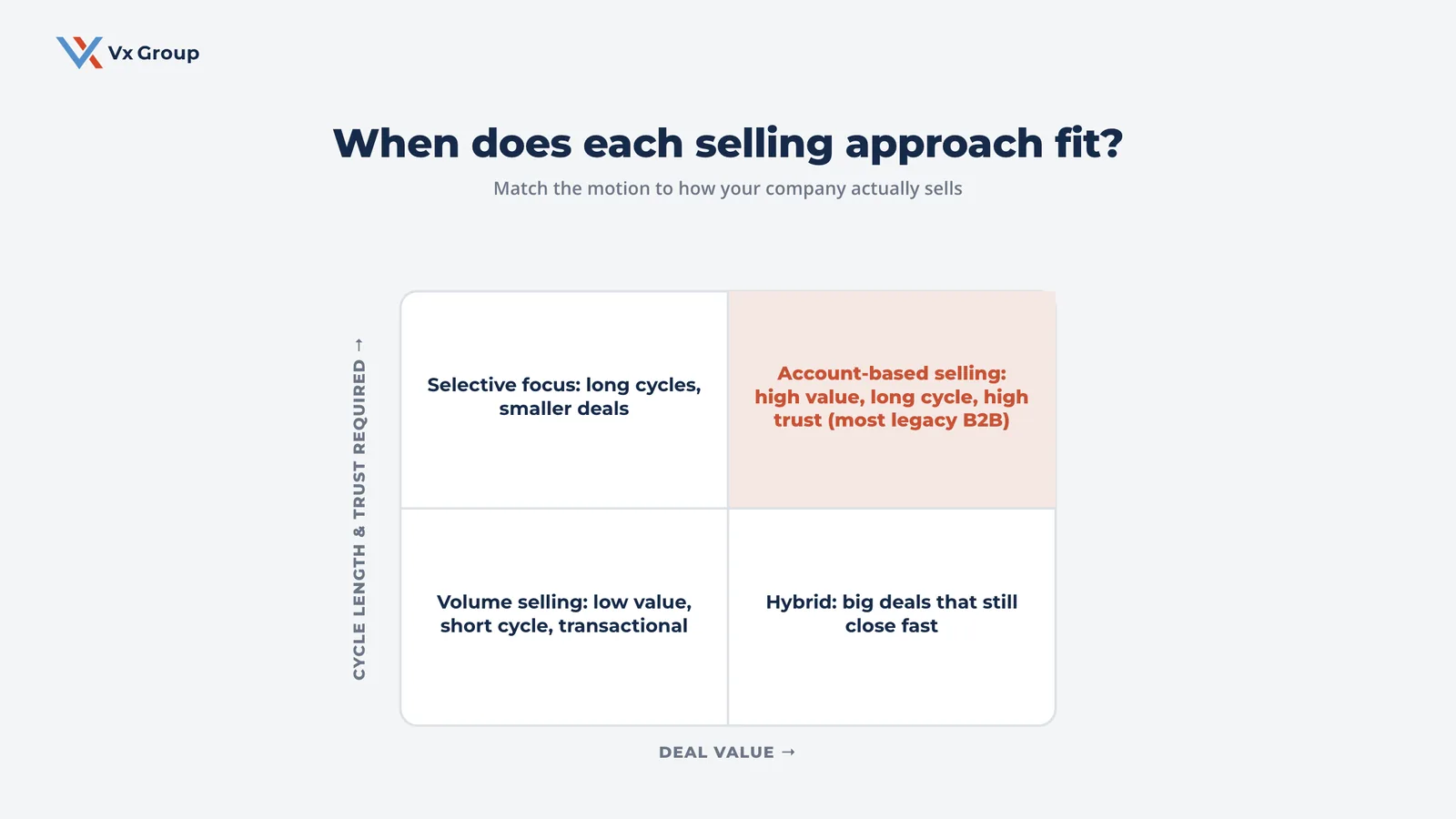
Volume selling makes sense when the sale is genuinely transactional: low value per deal, short cycle, and a decision that does not require deep trust. In those conditions, reach matters more than depth, and a wide net is the efficient approach.
Most legacy and lower-middle-market B2B companies do not run that kind of sale. Their offerings are complex, their cycles are long, and their relationships are worth protecting for years. For them, borrowing volume tactics is importing the wrong playbook, and it shows up as a busy team and a flat revenue line.
The two approaches serve different businesses. The mistake is a relationship-driven company running volume tactics because they are easier to measure, then wondering why all that activity is not converting.
| Dimension | Account-based selling | Volume selling |
|---|---|---|
| Focus | A defined set of best-fit accounts | The widest possible net |
| Optimizes for | Relationship depth | Activity and reach |
| Best for | High-value, long-cycle, high-trust sales | Low-value, short-cycle, transactional sales |
| Effort per account | High and concentrated | Low and spread thin |
| Risk | Choosing the wrong accounts to focus on | Generating noise that never converts |
| Fit for legacy B2B | Strong | Weak |
What does account-based selling look like in practice?
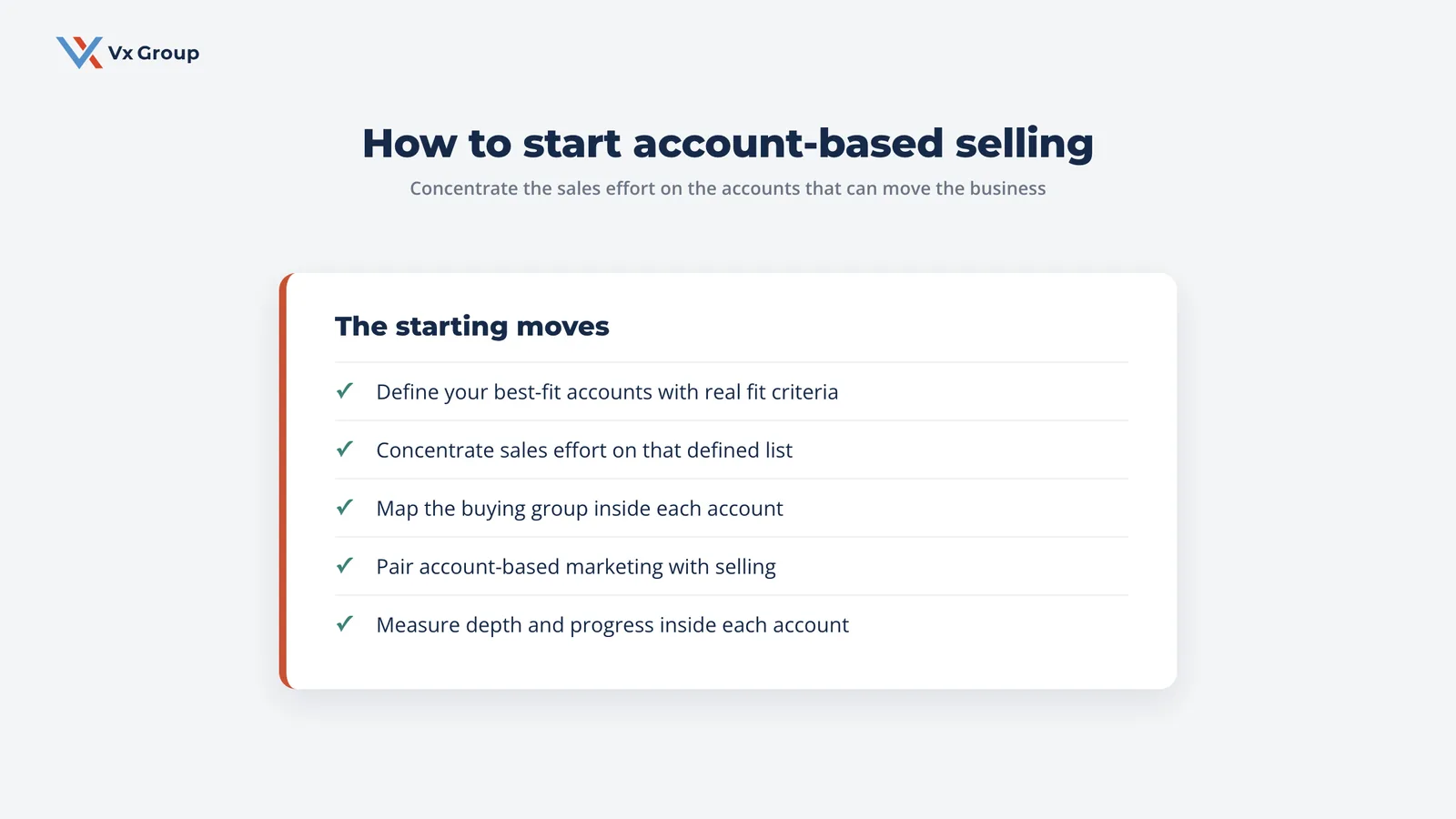
Account-based selling starts with a written definition of the accounts worth concentrating on, then organizes the whole sales effort around them. It is a deliberate way of working, and it looks different from a rep grinding through a long call list.
The motion has a few consistent parts. You define a tight list of best-fit accounts using real fit criteria. You map the buying group inside each one, because a high-value sale is rarely a single decision-maker. You plan the touches across that group so every interaction builds on the last. And you coordinate marketing and selling so each account hears a consistent message from both sides. The work is concentrated, documented, and patient, which is what a long cycle rewards.
How do you measure account-based selling versus volume selling?
The two approaches need different scorecards, and judging account-based selling by a volume scorecard is how good account work gets killed before it pays off. Volume selling measures activity: calls made, emails sent, meetings booked, leads in the funnel. Those numbers move fast and feel productive.
Account-based selling measures depth and progress inside the accounts that matter: how many of the right people you have a real relationship with, whether that relationship is advancing, how much pipeline and revenue is concentrated in best-fit accounts, and your win rate within the target list. These numbers move slowly at first, which is exactly why a team under pressure abandons the approach right before it starts working. Measuring the right things protects the patience the strategy requires.
Which should your company choose?
If you sell complex, high-value offerings into long relationships, choose account-based selling and build it on a clear definition of your best-fit accounts. The whole approach depends on choosing the right accounts, which means the work starts with knowing precisely who your ideal customer is.
Account-based selling and account-based marketing work as a pair. Marketing builds awareness and credibility with the target accounts, and selling builds the relationships inside them. Run together, they concentrate the whole company’s effort on the accounts that can actually move the business.
The practical starting point is to define your best-fit accounts, then prospect them with intention instead of chasing volume. Fewer, better accounts, pursued with real focus, is the approach that matches how these businesses actually grow. If you want a relationship-first playbook for working those accounts, our sales prospecting guide covers the mechanics.
Ready to grow?
Ready to focus your sales effort on the accounts that can actually move your business?
Subscribe to Insights →
FAQs
About the Author: David Tisdale
