

How to Measure Trade Show Effectiveness: Why It Isn’t Lead Volume

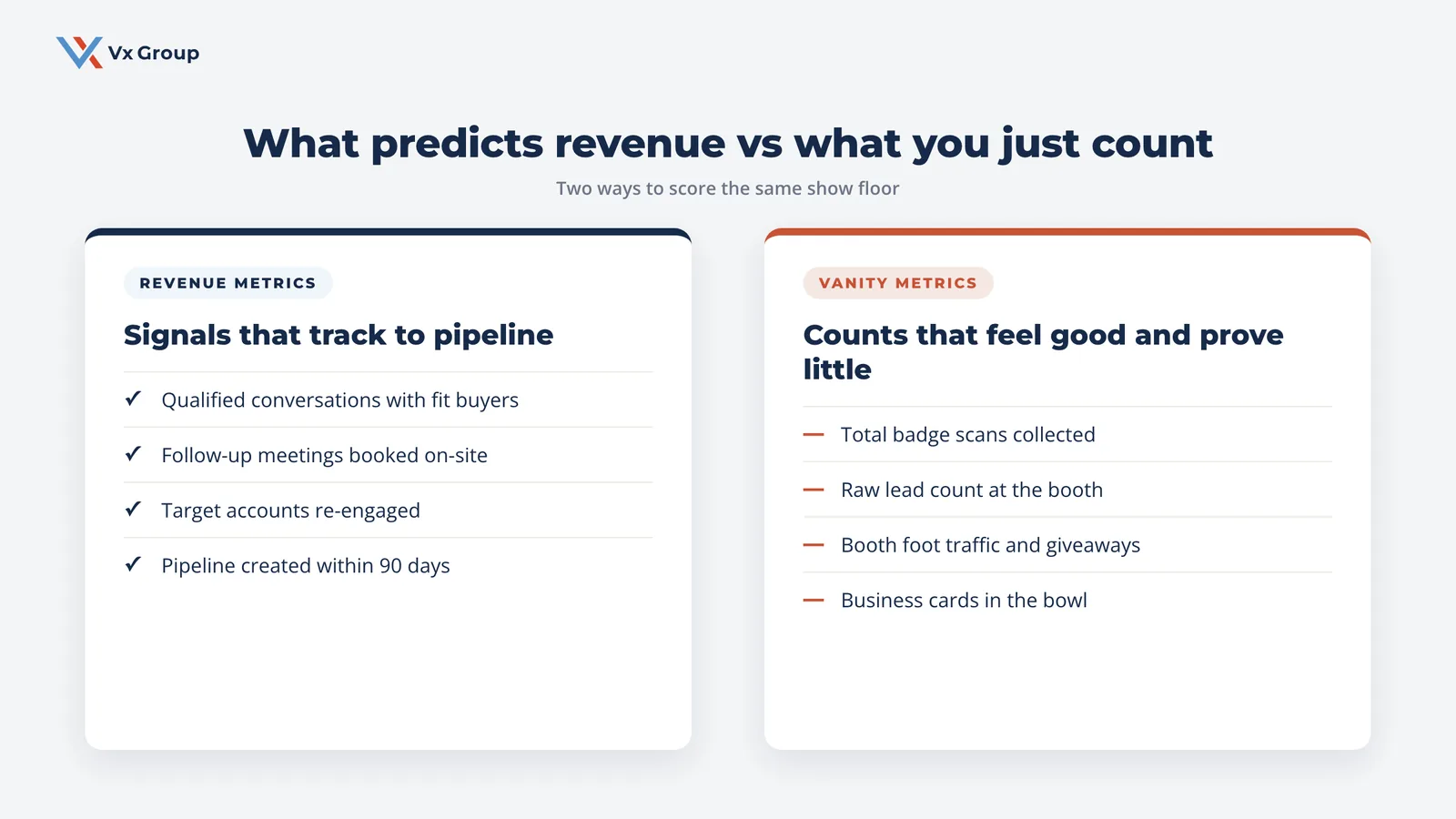
To measure trade show effectiveness, track relationship quality instead of lead volume. Count the qualified conversations you started, the follow-up meetings you booked, the target accounts you re-engaged, and the pipeline that moved within 90 days of the show. Badge scans tell you how busy the booth was, not whether you built anything worth pursuing.
TL;DR
- Lead counts and badge scans are activity metrics, not effectiveness metrics.
- The four numbers that matter: qualified conversations, follow-up meetings booked, target accounts re-engaged, and pipeline influenced.
- Set your success metrics before the show, not after.
- Tie every metric back to a named account, not an anonymous contact list.
- The real measure of a show is what happens in the 90 days after the floor closes.
Why Are Lead Counts the Wrong Way to Measure a Trade Show?
Lead counts reward volume over quality, and volume is rarely what builds revenue in relationship-driven B2B. A stack of 400 badge scans feels like a win on the flight home, then converts to three real conversations and zero deals.
Most companies measure trade shows this way because it is easy. Scanning a badge takes two seconds and produces a number you can put in a report.
The number looks like progress. It rarely is.
A booth that scanned 400 badges and a booth that had 25 substantive conversations with target accounts will show wildly different results six months later. The second booth wins almost every time.
Defined term: relationship-driven B2B
A company whose revenue depends on long-term, high-trust relationships rather than high-volume, short-cycle transactions. Think industrial manufacturers, packaging firms, and infrastructure suppliers with multi-year customer tenures.
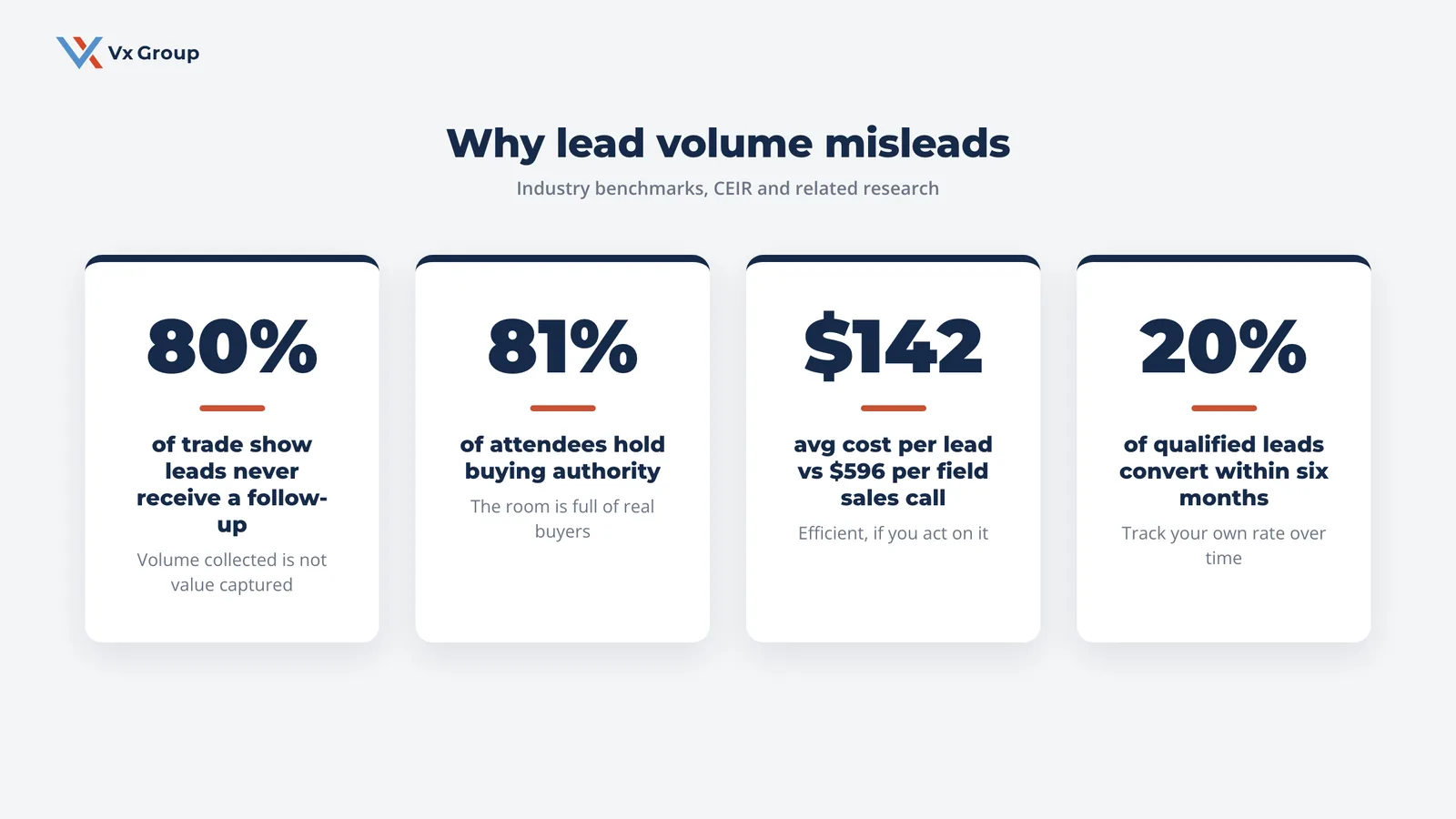
The numbers show why a big badge-scan count can mislead you. Lead generation is the number-one reason companies exhibit, cited by 72% of exhibitors. Yet an estimated 80% of trade show leads never get any follow-up, and the vast majority of marketers say their organization struggles to turn event leads into real opportunities. A booth can win the lead-volume contest and still produce almost no revenue, because the work that creates revenue happens after the show.
Step 1: Define Your Success Metrics Before the Show
Decide what a successful show looks like weeks before you arrive, not on the drive home. A metric you invent after the fact is a justification, not a measurement.
Write down the specific outcomes that would make the investment worth it. For most relationship-driven companies, that means a target number of conversations with named accounts that match your ideal customer profile, a target number of follow-up meetings booked on-site, and a list of dormant relationships you want to reopen.
Anchor every metric to a real business goal. “Talk to 15 of our top 40 target accounts” is a measurable goal. “Generate buzz” is not.
Share these metrics with everyone working the booth. A team that knows it is measured on conversation quality behaves differently from a team measured on scan count.
Step 2: Track Qualified Conversations, Not Foot Traffic
Count the conversations that reached a real business topic, and ignore the ones that did not. A qualified conversation is one where you learned something about the prospect’s situation or they learned something about how you could help.
Foot traffic measures how good your booth location is. Qualified conversations measure how good your show was.
Give your team a simple way to log these in the moment. A short note on each meaningful conversation, who it was with and what surfaced, is worth more than a hundred scanned badges with no context.
The point is to capture signal, not noise. Five documented conversations with decision-makers at priority accounts beat fifty business cards from people who wanted a free pen. Every qualified conversation from a show belongs in the same pipeline that drives relationship-driven prospecting the rest of the year, with the same next-step discipline and the same account-level tracking.
Ready to grow?
Measure trade shows by the relationships and pipeline they build, not the badges you scanned.
Step 3: Measure Follow-Up Meetings Booked On-Site
Count how many next steps you scheduled before leaving the floor, because a booked meeting is the clearest evidence a relationship is moving. A conversation that ends with “let’s talk next Tuesday” is worth far more than one that ends with “great to meet you.”
This metric forces discipline at the booth. When the team knows it is measured on meetings booked, it stops collecting contacts and starts advancing relationships.
Track who booked, what account they represent, and when the meeting is set. This turns a vague sense of momentum into a number you can hold the team accountable to.
Defined term: relationship momentum
The measurable forward motion in a relationship, shown by concrete next steps like a scheduled meeting, a requested proposal, or an introduction to another decision-maker. It is the difference between interest and progress.
Step 4: Track Target Accounts Re-Engaged
Count the dormant or stalled relationships you reopened at the show, because trade shows are one of the few places these conversations happen naturally. A customer you have not spoken to in two years walking up to your booth is an opportunity most reporting completely ignores.
Build your re-engagement list before the show from accounts that went quiet, lost deals worth revisiting, and customers whose contacts have changed roles. The same strategic targeting that drives relationship-driven prospecting applies here: prioritize the accounts that look like your best existing customers. Then track how many of them you actually reached.
These conversations almost never show up in a lead count. They are some of the most valuable outcomes a show produces. Trade shows, measured this way, function as a repeatable component of a company’s B2B growth strategy rather than a standalone marketing expense: a concentrated burst of relationship activity with the accounts that drive long-term revenue.
A reopened relationship with a former customer often carries more revenue potential than a dozen cold introductions. Measure it deliberately or you will miss it entirely.
Step 5: Connect Show Activity to Pipeline Within 90 Days
Track the pipeline that moved in the 90 days after the show and attribute it back to specific booth conversations. This is the metric that tells you whether the show was worth the spend.
Tag every opportunity that traces to a show conversation. Watch how those opportunities progress over the following quarter, and compare the pipeline created against the full cost of attending.
The 90-day window matters because relationship-driven deals do not close on the floor. They close months later, after the conversations you started at the booth have had time to develop.
If you only measure the day the show ends, you measure the least important moment in the entire cycle.
For a directional benchmark, CEIR data suggests exhibitors convert about 20% of qualified show leads into customers within six months. Treat that as a starting reference, then track your own conversion rate show over show so the number reflects your market and your follow-up discipline.
Step 6: Run a Structured Post-Show Review
Hold a review within two weeks of the show while the conversations are still fresh. Compare what you set as success metrics in Step 1 against what actually happened.
Walk through each priority account. Note who you reached, what you learned, and what the next step is for every one of them.
Capture what worked and what did not for next time. A show you reviewed honestly makes the next show better. A show you never reviewed teaches you nothing.
Document the findings somewhere the whole team can use them. The value of a review that lives only in one person’s head disappears the moment they move on.
What Metrics Actually Tell You a Trade Show Worked?
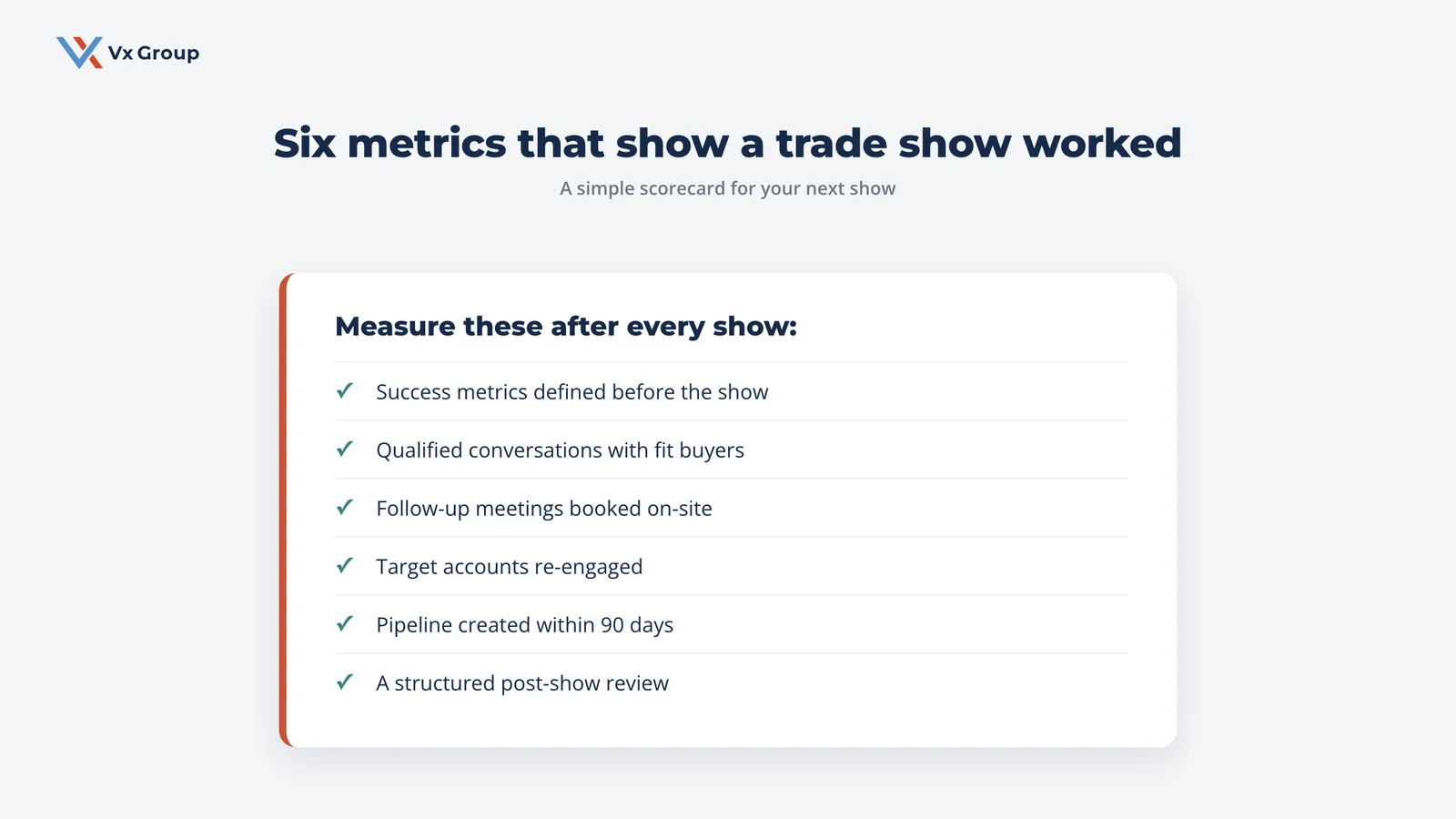
The metrics that tell you a show worked are the ones tied to relationships and revenue, not activity. Qualified conversations with named accounts, follow-up meetings booked on-site, dormant accounts re-engaged, and pipeline influenced within 90 days form a complete picture.
Each of these connects directly to how revenue is actually built in a relationship-driven company. None of them can be inflated by scanning more badges.
When you measure this way, a “smaller” show with 30 deep conversations can outperform a “bigger” show with 300 scans. The numbers finally reflect the business you are trying to grow.
Ready to grow?
Turn trade show activity into pipeline you can actually track back to revenue.
Trade shows concentrate buyers in a way few channels can. CEIR research finds 81% of attendees hold buying authority for the products on display, and 67% are prospects the exhibiting company has not reached before. On cost, the average trade show lead runs roughly $142, against about $596 for a traditional field sales call. The opportunity is real. The question is whether you measure the handful of conversations that can move a deal or simply count everyone who walked past.
Measure What You Came to Build
Trade shows reward companies that treat them as relationship events and punish the ones that treat them as lead-collection booths. The measurement framework you choose decides which kind of company you are. When a trade show is part of a documented B2B demand generation strategy, the work you do on the floor connects to account development, pipeline attribution, and relationship tracking that continues long after the show closes.
Set your metrics before the show, track conversations and meetings instead of scans, reopen the relationships that went quiet, and follow the pipeline for a full quarter afterward. That is how you find out whether a show was worth attending, and how you make the next one better.
FAQs
About the Author: Jacob Camhi
