

How to Build a B2B Marketing Strategy When Relationships Close the Deal

A B2B marketing strategy is a written plan for which accounts you want, what each buyer needs to hear, and how you will reach them. For a company with a long sales cycle, start with the relationships that already produce your revenue. Then spend marketing money where those relationships can grow.
TL;DR
- A B2B marketing strategy for a long-cycle company starts with a revenue map of where sales come from today. The campaign calendar comes after that.
- In the illustrative $25M example below, 40 of 340 accounts hold $17.5M, which is 70% of revenue.
- Rank accounts on four weighted factors, then give your top accounts a named owner and a written plan.
- Write one page for each person on the buying committee, because about six people share the decision.
- Pick channels by the job each one does for a 12-month sale: referrals, events, your website, and direct outreach.
- Measure meetings, quotes, and share of wallet at your top accounts every quarter, because closed deals come too late to act on.
Most B2B marketing strategy advice was written for a software company with a thirty-day sales cycle, one buyer, and a demo request form as the finish line. We regularly talk with owners of manufacturers around $25M who were handed that playbook and told to run it.
Their buying committee has six people. Their cycle runs twelve months. The last three big wins came from somebody the owner already knew. A plan built around form fills has nothing to say about any of that. So the company ends up with what we call random acts of marketing. That means a trade show here, a newsletter there, and an agency retainer nobody can tie to a quote.
This guide builds the strategy in the opposite order. It starts with the revenue you have. Next it decides which relationships get the next dollar. Only then does it pick messages and channels. Every section ends with something you can build this month.
Here is what the guide covers:
- What a B2B marketing strategy is, and how long-cycle selling changes it
- How to build a revenue map
- How to rank accounts and decide who gets the next dollar
- What each buyer on the committee needs to hear
- Which channels fit a 12-month sale
- How to measure the strategy
- Common mistakes and where to start
What is a B2B marketing strategy?
A B2B marketing strategy is the set of decisions that tells a company who to market to, what to say, where to say it, and how to tell whether it worked. It sits above the marketing plan. The strategy decides where to play, and the plan schedules the work for the year.
Defined Term: B2B marketing strategy.
A written set of choices about target accounts, buyer messages, channels, and measures, tied to the revenue a company already earns and the revenue it wants to add.
Two other terms get mixed up with it. A B2B go-to-market strategy covers the whole route to market, including pricing, sales coverage, and partners. A B2B marketing plan turns the strategy into a calendar and a budget. The strategy sits in the middle. Most companies skip it and jump from a go-to-market idea straight to a content calendar.
Compare the short-cycle playbook with the long-cycle playbook
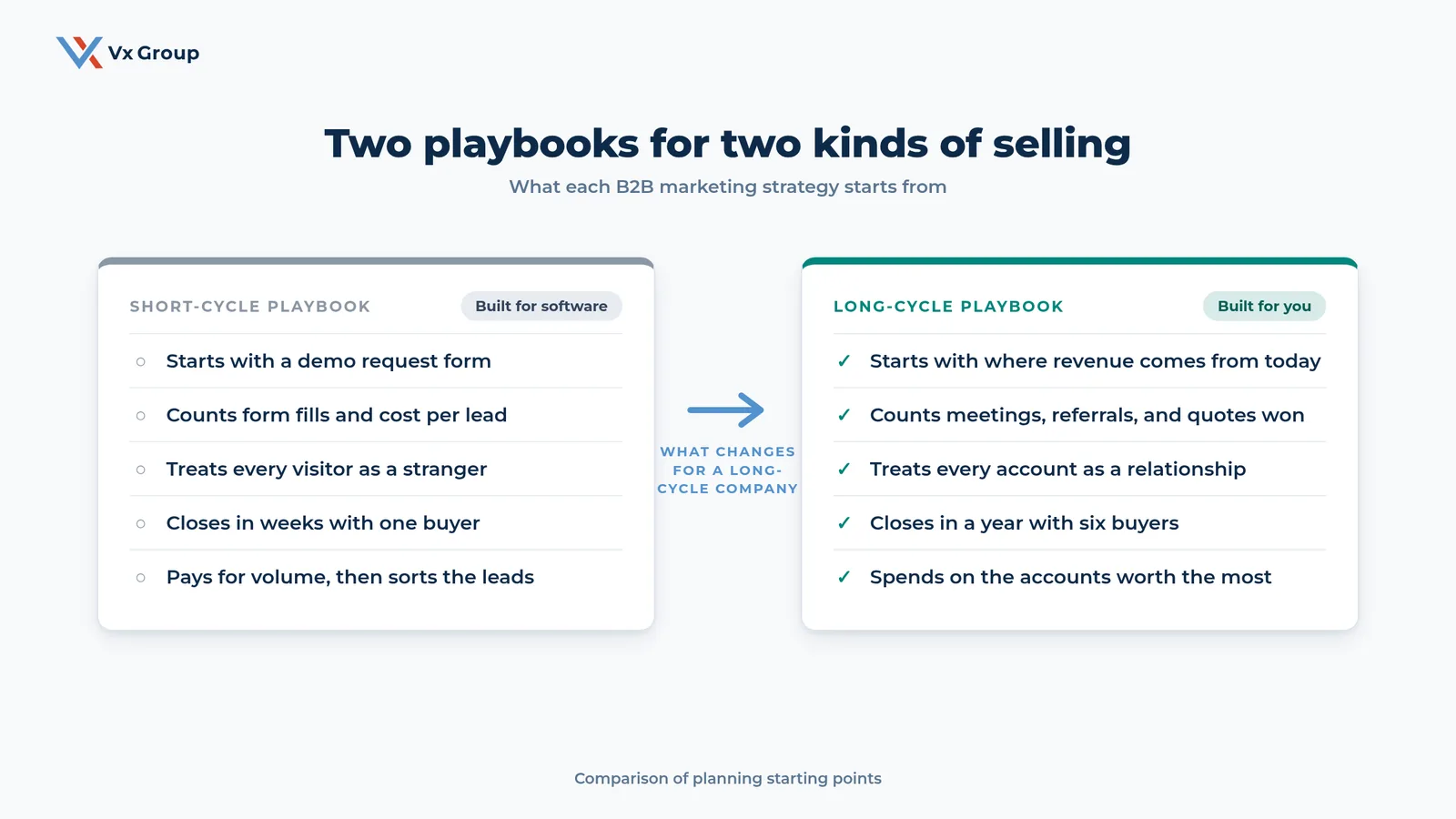
The table shows where the two playbooks start. Every difference in the right column comes from one fact. A long-cycle company already has customers who know it.
| Question | Short-cycle playbook | Long-cycle playbook |
|---|---|---|
| Where does planning start? | A demo request form | The revenue map of current accounts |
| Who is the buyer? | One person | A committee of about six |
| How long is the sale? | Weeks | Often 12 months |
| What gets counted? | Form fills and cost per lead | Meetings, quotes, referrals, and share of wallet |
| Where does the money go? | Volume | The accounts worth the most |
The graphic puts the same five questions to both playbooks. The short-cycle version starts with a form and counts leads. The long-cycle version starts with current revenue and counts meetings, referrals, and quotes.
Why does standard B2B marketing strategy advice fail long-cycle companies?
Standard advice assumes a stranger finds you, fills out a form, and buys within weeks. A company with a twelve-month cycle and a six-person committee often sells to people who already know it. A form-fill plan spends the budget on the wrong audience.
Three assumptions break first:
- One buyer. Advice says to build a persona. A $25M manufacturer sells to an owner, an engineer, a buyer in purchasing, a plant lead, a finance lead, and a quality lead. Each one can stop the deal. Our guide to the B2B buying committee walks through those seats.
- Anonymous leads. Advice says to measure cost per lead. Most of the revenue at a long-cycle company comes from named accounts. A lead from a stranger tells you little about whether that account is worth a year of attention.
- Speed. Advice says to shorten the funnel. A buyer comparing a custom part or a capital item takes as long as the purchase needs. Your job is to be useful the whole time.
The cost shows up in the numbers we see. In the companies we work with, wallet share at the biggest accounts is typically under 5%. The plan chases new names while 95% of what the best customers could buy goes to someone else.
How do you build a B2B marketing strategy step by step?
Build it in four parts, in this order: a revenue map, account priorities, a message for each buyer, and then channels and measures. Each part gives the next one its starting point. If you skip ahead to channels, you get a calendar with no reason behind it.
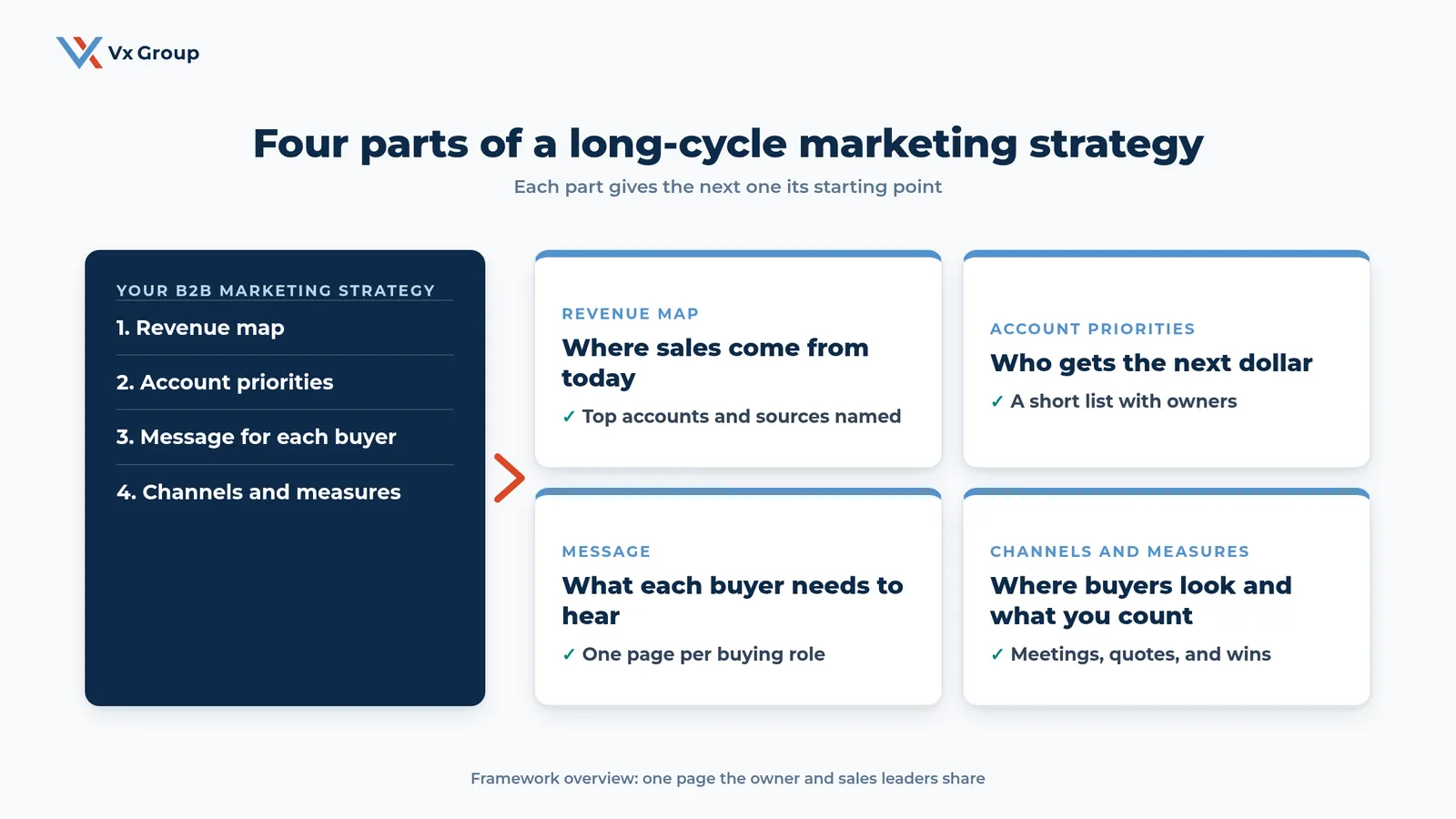
The diagram lists the four parts in build order. The revenue map shows where sales come from. The priorities list names who gets the next dollar. The messages say what each buyer needs to hear. The channels and measures say where buyers look and what you count.
The next four sections take one part each.
How do you build a revenue map for a B2B company?
A revenue map is a one-page table of your accounts, what each paid you over the last three years, and how you won each one. It takes an afternoon with your accounting export. It is the most useful page in the whole strategy because it shows where your revenue sits.
Defined Term: Revenue map.
A one-page table that lists every active account with three years of revenue, the product lines bought, and the source of the first sale.
Pull three years of invoices into one sheet
Export invoices by customer for the last three years. Put one row per account and one column per year, then add a column for total revenue and a column for the product lines each account buys.
Use whatever system holds the truth: your accounting software, your ERP, or a spreadsheet your controller trusts. Keep the file simple enough that the owner can read it without help.
Tag each account by how you won it
Add a column called “source” and fill it in for every account that matters. Use a short, fixed list so the tags can be counted:
- Referral from a customer
- Referral from a partner, distributor, or rep
- Trade show or industry event
- Inbound from the website or search
- Outbound by your sales team
- Existing relationship from a previous job or company
Ask your sales leaders to fill it in. Ask the owner to check the top 40 by hand. The owner usually knows the real story behind the big ones, and the invoice system never records it.
Read the revenue map for concentration
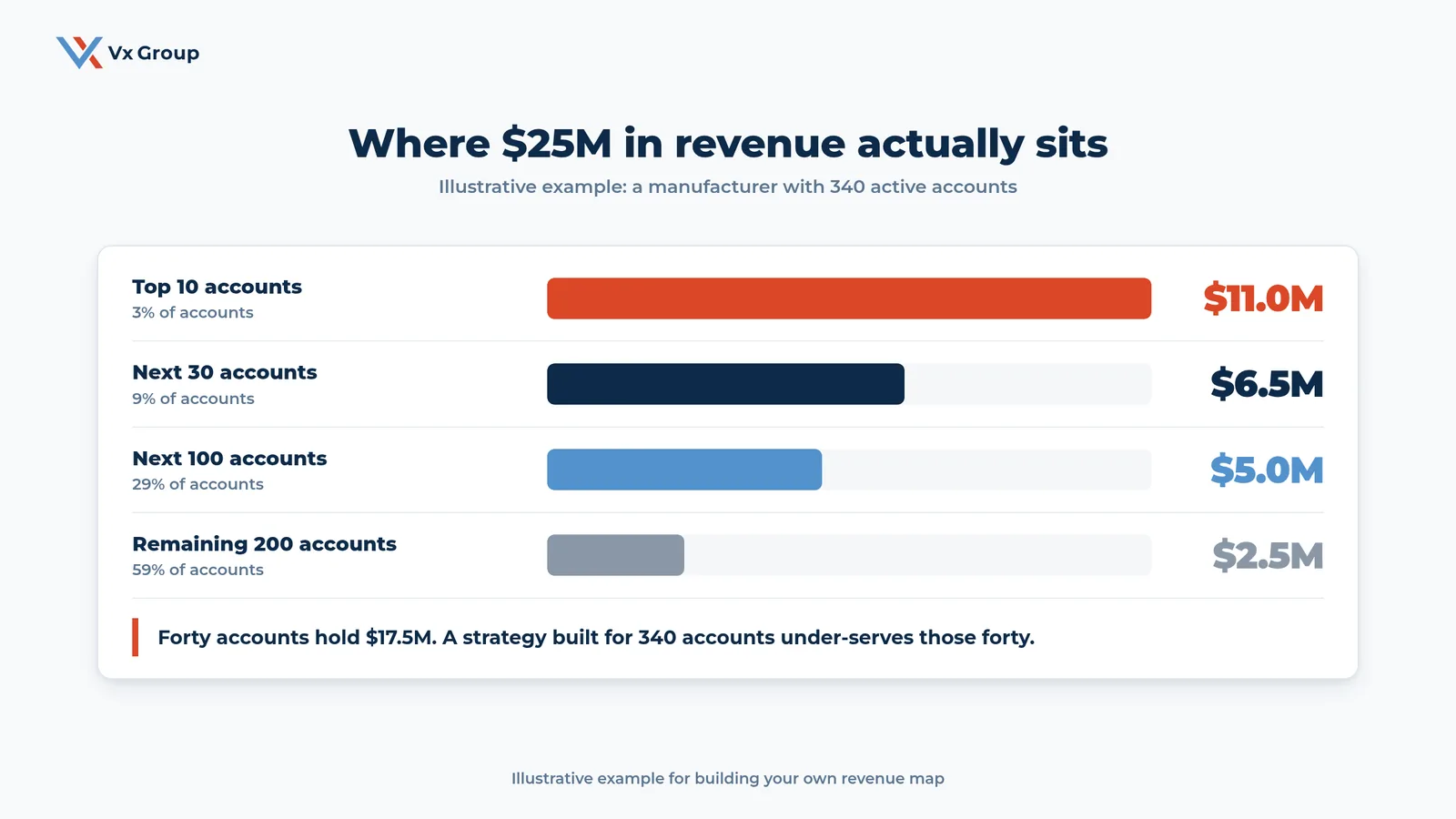
Sort the sheet by total revenue and add up the top 10, the next 30, the next 100, and the rest. The shape of that split tells you where the strategy should spend its money.
Here is an illustrative example for a manufacturer with $25M in revenue and 340 active accounts:
| Account group | Share of accounts | Revenue |
|---|---|---|
| Top 10 accounts | 3% | $11.0M |
| Next 30 accounts | 9% | $6.5M |
| Next 100 accounts | 29% | $5.0M |
| Remaining 200 accounts | 59% | $2.5M |
In this example the top 40 accounts hold $17.5M, which is 70% of revenue. Suppose the company spends $250,000 a year on marketing and spreads it evenly. That is about $735 per account, so the top 40 receive roughly $29,400, or 12% of the budget, while they produce 70% of the revenue.
Run your own numbers the same way. If your top 40 hold a similar share, the strategy has a clear first job: protect and grow those accounts. Our post on why your top 10 customers should shape your strategy goes deeper on the concentration side.
How do you decide which accounts get the next marketing dollar?
Score your accounts on a few weighted factors, then sort them into three lists. The score keeps the talk on the facts about each account. The lists tell marketing and sales where to put time and money. Scoring takes about two hours for a 40-account list.
Score every top account on four weighted factors
Use the same four factors we use to build an ideal customer profile for a long-cycle company. The weights put the relationship first:
- Relationship quality (35%): tenure, trust, and how easy the account is to work with.
- Expansion potential (25%): room to grow wallet share (or, are they already tapped out?).
- Strategic value (25%): referrals sent, and fit with where you want the company to go.
- Firmographic fit (15%): revenue, headcount, and industry, which is what most companies have been using the whole time.
Score each factor from 1 to 5, multiply by the weight, and total it out of 100. Here is one account as a worked example:
| Factor | Weight | Score (1 to 5) | Points |
|---|---|---|---|
| Relationship quality | 35% | 5 | 35 |
| Expansion potential | 25% | 4 | 20 |
| Strategic value | 25% | 3 | 15 |
| Firmographic fit | 15% | 4 | 12 |
| Total | 100% | 82 |
For more on the profile itself, see our ideal customer profile template and the guide to customer segmentation models.
Sort accounts into three lists
Rank the scored accounts and cut them into three lists:
- Protect and grow: high relationship score and room to expand. These get the most attention.
- Win next: accounts you want that buy only a small amount from you today, or accounts that look like your best customers and have never bought.
- Everyone else: served well, but no special marketing spend.
Keep “Protect and grow” to about 15 to 25 accounts. A longer list has no owner, which means it has no plan.
Name an owner and a next step for every top account
Put one person’s name beside each account on the first two lists, and write the next step in one line: a plant visit, an introduction to a second buyer, a quote review, a referral ask. The account owner is usually the salesperson or account manager who knows the buyer best.
This is where marketing and sales start working together. Our guide to B2B account management strategy covers how to run these accounts week to week.
Ready to grow?
See how a revenue map and account priorities would look for your own company.
What does each person on the buying committee need to hear?
Each person on the committee needs an answer to the question their job makes them ask. An engineer wants specs and test data. Purchasing wants price and lead time. The owner or president wants to know the supplier will still be there in ten years. One message aimed at “the customer” answers none of those questions well.
List the six seats and the question each one asks
Use this table as a starting point and edit it with your sales team. Every row should come from real calls, so ask the people who sit in those meetings.
| Seat | The question they ask | What to give them |
|---|---|---|
| Owner or president | Will this supplier still be here in ten years? | Company history, named customers, leadership bios |
| Engineer or spec writer | Will this part meet the spec? | Specs as page text, test data, CAD files |
| Buyer in purchasing | Is the price fair and the supply reliable? | Lead times, minimums, a clear quote format |
| Plant or operations lead | Will this part run in our line without trouble? | Installation guides, support contacts, return process |
| Finance lead | What is the total cost over the life of the part? | Total-cost examples, payment terms |
| Quality or safety lead | Can you prove it? | Certifications, audit results, traceability |
Write one page for each seat
Write a one-page summary for each seat that matters to your top accounts. Each page answers that seat’s question first, shows the proof, and ends with the next step.
A page for the engineer might open with the spec table and link to the test data. A page for the owner might open with the twenty-year customer list and the names of the people who answer the phone. Keep the facts consistent across pages, so a buyer who reads three of them sees one company.
Put the facts where an AI assistant can read them
Buyers now ask AI assistants to compare suppliers before they call anyone. The assistant reads text. Specs locked in a PDF scan or an image get skipped. Write lead times, certifications, and minimums as plain text on your own pages, and keep them identical on distributor and directory listings.
Two posts go deeper on this: LLM SEO explains how AI finds and compares suppliers, and the AI visibility audit shows how to check what an assistant says about you today.
Which marketing channels fit a long-cycle B2B company?
The channels that fit are the ones that build trust with a small number of known accounts over many months. Referrals, events with a meeting plan, a website that answers buyer questions, and direct outreach tied to your account list do that job. Broad paid campaigns do it poorly.
Pick each channel for the job it does, as in this table:
| Channel | Job in a 12-month sale | Where to start |
|---|---|---|
| Customer and partner referrals | Bring in buyers who already trust you | Ask the top 40 for one introduction each |
| Trade shows and events | Meet committee members face to face | Book meetings before the show |
| Website and search | Answer questions a buyer asks alone | One page per buyer seat, specs as text |
| Direct outreach to named accounts | Add second and third buyers inside accounts | Use the “Win next” list |
| Email to your own list | Stay present between meetings | A short note when something changes for them |
| Paid ads | Reach a narrow audience on a narrow topic | Small test, tied to one account list |
Start with the channels you already own
Your best channel today is probably referrals and repeat business. A campaign calendar never mentions them. Add a referral step to your account plans. For each top account, decide who in that company might know a peer. Then ask for the introduction in a conversation. A short ask from a happy customer often does more than a month of ads.
Plan every event around meetings you booked
At a trade show, the goal is a list of conversations that happen. Book meetings with named accounts weeks ahead, decide who from your team takes each one, and write the follow-up before you leave. Our guide to trade show ROI shows how to count what the booth produced.
Make the website answer buyer questions
A long-cycle buyer often researches alone before a first call. Build the website pages from your buyer table, one per seat, and give search and AI assistants clean text to read. Our posts on B2B SEO strategy and industrial B2B marketing cover the mechanics.
Use account-based outreach for the Win next list
Outreach tied to named accounts reaches the second and third buyers inside a company you already sell to. Write a short, specific note for each person on the list. Mention something you know about their plant or their product. The overview of account-based marketing explains why mid-market companies are already set up to do this without expensive software.
How do you measure a B2B marketing strategy over a 12-month sales cycle?
Measure the actions that come before a sale, because closed deals come too late to act on. Track meetings with your top accounts, quotes requested, referrals asked and received, and share of wallet at the accounts on your priority lists. Review them every quarter.
Defined Term: Share of wallet.
The portion of what a customer spends in your category that goes to you. If a customer buys $2M a year of parts like yours and $200,000 comes to you, your share of wallet is 10%.
Track four leading indicators
Use these four numbers. Define each one in writing so the team counts the same way:
| Measure | How to calculate it | What it shows |
|---|---|---|
| Meetings with priority accounts | Meetings held with the “Protect and grow” and “Win next” lists per quarter | Whether attention reaches the right accounts |
| Quotes requested | Quote requests from priority accounts per quarter | Whether interest is turning into buying activity |
| Referral asks and introductions | Asks made, and introductions received | Whether relationships are bringing in new introductions |
| Share of wallet | Your revenue at an account divided by its total spend in your category | Whether the best accounts are growing with you |
The posts on share of wallet and business leading indicators explain how to size a customer’s total spend and pick measures that move before revenue does.
Review the strategy every quarter with sales in the room
Hold a 60-minute review each quarter with the owner, the sales leaders, and whoever runs marketing. Check the four measures, move accounts between lists, and decide what to stop. Cut at least one activity every quarter. A strategy that only adds work turns back into random acts of marketing.
Sales and marketing need to share the lists and the numbers. Our post on B2B marketing and sales alignment covers how to set that up.
What mistakes sink a long-cycle B2B marketing strategy?
Most mistakes come from borrowing a plan built for a different kind of selling. Watch for the six below, and fix each one before you spend another dollar.
- Copying a software playbook. Demo forms, cost per lead, and short nurture sequences were built for a thirty-day cycle.
- Choosing channels first. A plan that starts with “we need LinkedIn and a podcast” has no reason behind it. Start with the revenue map instead.
- Counting leads from strangers. A lead count says how busy marketing was. It says little about whether an account worth a year of attention is moving.
- Spreading budget evenly. Equal spend across 340 accounts under-serves the forty that matter most.
- Keeping marketing apart from sales. If sales does not use the lists, the strategy stays a slide.
- Never refreshing it. Accounts change and buyers move. Last year’s revenue map is out of date by the next planning cycle.
Field Notes:
We see this often in owner-led manufacturers. The company has a marketing budget, a website, and a trade show schedule. Nobody can say which twenty accounts matter most to next year’s revenue. Once the owner and the sales leader build the revenue map together, the list takes an afternoon. The budget conversation changes the same day. The first question the team asks becomes “who should we call?”
Where should an owner start this month?
Start with a four-week plan that produces the revenue map and the priority lists before any new spending. One person owns it, and the owner joins the review sessions.
- Week 1: Export three years of invoices by customer, build the revenue map, and tag the source of each top account.
- Week 2: Score the top 40 accounts, cut them into the three lists, and name an owner for each account on the first two.
- Week 3: Fill in the buying committee table for your top ten accounts, and draft the first one-page summary for the seat that stalls deals most often.
- Week 4: Pick two channels from the table, set the four measures with a starting number for each, and book the first quarterly review.
We can help at each step. If you are weighing outside support, our guide to hiring a B2B marketing consultant covers what to look for. For the brand side of the work, see B2B brand strategy. To link strategy to growth, read why companies struggle to connect strategy and growth and the guide to what makes a growth plan work.
A strategy you can run on one page
A B2B marketing strategy for a company that sells through relationships fits on one page. It holds the revenue map, the priority accounts and their owners, a message for each buyer, two or three channels, and four measures. Build it in that order and review it every quarter. Cut what does not help the top accounts.
Start with the revenue map. The rest of the plan follows from what it shows.
Ready to grow?
Bring your revenue map and we will help you turn it into a one-page strategy.
FAQs
About the Author: Jacob Camhi
