

Your Top 10 Customers Are a Growth Strategy: Here’s How to Implement It

Your top 10 customers already contain your growth strategy. They show you which industries value what you do, which buyers say yes fastest, and which relationships compound over time. The work is to study that pattern, write it down, and use it to decide where the next account comes from.
TL;DR
- Your best accounts share a pattern you have never documented.
- An ideal customer profile for B2B is a written description of the accounts that buy faster, stay longer, and pay more, drawn from the customers you already serve.
- Most companies define their ICP by guessing or by listing every customer they would happily take money from. That produces a profile too broad to act on.
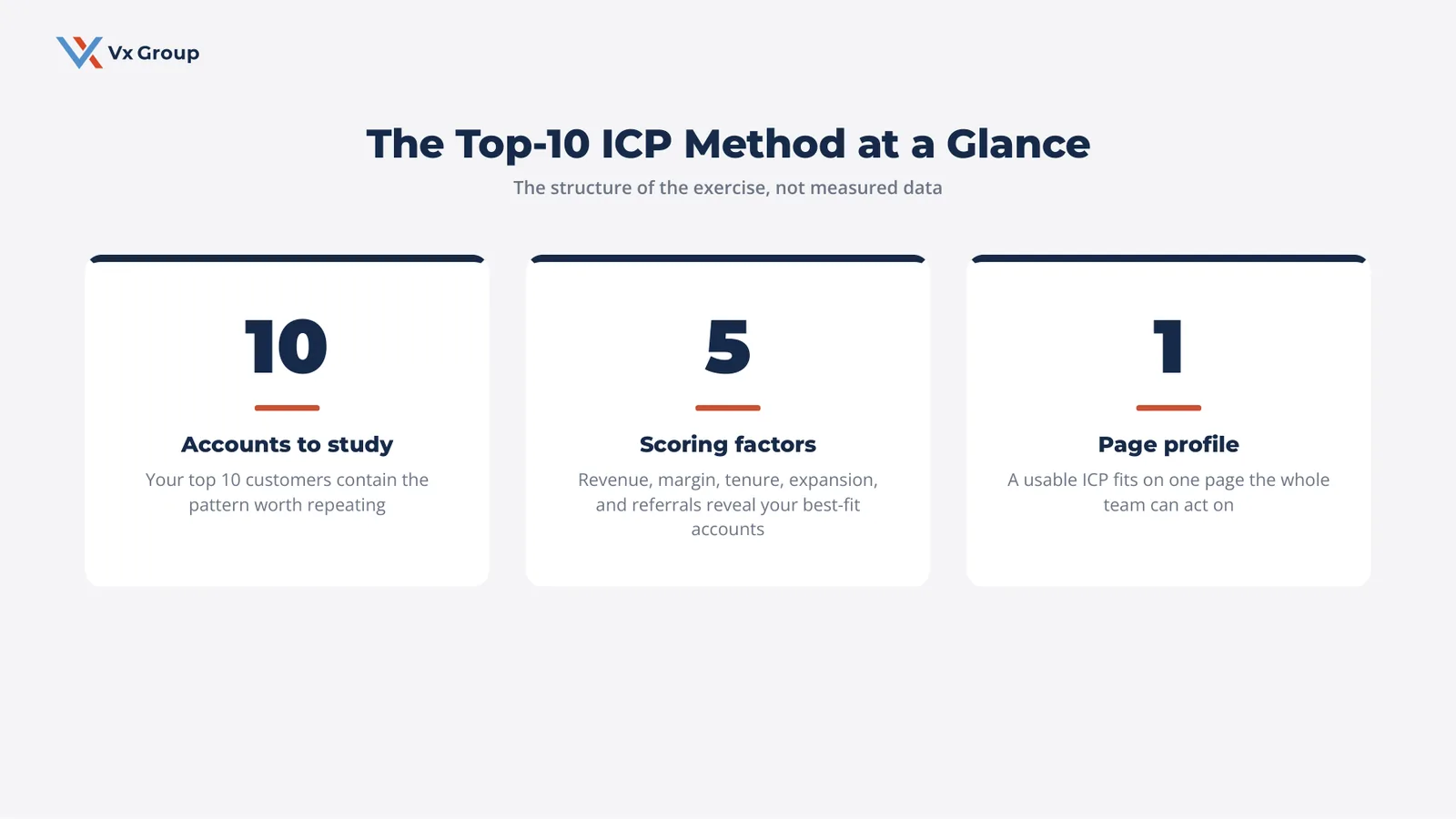
- The fix is to study your top 10 relationships across revenue, tenure, margin, referral activity, and fit, then name what they have in common.
- Once written down, the profile tells sales who to pursue, marketing who to speak to, and leadership where to invest.
Why your top 10 customers are the most ignored asset in your business
Most B2B companies can name their biggest customers in five seconds and explain why those relationships work in zero. The revenue is obvious. The pattern underneath it is invisible, because nobody has ever sat down to study it.
This is the quiet cost of running on instinct. A relationship-driven company spends two decades earning a roster of excellent accounts, then spends its marketing budget chasing prospects who look nothing like them. The strategy that built the business is sitting in the customer list, undocumented and unused.
The villain here is the scattered, tactic-first approach to growth. Spray-and-pray lead generation, the trade show booth that scans 400 badges, the agency retainer that produces activity without direction. All of it assumes you do not already know who your best customer is. You do. You just have not written it down.
An ideal customer profile changes that. It turns the pattern in your top accounts into a decision tool the whole team can use.
Defined term: Ideal Customer Profile (ICP)
A B2B ideal customer profile is a written description of the company-level traits shared by your best-fit accounts: the customers who buy faster, stay longer, expand more, and refer others. It describes the company you sell to at the firm level, while a buyer persona describes the individual human who makes the decision inside that company.
What does it mean to treat your customers as a strategy?
Treating your customers as a strategy means studying your existing accounts as data, finding the pattern that separates your best ones from the rest, and using that pattern to direct every future growth decision. The strategy is reverse-engineered from results you have already produced.
Most companies build a growth plan the other way around. They start with a market they want to win, write a profile that describes that aspiration, then go hunting. The aspiration is fine. The problem is that an aspirational profile has no evidence behind it, so it cannot tell you which prospects are worth your time and which will drain a year of sales effort before going dark.
A profile built from your top 10 accounts carries proof. When you can point to four current customers in the same industry, with the same buying structure, who each took under 90 days to close and have stayed for six years, you are no longer guessing about who to pursue. You are repeating a pattern that already pays.
Study the accounts you already win
Pull your top 10 customers and look at them as a set, not as individual relationships. Rank them by the measures that actually predict a good account: total revenue, relationship tenure, gross margin, expansion over time, and referrals generated. Revenue alone will mislead you. The biggest account is sometimes the worst account, propped up by price concessions and constant operational strain.
What you are hunting for is the account that is large, durable, profitable, and easy to serve. Those are the relationships worth cloning.
Find the pattern your best accounts share
Once ranked, look for what the top of the list has in common that the bottom does not. The pattern usually lives in a handful of traits: industry or sub-vertical, company size, ownership structure, the specific problem they hired you to solve, how they buy, and who signs off. When the same three or four traits keep appearing at the top of your list, you have found the spine of your ICP.
How is an ICP different from a target market or a buyer persona?
An ICP describes the specific company-level traits of your best-fit accounts, a target market describes a broad segment you could theoretically sell to, and a buyer persona describes the individual human who makes or influences the decision. You need all three, and they are not interchangeable.
A target market is wide. “Mid-sized industrial manufacturers in the Midwest” is a market. It might contain 4,000 companies, and most of them will never be a good fit for you. A market tells you where to look. It does not tell you where to spend.
An ICP narrows that market to the companies that match the pattern in your best accounts. Out of those 4,000 manufacturers, maybe 150 share the ownership structure, size, and buying behavior of your top 10. That smaller list is where your pipeline should come from.
A buyer persona then describes the people inside those 150 companies: the owner who came up through operations, the CFO who needs proof before signing, the sales leader measured on pipeline. The persona governs your message. The ICP governs your target list.
Defined term: Buyer persona
A semi-fictional profile of an individual decision-maker or influencer inside a target account, covering their role, priorities, frustrations, and how they evaluate a purchase. A single ICP company often contains three or four distinct personas who all touch the buying decision.
| Concept | What it describes | What it answers | Example |
|---|---|---|---|
| Target market | A broad addressable segment | Where could we sell? | Mid-market industrial manufacturers |
| Ideal customer profile | Company traits of your best-fit accounts | Where should we focus? | Family-owned manufacturers, $15M to $40M, single-plant, that buy through an owner-operator |
| Buyer persona | The individual decision-maker | Who do we speak to and how? | Owner-operator, engineering background, impatient, results-first |
What signals separate a great account from a merely large one?
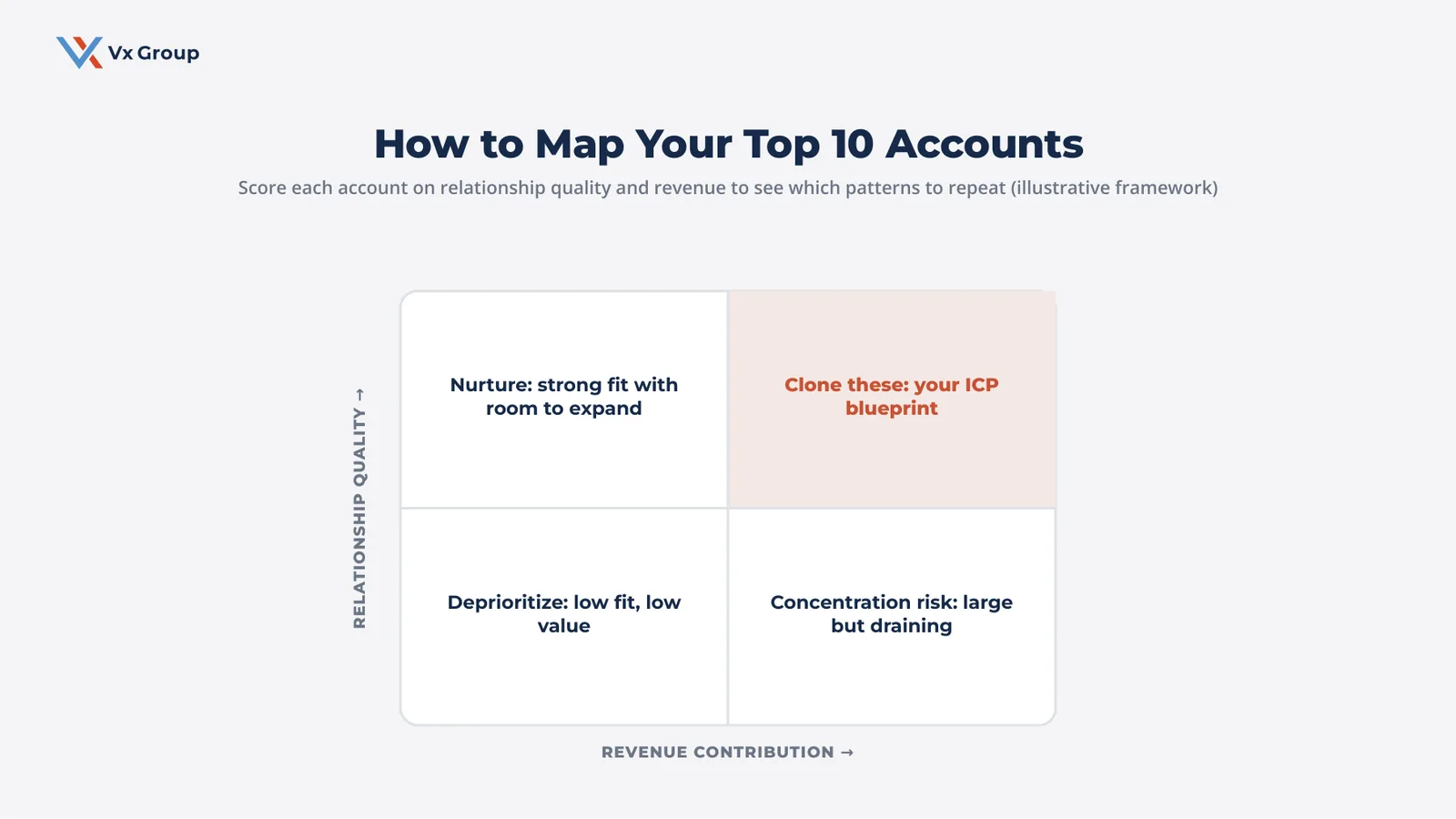
The signals that separate a great account from a large one are profitability, tenure, ease of service, expansion, and willingness to refer. A great account scores well across most of these. A merely large account is heavy on revenue and light on everything else.
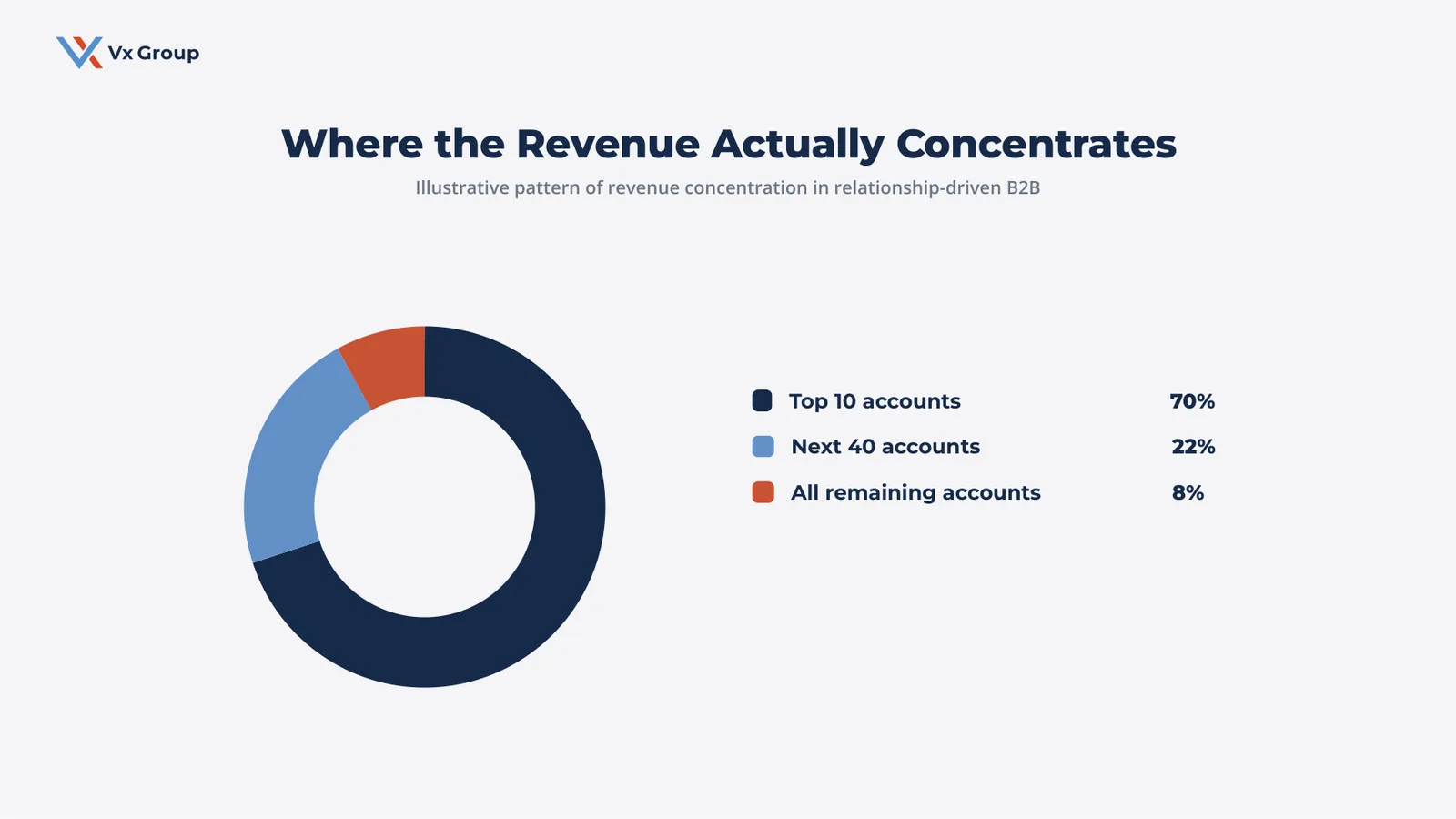
This distinction matters because revenue concentration hides risk. When a single account represents a large share of revenue but constantly negotiates on price, demands custom work, and would walk the moment a competitor undercuts you, that revenue is a source of exposure rather than strength. Studying your top 10 as a pattern forces you to separate the accounts you want more of from the accounts you happen to have.
Rank by relationship quality, not just revenue
Build a simple scorecard. For each of your top accounts, score five factors from one to five: revenue contribution, gross margin, years as a customer, expansion since onboarding, and referrals generated. Add them up. The accounts that score high across all five are your true best customers, and their shared traits become the foundation of your profile.
Watch for concentration risk while you study the pattern
While you are ranking, you will likely surface a related problem: too much revenue flowing through too few accounts. That is worth naming. The same exercise that builds your ICP also shows you how dependent you are on a small number of relationships, which is the first step toward building a pipeline that reduces that dependence.
Field Notes: the manufacturer who already had the answer
A specialty manufacturer came in convinced they needed to break into three new verticals to grow. Before chasing any of them, they ranked their existing accounts. Seven of their top 10 were family-owned businesses in a single adjacent industry, each introduced by a prior customer, each closed in under three months. They had been treating their strongest, most repeatable channel as background noise while planning to spend a year prospecting into industries where they had no proof of fit. The growth strategy was already in the customer list. The exercise just made it visible. They redirected outbound toward companies that matched those seven accounts and stopped funding the speculative verticals.
Ready to grow?
Turn your best customers into a documented profile your whole team can act on, not a gut feel in one head.
How do you turn the pattern into a documented profile?
You turn the pattern into a documented profile by writing down the firmographic traits, behavioral traits, and disqualifiers your top accounts share, in language specific enough that a salesperson can look at a prospect and know whether it fits. A profile that lives in one person’s head cannot direct a team. A profile on one page that everyone uses can.
A strong written ICP covers four things. First, the firmographics: industry, revenue range, employee count, ownership structure, and geography. Second, the situational traits: the trigger that made them buy, the problem they needed solved, and the way their buying decision gets made. Third, the behavioral signals: how they evaluate vendors, how long they take to decide, and what they value in a partner. Fourth, the disqualifiers: the traits that reliably predict a bad fit, so your team knows when to walk away.
That last category is the one most companies skip, and it is often the most useful. Knowing who is not your customer saves more wasted effort than any prospecting list.
Write it in language a salesperson can act on
Vague profiles fail because they cannot be applied. “Companies that value quality and partnership” describes no one and everyone. “Family-owned manufacturers between $15M and $40M, single facility, where the owner signs off on purchases over $50K and the trigger is a retirement or a capacity ceiling” describes a specific company a rep can recognize on a first call. Specificity is what makes the profile usable.
Keep it to one page and put it where the team works
The profile only works if people use it, so it has to live where the work happens, not in a slide deck nobody opens. One page. Visible in the CRM, in the sales playbook, and in the marketing brief. Reviewed when a new lead comes in and when a campaign gets planned.
How does a documented ICP change what your team does day to day?
A documented ICP changes daily decisions across sales, marketing, and leadership by giving everyone the same answer to one question: is this account worth our time? Sales stops chasing poor-fit leads, marketing stops speaking to everyone, and leadership stops funding growth bets that have no evidence behind them.
For sales, the profile becomes a qualification filter. A rep can score an inbound lead against the ICP in 30 seconds and decide whether to invest a full pursuit or a polite hand-off. Time that used to disappear into long-shot deals goes to accounts that look like the ones you already win.
For marketing, the profile sharpens every message and every targeting decision. Instead of writing for a generic “business owner,” the team writes for the specific industry, situation, and buyer the ICP describes. Ad targeting narrows. Content gets more relevant. Cost per qualified lead drops because the net is aimed, not cast wide.
For leadership, the profile turns growth planning from instinct into direction. When someone proposes entering a new market, the question becomes whether that market contains companies that match the proven pattern, or whether it is a hopeful bet dressed up as a strategy.
Systems make the profile repeatable
A profile written once and forgotten decays. The companies that get value from an ICP build it into how they operate: scoring leads against it, reviewing it quarterly as the customer base shifts, and updating it when the pattern at the top of the list changes. The point of writing it down is to make good judgment repeatable across the team, so growth does not depend on the one person who happens to have the pattern in their head.
Defined term: Concentration risk
The exposure a company carries when a large share of its revenue depends on a small number of accounts. Studying your top 10 customers reveals both the pattern worth repeating and the concentration worth reducing.
How often should you revisit your ICP?
You should revisit your ICP at least once a year, and any time your best-account pattern shifts: a new product line, a change in who is buying, an acquisition, or a deliberate move into a new market. The profile is a living description of where you win, and where you win changes as the business grows.
An annual review is the floor. Pull your top accounts again, re-rank them, and check whether the pattern still holds. Sometimes it has tightened, and you can be even more specific. Sometimes a new type of account has climbed into the top 10, signaling a second profile worth defining. Either way, the review keeps the profile honest and keeps the team pointed at the right targets.
Start with the customers you already have
The growth strategy most B2B companies are searching for is already written into their customer list. The top 10 accounts show you which industries value your work, which buyers move quickly, and which relationships compound into years of revenue. Studying that pattern and writing it down turns two decades of earned trust into a tool the whole team can use to decide where the next account comes from.
Ready to grow?
Build the clarity that turns your top accounts into a repeatable growth strategy.
Related reading: What Is an Ideal Customer Profile? · How to Define Your ICP · The Ideal Customer Profile hub
FAQs
About the Author: Beth Barbaglia
